
Web of Science
Web of Science: A broad citation index for institutions that need structured scholarly discovery and tracking. Ranked #1 of 35 in Academic Research Databases by our editors (9.4/10); pricing: Pricing on request; best for institutional citation indexing.
At a glance
- Editor score9.4 / 10
- PricingPricing on request
- Best forInstitutional citation indexing
- Free planNo
- Full-text accessYes
- Founded1997 · London, United Kingdom
- Facts checked20 Sep 2026
Where it wins
- Covers journals, books, conferences, theses, datasets, grants, and patents
- Supports Boolean, proximity, fielded search, and citation tracking
- Connects with EndNote, OpenURL, library catalogs, and ORCID
Where it doesn't
- Subscription pricing requires contacting sales
- There is no free plan
- Full-text access depends on holdings, subscriptions, or open-access links
Our verdict on Web of Science
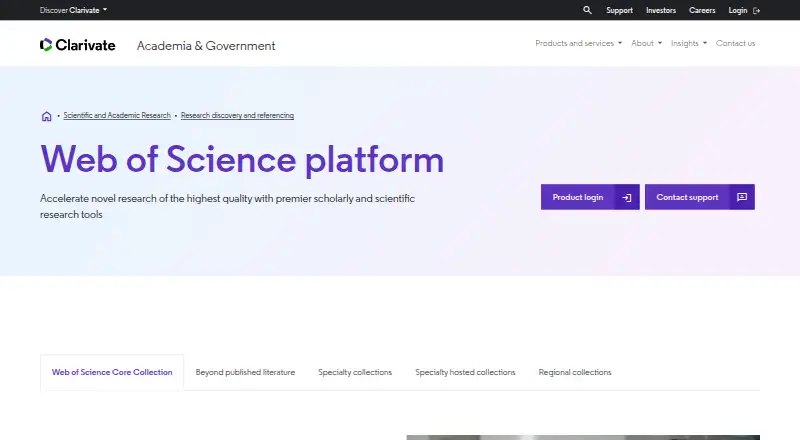
Web of Science is a subscription-based academic research platform from Clarivate for researchers, students, librarians, administrators, and institutions. Its scope spans sciences, social sciences, arts, and humanities, with records covering journals, conference proceedings, scholarly books, dissertations, theses, preprints, datasets, grants, and patents. The platform is particularly suited to institutions that need citation indexing, structured discovery, and research monitoring across disciplines.
Search depth is a central strength. Users can search bibliographic fields with Boolean and proximity operators, follow cited and citing references, and create saved searches, citation alerts, and research alerts. Full-text links can connect through institutional holdings, OpenURL, DOI, library catalogs, or open-access sources. Export to EndNote and other bibliographic formats supports library and research workflows, while integrations with EndNote, OpenURL resolvers, library OPAC systems, and ORCID improve fit with established academic systems. Choose Web of Science when citation relationships and broad scholarly coverage matter as much as finding individual articles.
The main trade-off is access and purchasing. The published model is institutional subscription access, with pricing handled through contact-sales channels rather than a free plan. Full-text availability also varies according to library holdings, institutional subscriptions, and open-access links, so the database should not be treated as a guarantee of immediate full-text access for every record. Institutions seeking multidisciplinary citation analysis and research alerts are the strongest fit; individuals who need a free database or dependable full text without library access should consider a different option.
Your product? Our editors can test Web of Science in depth and publish a review, labelled as paid · from $149/mo →
Web of Science pricing
Web of Science fact sheet
| Free plan | No |
|---|---|
| Paid from | Not verified |
| Full-text access | Yes |
| Advanced search | Yes |
| Subject coverage | Multidisciplinary |
| Content types | journals, conference proceedings, scholarly books, dissertations, theses, preprints, datasets, grants, patents |
| Theses and dissertations | Yes |
| Conference proceedings | Yes |
| Institutional access | Yes |
| Deployment | Cloud |
| Platforms | Web |
| Support | Live chat, Phone, Email, Docs |
| Built for | Mid-market, Enterprise (editorial estimate) |
| Integrations | 4 integrations: EndNote, OpenURL resolvers, Library OPAC systems, ORCID |
| Pricing | Pricing on request |
| Website | clarivate.com |
| Facts checked | 20 Sep 2026 |
Web of Science integrations
Web of Science lists 4 integrations on its own site.
- EndNote
- OpenURL resolvers
- Library OPAC systems
- ORCID
Alternatives to Web of Science
- ProQuest CentralBroad institutional access to scholarly, professional, and research content.9.3
- OpenAlexA strong open-data foundation for multidisciplinary scholarly discovery and analysis.9.2
- JSTORA broad, full-text academic collection with flexible personal and institutional access.9.1


See all Web of Science alternatives →
Web of Science vs the competition
- Web of Science vs ProQuest Central
- Web of Science vs OpenAlex
- Web of Science vs JSTOR
- Web of Science vs Scopus with AI
- Web of Science vs Dimensions
- Web of Science vs The Lens



Compare Web of Science with any tool side by side →
Also Ranked In
Web of Science is ranked in 2 of our directories.
Used Web of Science? Be the first to review it
The editor score above is our own research. What this page doesn't have yet is a reader's view — what you used Web of Science for, what worked and what didn't. No stars are seeded and no review is paid for; an editor reads every one before it appears.
Write a reviewTwo minutes · verified accounts only · read by an editor before it appears
Featured on iTechGuides

Web of Science is listed in our Academic Research Databases directory. Add the badge to your site — it links back to this page.
<a href="https://www.itechguides.com/products/web-of-science/"><img src="https://www.itechguides.com/best/badge/web-of-science.svg" alt="Featured on iTechGuides" width="230" height="46"></a>
Reviewed by iTechGuides Editors · Editorial team · Updated Oct 2026
Advertiser disclosure: iTechGuides is reader-supported. Vendors can pay for top positions in our rankings and for a place on other products' pages, and we may earn a commission when you click some links. Bought places stand at the number bought; this page and our disclosure say so. Paying vendors may get a fuller, more detailed review from our editors, and that review can change their score. How we rank.
Last updated · How we research and update