
UpTrain
UpTrain: A broad toolkit for evaluating, versioning, and diagnosing LLM application quality. Ranked #19 of 30 in AI LLM Evaluation Tools by our editors (7.5/10); pricing: Open source; best for teams needing open-source regression diagnostics.
At a glance
- Editor score7.5 / 10
- PricingOpen source
- Best forTeams needing open-source regression diagnostics
- Paid fromFree
- Safety evaluationsYes
- Facts checked22 Sep 2026
Where it wins
- 20+ checks spanning quality, context, language, code, conversation, and security
- Custom Python and prompt-based evaluations with regression testing
- Prompt versioning, rollback, experiments, and root-cause analysis
Where it doesn't
- Requires teams to choose between package, dashboard, and API workflows
- The feature set may be broader than needed for narrow evaluation tasks
- Hybrid deployment may require decisions about local and remote evaluation
Our verdict on UpTrain
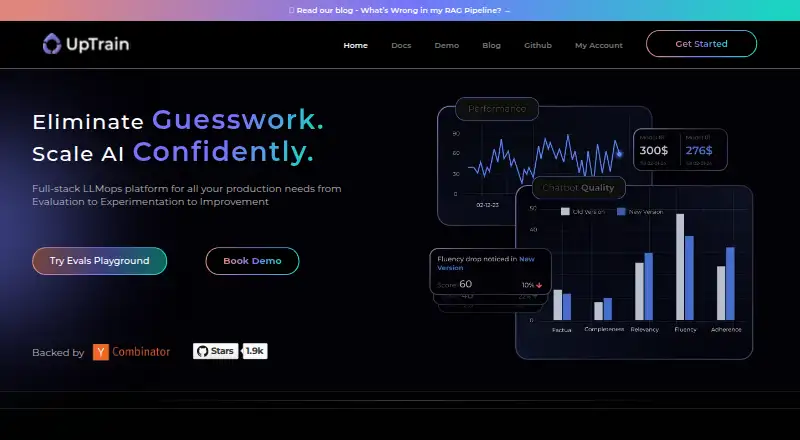
UpTrain is an open-source platform for evaluating and improving generative AI and LLM applications. It is suited to teams that need repeatable checks across response quality, context awareness, language, code, conversations, and security. Access is available through a Python package, a locally hosted web dashboard, or an API client for remote evaluations, giving engineering teams several ways to fit evaluation into existing workflows.
Its strongest area is evaluation depth. UpTrain includes 20+ preconfigured checks, custom Python and prompt-based evaluations, model-graded evaluations, classification, chain-of-thought classification, experiments, and automated regression testing. Prompt iteration, versioning, and rollback connect evaluation work with prompt development, while root-cause analysis helps investigate evaluation failures. Jailbreak and prompt-injection detection add a defined safety-evaluation layer. Teams focused on diagnosing quality changes across prompts and application versions should find this breadth relevant; a narrow checker may be simpler for teams with only one evaluation need.
The ecosystem is also broad. Documentation lists support for OpenAI, Azure, Claude, Mistral, Together AI, Anyscale, Ollama, Hugging Face, Replicate, and custom endpoints, along with tools such as LlamaIndex, Langfuse, Helicone, Zeno, ChromaDB, Qdrant, FAISS, and OpenAI Evals. Hybrid deployment, API access, and a local dashboard support different operating models, but teams should be prepared to select and manage the workflow that fits their environment. UpTrain is a strong match for engineering groups wanting open-source regression diagnostics and customizable evaluation logic; teams seeking a narrowly focused, single-workflow tool may prefer a smaller scope.
Your product? Our editors can test UpTrain in depth and publish a review, labelled as paid · from $149/mo →
UpTrain pricing
UpTrain fact sheet
| Free plan | Not verified |
|---|---|
| Paid from | Free |
| Evaluation methods | preconfigured checks; custom prompt evaluations; custom Python evaluations; model-graded evaluations; classification; chain-of-thought classification; regression testing; experiments |
| Model support | OpenAI; Azure; Claude; Mistral; Together AI; Anyscale; Ollama; Hugging Face; Replicate; custom endpoints |
| Safety evaluations | Yes |
| Deployment | Hybrid |
| Prompt versioning | Yes |
| API access | Yes |
| Deployment | Cloud, Self-hosted |
| Platforms | Web |
| Support | Community, Docs |
| Built for | Small business, Mid-market, Enterprise (editorial estimate) |
| Integrations | 17 integrations: OpenAI, Azure, Claude, Mistral, Together AI, Anyscale … |
| Pricing | Open source |
| Website | uptrain.ai |
| Facts checked | 22 Sep 2026 |
UpTrain integrations
UpTrain lists 17 integrations on its own site.
- OpenAI
- Azure
- Claude
- Mistral
- Together AI
- Anyscale
- Ollama
- LlamaIndex
- Langfuse
- Helicone
- Zeno
- ChromaDB
- Qdrant
- FAISS
- OpenAI Evals
- Replicate
- Hugging Face
Alternatives to UpTrain
- DeepEvalA code-first toolkit for testing LLM apps, agents, tools, safety, and regressions.9.4
- Arize PhoenixA free, open-source toolkit covering traces, evaluations, prompts, datasets, and costs.9.3
- PromptfooA broad evaluation and security toolkit for teams testing AI systems in development.9.2



See all UpTrain alternatives →
Used UpTrain? Be the first to review it
The editor score above is our own research. What this page doesn't have yet is a reader's view — what you used UpTrain for, what worked and what didn't. No stars are seeded and no review is paid for; an editor reads every one before it appears.
Write a reviewTwo minutes · verified accounts only · read by an editor before it appears
Featured on iTechGuides

UpTrain is listed in our AI LLM Evaluation Tools directory. Add the badge to your site — it links back to this page.
<a href="https://www.itechguides.com/products/uptrain/"><img src="https://www.itechguides.com/best/badge/uptrain.svg" alt="Featured on iTechGuides" width="230" height="46"></a>
Reviewed by iTechGuides Editors · Editorial team · Updated Oct 2026
Advertiser disclosure: iTechGuides is reader-supported. Vendors can pay for top positions in our rankings and for a place on other products' pages, and we may earn a commission when you click some links. Bought places stand at the number bought; this page and our disclosure say so. Paying vendors may get a fuller, more detailed review from our editors, and that review can change their score. How we rank.
Last updated · How we research and update