
Studio Lofi
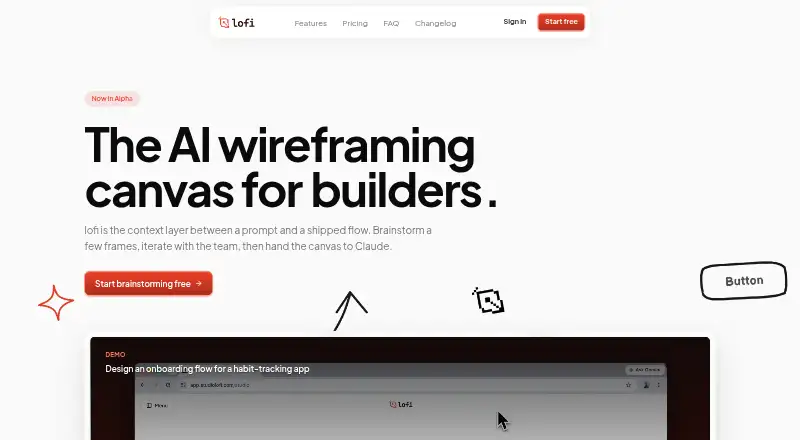
Studio Lofi: A collaborative low-fidelity wireframing canvas with prompts, tappable flows, and agent handoff. Ranked #6 of 33 in AI Wireframe Generators by our editors (8.8/10); pricing: Free plan; best for low-fidelity collaborative wireframing.
At a glance
- Editor score8.8 / 10
- PricingFree plan
- Best forLow-fidelity collaborative wireframing
- Free planYes
- Paid from$12/mo
- Sketch or image inputYes
- Facts checked20 Sep 2026
Where it wins
- Generates tappable, connected wireframe frames from text prompts
- Combines real-time boards with sketching, annotations, and chat iteration
- Exports to PNG, SVG, Figma, Claude, JSON, and HTML with Tailwind
Where it doesn't
- The product is currently in alpha
- AI credits are shared across generations, chat, edits, and code exports
- It is available on the web rather than as a native desktop or mobile app
Our verdict on Studio Lofi
Studio Lofi is a collaborative, low-fidelity wireframing canvas for builders, designers, and product teams that need to shape screens and user flows before moving into detailed design or code. Plain-language prompts generate wireframes, while connected frames support tappable flows. Teams can also sketch with a pen, sticky notes, arrows, and freeform text; add image or hand-sketch references; and refine frames through chat. Its focus is early product planning rather than polished interface production.
The pricing structure is straightforward. The Free plan costs $0 per month and includes Thinking mode, canvas sketching, and exports to PNG, Figma, and Claude. Lofi Studio Pro costs $12 per month on monthly billing and adds Thinking mode at full capacity, unlimited projects, the same sketching and export capabilities, and the option to cancel anytime. The product's standout feature is the combination of prompt-based generation and connected, tappable frames, which gives teams a quicker way to express and revise flows than starting with isolated static screens. AI credits are shared across generations, chat messages, canvas edits, and code exports, so the 500 credits on Pro do not represent a fixed number of generations.
Studio Lofi fits teams that want a shared web canvas with live cursors and edits, plus handoff paths into Claude, Claude Code, Codex, Figma, Mobbin, and Landingfolio. Export options also include SVG, frame JSON, HTML with Tailwind, Claude-ready prompts, and Markdown, giving technical teams several ways to continue work. The main qualification is product maturity: Studio Lofi is in alpha, and its broad handoff workflow may be more useful to teams already comfortable with AI-assisted design and coding tools. Choose it for collaborative low-fidelity exploration and agent-oriented handoff; choose an alternative if you need a mature, standalone high-fidelity design environment.
Your product? Our editors can test Studio Lofi in depth and publish a review, labelled as paid · from $149/mo →
Studio Lofi pricing
All 2 Studio Lofi plans and prices →
Studio Lofi fact sheet
| Free plan | Yes |
|---|---|
| Paid from | $12/mo |
| Sketch or image input | Yes |
| Clickable prototypes | Yes |
| Export formats | PNG, SVG, frame JSON, HTML with Tailwind, Claude-ready prompt, Markdown |
| Collaboration level | Real_time |
| AI generation limit | Not verified |
| Custom components | Not verified |
| Deployment | Cloud |
| Platforms | Web |
| Support | |
| Built for | Solo, Small business, Mid-market (editorial estimate) |
| Integrations | 6 integrations: Claude, Claude Code, Codex, Figma, Mobbin, Landingfolio |
| Pricing | Free plan (source) |
| Website | studiolofi.com |
| Facts checked | 20 Sep 2026 |
Studio Lofi integrations
Studio Lofi lists 6 integrations on its own site.
- Claude
- Claude Code
- Codex
- Figma
- Mobbin
- Landingfolio
Alternatives to Studio Lofi
- UX PilotA broad AI wireframing workspace that connects ideas, flows, prototypes, Figma, and code.9.4
- UizardA collaborative web tool for turning prompts, screenshots, and sketches into prototypes.9.2
- VisilyA collaborative AI wireframing workspace with strong prototyping and Figma workflows.9.1



See all Studio Lofi alternatives →
Studio Lofi vs the competition
- Studio Lofi vs UX Pilot
- Studio Lofi vs Uizard
- Studio Lofi vs Visily
- Studio Lofi vs MockFlow
- Studio Lofi vs Prototyper
- Studio Lofi vs Banani



Compare Studio Lofi with any tool side by side →
Used Studio Lofi? Be the first to review it
The editor score above is our own research. What this page doesn't have yet is a reader's view — what you used Studio Lofi for, what worked and what didn't. No stars are seeded and no review is paid for; an editor reads every one before it appears.
Write a reviewTwo minutes · verified accounts only · read by an editor before it appears
Featured on iTechGuides

Studio Lofi is listed in our AI Wireframe Generators directory. Add the badge to your site — it links back to this page.
<a href="https://www.itechguides.com/products/studio-lofi/"><img src="https://www.itechguides.com/best/badge/studio-lofi.svg" alt="Featured on iTechGuides" width="230" height="46"></a>
Reviewed by iTechGuides Editors · Editorial team · Updated Oct 2026
Advertiser disclosure: iTechGuides is reader-supported. Vendors can pay for top positions in our rankings and for a place on other products' pages, and we may earn a commission when you click some links. Bought places stand at the number bought; this page and our disclosure say so. Paying vendors may get a fuller, more detailed review from our editors, and that review can change their score. How we rank.
Last updated · How we research and update