pyuvsim
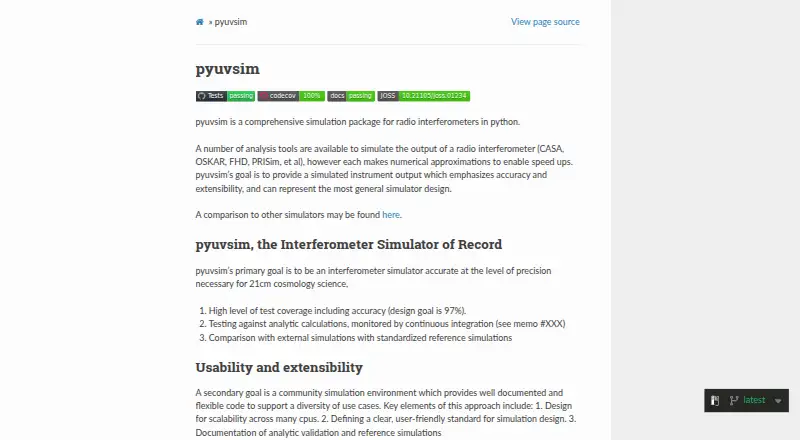
pyuvsim: An open-source Python package for precision radio-interferometer observation simulation. Ranked #23 of 89 in Physics Simulation Software by our editors (6.8/10); pricing: Free plan; best for radio astronomers simulating interferometer observations.
At a glance
- Editor score6.8 / 10
- PricingFree plan
- Best forRadio astronomers simulating interferometer observations
- Free planYes
- Paid fromFree
- Delivery modeDesktop
- Facts checked24 Sep 2026
Where it wins
- Simulates polarized responses with analytic or file-based beam models
- Accepts point-source, catalog-based, diffuse, and arbitrary-spectrum inputs
- Supports MPI execution and exports uvh5, uvfits, and MIRIAD files
Where it doesn't
- Focused on radio-interferometer simulation rather than general physics modeling
- Requires local Python installation and YAML-based configuration
- Does not provide lesson-library or assessment tools
Our verdict on pyuvsim
pyuvsim is an open-source Python package for simulating radio-interferometer observations, aimed at precision radio astronomy and 21 cm cosmology research. It is suited to researchers who need to model an observation from telescope, beam, and sky inputs, including simulations involving antenna positions and direction-dependent responses. Its focus is scientific simulation rather than a general-purpose physics environment or educational lesson platform, so it fits specialized radio astronomy workflows more closely than broad classroom use.
Configuration and input flexibility are central to the package. YAML files can describe observations, telescopes, and beams; sky inputs can be point sources or catalogs, with support for diffuse emission and arbitrary spectra. Beam models may be analytic or file-based, and source and instrument modeling includes polarized responses. These options make pyuvsim relevant when a project needs varied sky or beam representations, as well as simulations involving lunar or other non-terrestrial observatories. Users should expect to work with these scientific inputs rather than a lesson-authoring or assessment workflow.
The package is installed locally with pip and is designed for cluster workloads, with MPI parallel execution for multi-process simulations. Its outputs include UVData objects and files in uvh5, uvfits, and MIRIAD formats, which support astronomy-specific workflows. pyuvsim is free and open source, with documentation and community support channels. It is a sensible fit for radio astronomers who need configurable, high-precision interferometer simulations and can work in Python; teams seeking a broad physics simulator, built-in lessons, or assessments should look elsewhere.
Your product? Our editors can test pyuvsim in depth and publish a review, labelled as paid · from $149/mo →
pyuvsim pricing
pyuvsim fact sheet
| Free plan | Yes |
|---|---|
| Paid from | Free |
| Delivery mode | Desktop |
| Lesson library | No |
| Authoring tools | Yes |
| Assessment tools | No |
| 3D visuals | Not verified |
| Offline access | Not verified |
| Data export | Yes |
| Deployment | Self-hosted |
| Platforms | Windows, macOS, Linux |
| Support | Community, Docs |
| Built for | Small business, Mid-market, Enterprise (editorial estimate) |
| Pricing | Free plan |
| Website | pyuvsim.readthedocs.io |
| Facts checked | 24 Sep 2026 |
Alternatives to pyuvsim
- COMSOL MultiphysicsA broad desktop environment for coupled physics, engineering models, and custom simulation apps.9.4
- Ansys FluentA deep CFD and HPC environment for demanding industrial simulation work.9.3
- SimScaleA broad browser-based multiphysics platform with flexible cloud workflows and tiered access.9.1


See all pyuvsim alternatives →
Used pyuvsim? Be the first to review it
The editor score above is our own research. What this page doesn't have yet is a reader's view — what you used pyuvsim for, what worked and what didn't. No stars are seeded and no review is paid for; an editor reads every one before it appears.
Write a reviewTwo minutes · verified accounts only · read by an editor before it appears
Featured on iTechGuides

pyuvsim is listed in our Physics Simulation Software directory. Add the badge to your site — it links back to this page.
<a href="https://www.itechguides.com/products/pyuvsim/"><img src="https://www.itechguides.com/best/badge/pyuvsim.svg" alt="Featured on iTechGuides" width="230" height="46"></a>
Reviewed by iTechGuides Editors · Editorial team · Updated Oct 2026
Advertiser disclosure: iTechGuides is reader-supported. Vendors can pay for top positions in our rankings and for a place on other products' pages, and we may earn a commission when you click some links. Bought places stand at the number bought; this page and our disclosure say so. Paying vendors may get a fuller, more detailed review from our editors, and that review can change their score. How we rank.
Last updated · How we research and update