PySDM
PySDM: A focused simulation library for aerosol, cloud and rain particle processes. Ranked #17 of 89 in Physics Simulation Software by our editors (7.4/10); pricing: Free plan; best for researchers modeling aerosol and cloud microphysics.
At a glance
- Editor score7.4 / 10
- PricingFree plan
- Best forResearchers modeling aerosol and cloud microphysics
- Free planYes
- Paid fromFree
- Delivery modeHybrid
- Facts checked23 Sep 2026
Where it wins
- Simulates diffusional and collisional particle growth, coagulation and breakup
- Supports multi-threaded CPU and CUDA GPU backends, with JAX in development
- Includes Jupyter tutorials and exports raw data to VTK and netCDF
Where it doesn't
- Its focus is atmospheric microphysics rather than general-purpose physics simulation
- PySDM is a Python library, not a conventional desktop application
- The JAX backend is still developing
Our verdict on PySDM
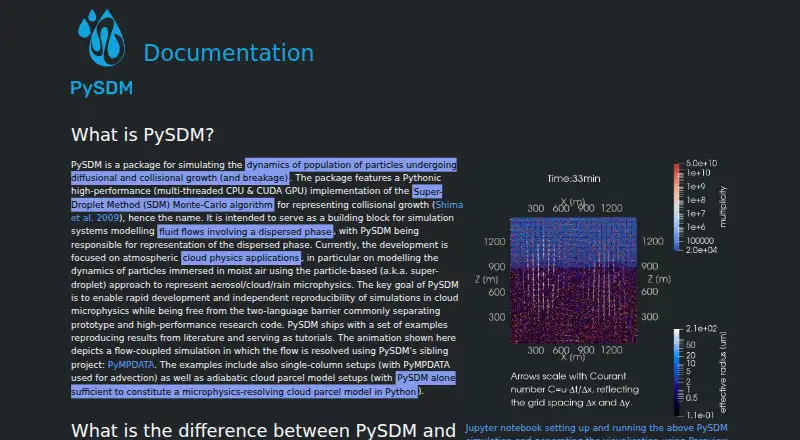
PySDM is an open-source Python library for particle-based atmospheric microphysics, aimed at researchers modeling aerosol, cloud and rain populations. Its Super-Droplet Method Monte Carlo implementation supports particle coagulation, while additional processes include diffusional and collisional growth, collisional breakup and aqueous chemistry. Researchers can work in box, parcel, single-column or 2D prescribed-flow environments. That makes PySDM a specialist research tool rather than a general-purpose physics simulator or a conventional desktop application.
Its scientific scope is a key strength: the package brings several particle-growth processes and atmospheric workflows together, with examples covering aqueous chemistry, freezing and isotopes. The computational options include multi-threaded CPU and CUDA GPU backends; a JAX backend supporting CPU, GPU and TPU devices is developing. Separate PySDM-examples notebooks provide tutorials, literature-reproducing cases and interactive visualisation and export workflows. Raw simulation data can be exported in VTK and netCDF formats, useful for taking results into analysis workflows that support those formats.
PySDM is open source, with a free plan, and supports web and self-hosted platforms; deployment is self-hosted. Documentation, community and ticket channels are listed for support. The notebook-led examples are a natural starting point for researchers comfortable working in Python, but the package's library format means it is less suited to buyers seeking a turnkey graphical application. Choose PySDM for particle-scale atmospheric cloud microphysics and its focused process coverage; consider another tool if your work needs a broad range of physics domains or a conventional desktop workflow.
Your product? Our editors can test PySDM in depth and publish a review, labelled as paid · from $149/mo →
PySDM pricing
PySDM fact sheet
| Free plan | Yes |
|---|---|
| Paid from | Free |
| Delivery mode | Hybrid |
| Lesson library | Yes |
| Authoring tools | Yes |
| Assessment tools | Not verified |
| 3D visuals | Not verified |
| Offline access | Not verified |
| Data export | Yes |
| Deployment | Self-hosted |
| Platforms | Web |
| Support | Docs, Community, Tickets |
| Built for | Solo, Small business, Mid-market, Enterprise (editorial estimate) |
| Pricing | Free plan |
| Website | open-atmos.github.io |
| Facts checked | 23 Sep 2026 |
Alternatives to PySDM
- COMSOL MultiphysicsA broad desktop environment for coupled physics, engineering models, and custom simulation apps.9.4
- Ansys FluentA deep CFD and HPC environment for demanding industrial simulation work.9.3
- SimScaleA broad browser-based multiphysics platform with flexible cloud workflows and tiered access.9.1


Used PySDM? Be the first to review it
The editor score above is our own research. What this page doesn't have yet is a reader's view — what you used PySDM for, what worked and what didn't. No stars are seeded and no review is paid for; an editor reads every one before it appears.
Write a reviewTwo minutes · verified accounts only · read by an editor before it appears
Featured on iTechGuides

PySDM is listed in our Physics Simulation Software directory. Add the badge to your site — it links back to this page.
<a href="https://www.itechguides.com/products/pysdm/"><img src="https://www.itechguides.com/best/badge/pysdm.svg" alt="Featured on iTechGuides" width="230" height="46"></a>
Reviewed by iTechGuides Editors · Editorial team · Updated Oct 2026
Advertiser disclosure: iTechGuides is reader-supported. Vendors can pay for top positions in our rankings and for a place on other products' pages, and we may earn a commission when you click some links. Bought places stand at the number bought; this page and our disclosure say so. Paying vendors may get a fuller, more detailed review from our editors, and that review can change their score. How we rank.
Last updated · How we research and update