Portofino
Portofino: A developer-focused option for self-hosted CRUD applications built around existing databases. Ranked #44 of 55 in Low-Code Development Platforms by our editors (6.0/10); pricing: Open source; best for developers building self-hosted CRUD applications.
At a glance
- Editor score6.0 / 10
- PricingOpen source
- Best forDevelopers building self-hosted CRUD applications
- Paid fromFree
- Pro-code supportYes
- Facts checked20 Sep 2026
Where it wins
- Generates REST APIs and CRUD resources from existing databases
- Supports Java and Groovy custom operations alongside declarative configuration
- Includes authentication, authorization, and user management
Where it doesn't
- Portofino 6 does not include a built-in user interface
- Self-hosted deployment requires responsibility for the application environment
- Frontend integration depends on external libraries and custom development
Our verdict on Portofino
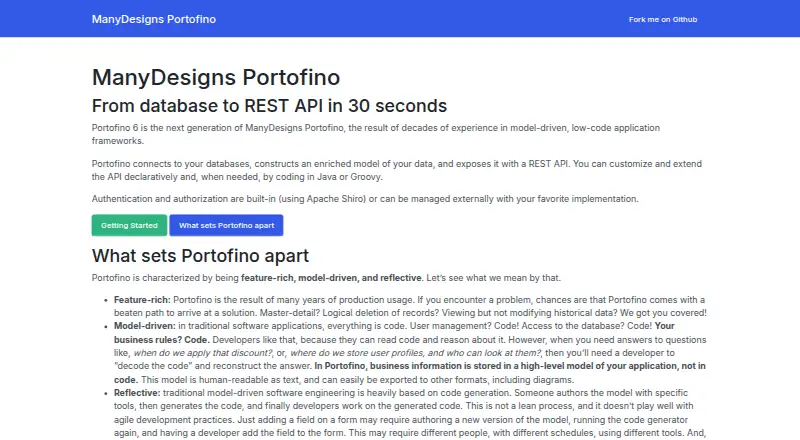
Portofino is an open-source, model-driven low-code framework for developers creating REST APIs and enterprise web applications. It connects to existing databases, builds an enriched data model, and exposes database-backed resources with search, create, read, update, and delete operations. Built-in authentication, authorization, and user management support common application access requirements. The platform is aimed at teams that want developer control, self-hosted deployment, and a path from database structure to working web application rather than a fully managed visual builder.
Its strongest angle is the combination of generated application structure and pro-code extension. Declarative model-driven configuration can define the application, while custom Java and Groovy operations extend behavior. Portofino also supports JavaScript and JVM technologies, Spring Boot and microservice deployment, an email subsystem, and a scheduler. Portofino 5 included a responsive Angular-based web UI, while Portofino 6 directs developers toward external frontend libraries. That makes the current product a better fit for teams comfortable choosing or building their frontend than for buyers seeking a complete built-in interface.
Deployment is self-hosted across web environments, with support for database-backed applications and progressive web applications described for Portofino 5. The published product details also identify workflow automation, data connectors, role permissions, and mobile-app support. These capabilities give developers room to shape an application around existing data and custom business logic, but they also place more emphasis on implementation decisions. Choose Portofino when open-source control, REST generation, CRUD coverage, and Java or Groovy customization matter most. Consider another low-code platform if you want a built-in UI in Portofino 6 or prefer a more managed frontend and platform experience.
Your product? Our editors can test Portofino in depth and publish a review, labelled as paid · from $149/mo →
Portofino pricing
Portofino fact sheet
| Free plan | Not verified |
|---|---|
| Paid from | Free |
| Pro-code support | Yes |
| Workflow automation | Yes |
| Mobile app support | Yes |
| Deployment options | Self-hosted |
| Data connectors | Yes |
| Role permissions | Yes |
| Deployment | Self-hosted |
| Platforms | Web |
| Support | Community, Docs |
| Built for | Small business, Mid-market, Enterprise (editorial estimate) |
| Pricing | Open source |
| Website | manydesigns.github.io |
| Facts checked | 20 Sep 2026 |
Alternatives to Portofino
- MendixA broad low-code platform for web, PWA, native mobile, API, and enterprise integration work.9.4
- OutSystemsA full-lifecycle low-code platform for enterprises building connected business applications.9.3
- GeneXusA broad low-code platform for teams building enterprise systems across web, mobile, and hybrid environments.9.2



See all Portofino alternatives →
Used Portofino? Be the first to review it
The editor score above is our own research. What this page doesn't have yet is a reader's view — what you used Portofino for, what worked and what didn't. No stars are seeded and no review is paid for; an editor reads every one before it appears.
Write a reviewTwo minutes · verified accounts only · read by an editor before it appears
Featured on iTechGuides

Portofino is listed in our Low-Code Development Platforms directory. Add the badge to your site — it links back to this page.
<a href="https://www.itechguides.com/products/portofino/"><img src="https://www.itechguides.com/best/badge/portofino.svg" alt="Featured on iTechGuides" width="230" height="46"></a>
Reviewed by iTechGuides Editors · Editorial team · Updated Oct 2026
Advertiser disclosure: iTechGuides is reader-supported. Vendors can pay for top positions in our rankings and for a place on other products' pages, and we may earn a commission when you click some links. Bought places stand at the number bought; this page and our disclosure say so. Paying vendors may get a fuller, more detailed review from our editors, and that review can change their score. How we rank.
Last updated · How we research and update