
PlayFlow
PlayFlow: An approachable managed service with scaling, matchmaking, and broad engine support. Ranked #6 of 23 in Game Server Orchestration Software by our editors (8.6/10); pricing: Free plan; best for indie studios building multiplayer games.
At a glance
- Editor score8.6 / 10
- PricingFree plan
- Best forIndie studios building multiplayer games
- Free planYes
- Paid from$20/mo
- AutoscalingYes
- Facts checked22 Sep 2026
Where it wins
- Free Hobby plan with access to all regions
- Automatic scaling and on-demand dedicated servers
- Unity, Unreal, Godot, Docker, and console integrations
Where it doesn't
- Hobby is limited to one server with a 60-minute limit
- Pro adds usage-based compute costs beyond its monthly fee
- Enterprise capabilities require custom infrastructure
Our verdict on PlayFlow
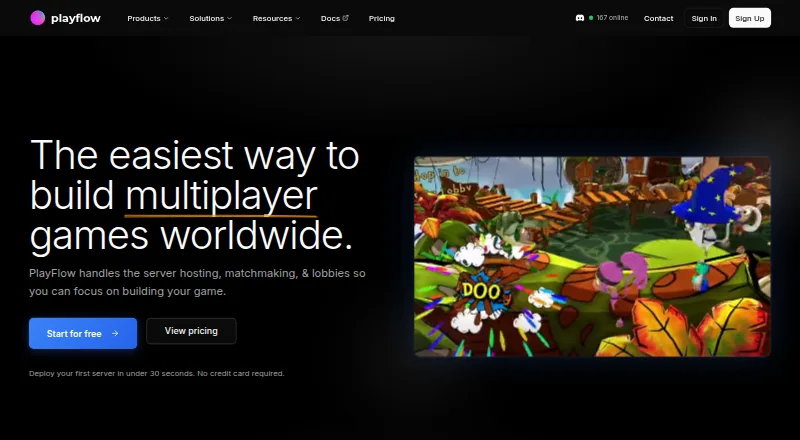
PlayFlow is a managed game server orchestration platform for multiplayer developers. It provisions dedicated game servers on demand, deploys them across multiple regions, and automatically stops them when matches end. Its feature set covers lobbies, matchmaking, analytics, server APIs, and SDK access for Unity, Unreal Engine, Godot, and custom engines. Developers can upload server builds as ZIP files or deploy Docker images, while WebGL clients can connect through TLS-enabled TCP ports.
The published plans give small teams a low-commitment starting point. Hobby is free forever and includes one server with a 60-minute limit, access to all regions, basic metrics, and community support. Pro costs $20 per month, billed monthly, and adds unlimited servers, matchmaking and lobbies, DDoS protection, and priority support. The official pricing page also describes additional usage beyond the Pro base fee. Enterprise adds custom infrastructure, a 99.99% SLA, dedicated support, advanced analytics, and multiregion deployment.
PlayFlow fits teams that want managed deployment without limiting their technology choices. Integrations include Unity, Unreal Engine, Godot, Docker, Mirror Networking, FishNet, Unity Netcode for GameObjects, PurrNet, Steam, Nintendo Switch, PlayStation, Xbox, PlayFab, DigitalOcean, and Vultr. Matchmaking supports skill, region, role, and custom rules, while analytics cover CCU, match times, and retention. Studios needing only a single short-lived server may find Hobby sufficient; teams needing unlimited servers, production matchmaking, or stronger support should consider Pro. The platform is less suited to projects that do not need managed multiplayer infrastructure or usage-based compute.
Your product? Our editors can test PlayFlow in depth and publish a review, labelled as paid · from $149/mo →
PlayFlow pricing
All 3 PlayFlow plans and prices →
PlayFlow fact sheet
| Free plan | Yes |
|---|---|
| Paid from | $20/mo |
| Deployment model | Managed |
| Autoscaling | Yes |
| Multiregion deployment | Yes |
| Matchmaking | Yes |
| Container support | Yes |
| Supported platforms | Unity, Unreal Engine, Godot, custom engines, WebGL, PC, console, mobile |
| Pricing model | Usage |
| Deployment | Cloud |
| Platforms | Web |
| Support | Community, Docs |
| Built for | Solo, Small business, Mid-market, Enterprise (editorial estimate) |
| Integrations | 18 integrations: Unity, Unreal Engine, Godot, Docker, Mirror Networking, FishNet … |
| Pricing | Free plan (source) |
| Website | playflowcloud.com |
| Facts checked | 22 Sep 2026 |
PlayFlow integrations
PlayFlow lists 18 integrations on its own site.
- Unity
- Unreal Engine
- Godot
- Docker
- Mirror Networking
- FishNet
- Unity Netcode for GameObjects
- PurrNet
- Steam
- Nintendo Switch
- PlayStation
- Xbox
- PlayFab
- DigitalOcean
- Vultr
- Google Cloud
- Amazon Web Services
- Microsoft Azure
Alternatives to PlayFlow
- Amazon GameLift ServersA strong AWS-centered choice for operating dedicated multiplayer game servers at scale.9.4
- PlayFabA broad managed backend for multiplayer, player services, and live operations.9.2
- EdgegapA broad edge orchestration stack for studios that need global multiplayer infrastructure.9.0


See all PlayFlow alternatives →
PlayFlow vs the competition
- PlayFlow vs Amazon GameLift Servers
- PlayFlow vs PlayFab
- PlayFlow vs Edgegap
- PlayFlow vs Multiplay
- PlayFlow vs AccelByte Multiplayer Servers
- PlayFlow vs Gameye



Compare PlayFlow with any tool side by side →
Also Ranked In
PlayFlow is ranked in 2 of our directories.
Used PlayFlow? Be the first to review it
The editor score above is our own research. What this page doesn't have yet is a reader's view — what you used PlayFlow for, what worked and what didn't. No stars are seeded and no review is paid for; an editor reads every one before it appears.
Write a reviewTwo minutes · verified accounts only · read by an editor before it appears
Featured on iTechGuides

PlayFlow is listed in our Game Server Orchestration Software directory. Add the badge to your site — it links back to this page.
<a href="https://www.itechguides.com/products/playflow/"><img src="https://www.itechguides.com/best/badge/playflow.svg" alt="Featured on iTechGuides" width="230" height="46"></a>
Reviewed by iTechGuides Editors · Editorial team · Updated Oct 2026
Advertiser disclosure: iTechGuides is reader-supported. Vendors can pay for top positions in our rankings and for a place on other products' pages, and we may earn a commission when you click some links. Bought places stand at the number bought; this page and our disclosure say so. Paying vendors may get a fuller, more detailed review from our editors, and that review can change their score. How we rank.
Last updated · How we research and update