
Play Framework
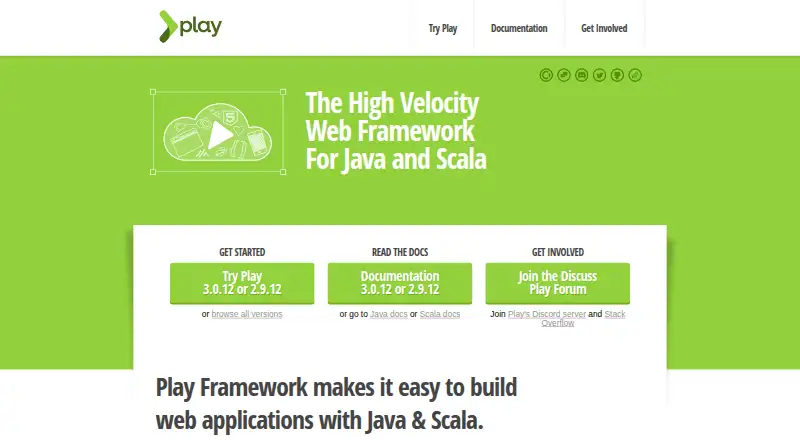
Play Framework: A full-stack Java and Scala framework for asynchronous, self-hosted web services. Ranked #6 of 31 in Web Frameworks by our editors (8.4/10); pricing: Open source; best for java or Scala teams building asynchronous web services.
At a glance
- Editor score8.4 / 10
- PricingOpen source
- Best forJava or Scala teams building asynchronous web services
- Paid fromFree
- Framework typeFull-stack
- Facts checked24 Sep 2026
Where it wins
- Stateless, non-blocking architecture supports asynchronous web services
- Combines MVC, REST, JSON, WebSockets, routing, and Twirl templates
- Database integrations include Anorm, Ebean, Slick, and JPA
Where it doesn't
- Self-hosted deployment leaves infrastructure operations to your team
- No built-in authentication module is included
- Support is centered on community resources and documentation
Our verdict on Play Framework
Play Framework is an open-source, full-stack web application framework for Java and Scala. It targets teams building web applications and REST services that need an integrated HTTP server, routing, form handling, server-rendered Twirl templates, JSON, and WebSockets. Its stateless, non-blocking architecture suits asynchronous services, while support for Linux, Windows, macOS, API use, and self-hosted deployment gives teams flexibility in where applications run. Small, mid-market, and enterprise teams can use the same framework model.
The framework’s standout strength is how many web concerns are assembled in one codebase. MVC architecture, compiled Twirl templates, REST services, JSON handling, WebSockets, dependency injection through Guice or compile-time mechanisms, hot reload development, and built-in testing tools cover both application structure and development workflow. Security-related filters for CSRF, security headers, and allowed hosts are included. Database access can connect through Anorm, Ebean, Slick, or JPA, with Pekko and Pekko HTTP also listed among integrations. This combination fits teams that want Java or Scala APIs without stitching together separate web layers.
Play uses an open-source pricing model rather than tiered hosted plans. Applications are packaged for production deployment, but operating the resulting self-hosted or cloud deployment remains the team’s responsibility. Authentication is not built in, so teams needing that capability must select an approach beyond the included filters and dependency-injection options. Support channels are community and documentation, which may suit teams comfortable with self-service maintenance better than organizations seeking a vendor-managed service. Choose Play for broad, asynchronous Java or Scala web development; consider another framework if hosted operations or built-in authentication is a primary requirement.
Your product? Our editors can test Play Framework in depth and publish a review, labelled as paid · from $149/mo →
Play Framework pricing
Play Framework fact sheet
| Free plan | Not verified |
|---|---|
| Paid from | Free |
| Framework type | Full-stack |
| Primary languages | Java, Scala |
| Rendering modes | Ssr |
| Included ORM | Yes |
| Built-in authentication | No |
| Deployment targets | Self-hosted |
| License model | Open-source |
| Deployment | Self-hosted, Cloud |
| Platforms | Linux, Windows, macOS |
| Support | Community, Docs |
| Built for | Small business, Mid-market, Enterprise (editorial estimate) |
| Integrations | 7 integrations: Anorm, Ebean, Slick, JPA, Pekko, Pekko HTTP … |
| Pricing | Open source |
| Website | playframework.com |
| Facts checked | 24 Sep 2026 |
Play Framework integrations
Play Framework lists 7 integrations on its own site.
- Anorm
- Ebean
- Slick
- JPA
- Pekko
- Pekko HTTP
- Guice
Alternatives to Play Framework
- Ruby on RailsRails gives Ruby teams a convention-led, full-stack foundation for database-backed web apps.9.3
- DjangoA free Python backend framework combining ORM, authentication, administration, and deployment flexibility.9.1
- Next.jsA free, open-source full-stack React framework with hybrid rendering and backend routes.9.0


See all Play Framework alternatives →
Play Framework vs the competition
- Play Framework vs Ruby on Rails
- Play Framework vs Django
- Play Framework vs Next.js
- Play Framework vs Nuxt
- Play Framework vs SvelteKit
- Play Framework vs FastAPI



Compare Play Framework with any tool side by side →
Also Ranked In
Play Framework is ranked in 2 of our directories.
Used Play Framework? Be the first to review it
The editor score above is our own research. What this page doesn't have yet is a reader's view — what you used Play Framework for, what worked and what didn't. No stars are seeded and no review is paid for; an editor reads every one before it appears.
Write a reviewTwo minutes · verified accounts only · read by an editor before it appears
Featured on iTechGuides

Play Framework is listed in our Web Frameworks directory. Add the badge to your site — it links back to this page.
<a href="https://www.itechguides.com/products/play-framework/"><img src="https://www.itechguides.com/best/badge/play-framework.svg" alt="Featured on iTechGuides" width="230" height="46"></a>
Reviewed by iTechGuides Editors · Editorial team · Updated Oct 2026
Advertiser disclosure: iTechGuides is reader-supported. Vendors can pay for top positions in our rankings and for a place on other products' pages, and we may earn a commission when you click some links. Bought places stand at the number bought; this page and our disclosure say so. Paying vendors may get a fuller, more detailed review from our editors, and that review can change their score. How we rank.
Last updated · How we research and update