OpenAI Computer-Using Agent (CUA)
OpenAI Computer-Using Agent (CUA): A capable API-first computer-use model for developers who can manage preview-stage limitations. Ranked #8 of 24 in AI Computer Use Agents by our editors (8.5/10); pricing: Paid; best for developers building API-based computer-use agents.
At a glance
- Editor score8.5 / 10
- PricingPaid
- Best forDevelopers building API-based computer-use agents
- Free planNo
- Paid from$3/unit usage-based
- Desktop app controlYes
- Founded2015 · San Francisco, California, United States
- Facts checked22 Sep 2026
Where it wins
- Controls browsers and operating systems with mouse and keyboard actions
- Supports screenshots, function calling, and Responses API integration
- Adds human confirmations and safety checks for sensitive actions
Where it doesn't
- No free plan is available
- The model remains a research preview
- Non-browser use requires particular human oversight
Our verdict on OpenAI Computer-Using Agent (CUA)
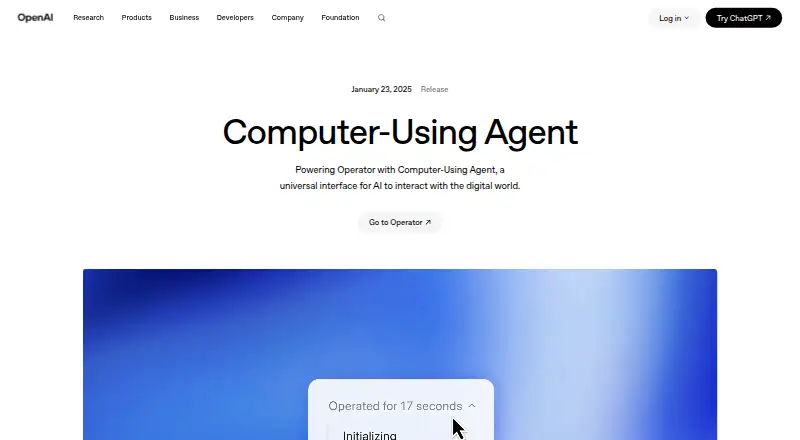
OpenAI Computer-Using Agent (CUA) is a specialized model for developers building agents that operate graphical interfaces. It interprets screenshots, generates mouse and keyboard actions, interacts with browsers, and handles operating-system computer-use tasks. Access is provided through the computer-use tool in OpenAI’s Responses API, with support for web, Windows, macOS, Linux, and API workflows. Typical applications include browser automation, quality assurance, data entry, internal process automation, and software workflows without suitable APIs.
Pricing is usage-based rather than subscription-based. The published plans show $3 per 1M input tokens for computer-use model input and $12 per 1M output tokens for computer-use model output. There is no free plan. This structure suits teams that want API access and can estimate or monitor token consumption, while buyers seeking a no-cost trial tier or a fixed desktop automation subscription should look elsewhere. CUA also supports function calling, which can help connect computer-use actions with surrounding application logic.
Safety and control are central to the product’s operating model. CUA includes human confirmation prompts for sensitive actions, along with prompt-injection and sensitive-domain safety checks. OpenAI presents the API model as a research preview and recommends human oversight, particularly for non-browser environments. That makes it a fit for developers who need broad browser or desktop control and are prepared to keep people involved in higher-risk workflows. Organizations seeking a mature, unattended automation layer with minimal supervision should consider an alternative designed for that requirement.
Your product? Our editors can test OpenAI Computer-Using Agent (CUA) in depth and publish a review, labelled as paid · from $149/mo →
OpenAI Computer-Using Agent (CUA) pricing
All 2 OpenAI Computer-Using Agent (CUA) plans and prices →
OpenAI Computer-Using Agent (CUA) fact sheet
| Free plan | No |
|---|---|
| Paid from | $3/unit usage-based |
| Desktop app control | Yes |
| Supported platforms | web, Windows, macOS, Linux, API |
| Browser control | Yes |
| Screen understanding | Yes |
| Deployment | Hybrid |
| Human approval controls | Yes |
| API access | Yes |
| Deployment | Cloud |
| Platforms | Web, Windows, macOS, Linux |
| Support | Docs |
| Built for | Small business, Mid-market, Enterprise (editorial estimate) |
| Pricing | Paid (source) |
| Website | openai.com |
| Facts checked | 22 Sep 2026 |
Alternatives to OpenAI Computer-Using Agent (CUA)
- CoastyA programmable computer-use platform with managed machines, workflows, approvals, and APIs.9.2
- Claude CoworkA broad computer-use workspace for business automation, with paid plans starting at $17 annually.9.1
- Clawd CursorA free, open-source local MCP server for controlled desktop automation.9.0



See all OpenAI Computer-Using Agent (CUA) alternatives →
OpenAI Computer-Using Agent (CUA) vs the competition
- OpenAI Computer-Using Agent (CUA) vs Coasty
- OpenAI Computer-Using Agent (CUA) vs Claude Cowork
- OpenAI Computer-Using Agent (CUA) vs Clawd Cursor
- OpenAI Computer-Using Agent (CUA) vs Contop
- OpenAI Computer-Using Agent (CUA) vs UFO
- OpenAI Computer-Using Agent (CUA) vs Pan-Agent
Compare OpenAI Computer-Using Agent (CUA) with any tool side by side →
Also Ranked In
OpenAI Computer-Using Agent (CUA) is ranked in 2 of our directories.
Used OpenAI Computer-Using Agent (CUA)? Be the first to review it
The editor score above is our own research. What this page doesn't have yet is a reader's view — what you used OpenAI Computer-Using Agent (CUA) for, what worked and what didn't. No stars are seeded and no review is paid for; an editor reads every one before it appears.
Write a reviewTwo minutes · verified accounts only · read by an editor before it appears
Featured on iTechGuides

OpenAI Computer-Using Agent (CUA) is listed in our AI Computer Use Agents directory. Add the badge to your site — it links back to this page.
<a href="https://www.itechguides.com/products/openai-computer-using-agent-cua/"><img src="https://www.itechguides.com/best/badge/openai-computer-using-agent-cua.svg" alt="Featured on iTechGuides" width="230" height="46"></a>
Reviewed by iTechGuides Editors · Editorial team · Updated Oct 2026
Advertiser disclosure: iTechGuides is reader-supported. Vendors can pay for top positions in our rankings and for a place on other products' pages, and we may earn a commission when you click some links. Bought places stand at the number bought; this page and our disclosure say so. Paying vendors may get a fuller, more detailed review from our editors, and that review can change their score. How we rank.
Last updated · How we research and update