open-computer-use
open-computer-use: Open-source desktop automation for AI agents across macOS, Windows, and Linux. Ranked #15 of 24 in AI Computer Use Agents by our editors (7.8/10); pricing: Open source; best for open-source cross-platform desktop automation.
At a glance
- Editor score7.8 / 10
- PricingOpen source
- Best forOpen-source cross-platform desktop automation
- Paid fromFree
- Desktop app controlYes
- Facts checked22 Sep 2026
Where it wins
- Reads accessibility trees and screenshots for desktop context
- Supports clicks, coordinates, Unicode typing, keys, scrolling, and dragging
- Integrates with Codex, Claude Code, Gemini CLI, opencode, and ZCode
Where it doesn't
- Its focus is desktop applications rather than browser-specific controls
- No conventional external API is part of its documented scope
- A built-in user approval workflow is not documented
Our verdict on open-computer-use
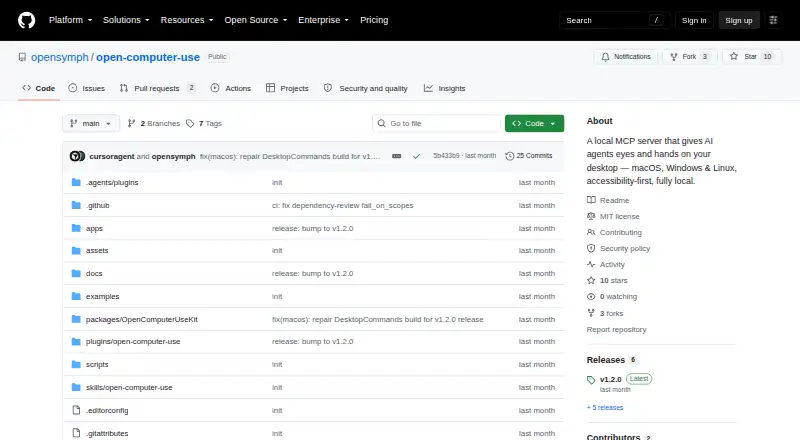
open-computer-use is a local Model Context Protocol server for developers who want AI agents to inspect and operate graphical desktop applications. It runs on macOS, Windows, and Linux, using platform-specific accessibility or automation backends. The project can read accessibility trees and screenshots, interact with interface elements or screenshot coordinates, type Unicode-safe text, manage windows, launch applications, and provide whole-desktop screenshots and recording commands.
Its standout capability is the breadth of desktop actions exposed through one local tool. Agents can click, scroll, drag between coordinates, press keys and key chords, set values on supported controls, and inspect applications and windows. Combining accessibility data with screenshots gives connected clients both structured interface context and visual desktop context. The integration list includes Codex CLI, Codex App, Claude Code, Gemini CLI, opencode, and ZCode, making the project suitable for developers already working with MCP-compatible agent clients.
The product is a focused choice for local, cross-platform desktop automation rather than a broad automation service. Its open-source model and local deployment suit teams that want desktop control on their own machines across three major operating systems. Choose it when the target work involves native applications, windows, accessibility trees, screenshots, and direct input actions. Choose an alternative when browser-specific controls, a conventional external API, or a built-in approval workflow are central requirements.
Your product? Our editors can test open-computer-use in depth and publish a review, labelled as paid · from $149/mo →
open-computer-use pricing
open-computer-use fact sheet
| Free plan | Not verified |
|---|---|
| Paid from | Free |
| Desktop app control | Yes |
| Supported platforms | macOS, Windows, Linux |
| Browser control | Not verified |
| Screen understanding | Yes |
| Deployment | Local |
| Human approval controls | Not verified |
| API access | Not verified |
| Deployment | Desktop |
| Platforms | macOS, Windows, Linux |
| Support | Docs |
| Built for | Solo, Small business (editorial estimate) |
| Integrations | 6 integrations: Codex CLI, Codex App, Claude Code, Gemini CLI, opencode, ZCode |
| Pricing | Open source |
| Website | github.com |
| Facts checked | 22 Sep 2026 |
open-computer-use integrations
open-computer-use lists 6 integrations on its own site.
- Codex CLI
- Codex App
- Claude Code
- Gemini CLI
- opencode
- ZCode
Alternatives to open-computer-use
- CoastyA programmable computer-use platform with managed machines, workflows, approvals, and APIs.9.2
- Claude CoworkA broad computer-use workspace for business automation, with paid plans starting at $17 annually.9.1
- Clawd CursorA free, open-source local MCP server for controlled desktop automation.9.0



See all open-computer-use alternatives →
Used open-computer-use? Be the first to review it
The editor score above is our own research. What this page doesn't have yet is a reader's view — what you used open-computer-use for, what worked and what didn't. No stars are seeded and no review is paid for; an editor reads every one before it appears.
Write a reviewTwo minutes · verified accounts only · read by an editor before it appears
Featured on iTechGuides

open-computer-use is listed in our AI Computer Use Agents directory. Add the badge to your site — it links back to this page.
<a href="https://www.itechguides.com/products/open-computer-use/"><img src="https://www.itechguides.com/best/badge/open-computer-use.svg" alt="Featured on iTechGuides" width="230" height="46"></a>
Reviewed by iTechGuides Editors · Editorial team · Updated Oct 2026
Advertiser disclosure: iTechGuides is reader-supported. Vendors can pay for top positions in our rankings and for a place on other products' pages, and we may earn a commission when you click some links. Bought places stand at the number bought; this page and our disclosure say so. Paying vendors may get a fuller, more detailed review from our editors, and that review can change their score. How we rank.
Last updated · How we research and update