Minato
Minato: Open-source fleet control for persistent game servers running on Kubernetes. Ranked #15 of 23 in Game Server Orchestration Software by our editors (7.3/10); pricing: Open source; best for kubernetes operators needing persistent identity.
At a glance
- Editor score7.3 / 10
- PricingOpen source
- Best forKubernetes operators needing persistent identity
- Paid fromFree
- Facts checked22 Sep 2026
Where it wins
- Persistent server identity with StatefulSets and persistent volume claims
- Fleet management, action dispatch, snapshots, and real-time console streaming
- RBAC, quotas, network policies, and Prometheus-compatible metrics
Where it doesn't
- Requires a self-hosted Kubernetes deployment
- Game support centers on Minecraft Paper, CS2, and Palworld
- Per-game operations require an agent SDK and sidecar architecture
Our verdict on Minato
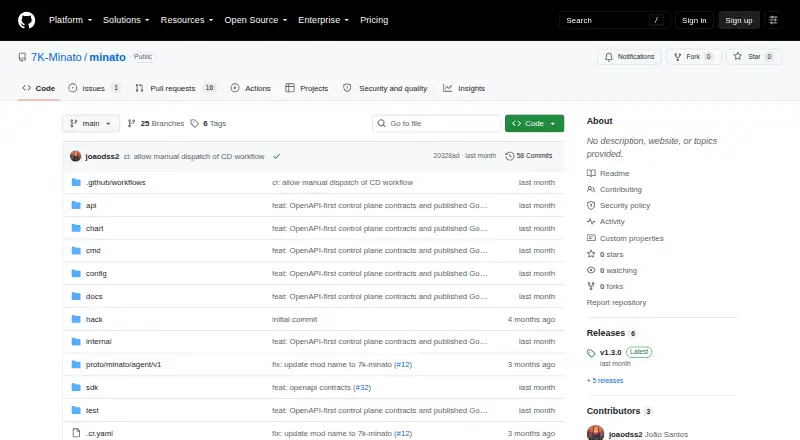
Minato is an open-source, Kubernetes-native platform for hosting persistent dedicated game servers across multiple games. It is aimed at hosting providers operating servers for multiple tenants and operators managing fleets of persistent worlds. The platform reconciles GameServer, GameProfile, GameServerFleet, ActionExecution, and GameSnapshot resources, while generic game profiles extend its scope beyond the listed integrations. Deployment is self-hosted on Linux through Kubernetes, with installation options using Helm, Kustomize, or manual deployment.
Its strongest technical differentiator is persistent identity. Minato uses StatefulSets and persistent volume claims so game servers can retain their identity across lifecycle operations. Fleet management supports multiple servers built from the same game profile, while action dispatch covers operations such as restart, save, and kick. Operators also get real-time console streaming through WebSocket and declarative snapshots with retention policies using VolumeSnapshots. These capabilities make Minato suited to environments where server state and repeatable operations matter more than a simple server launcher.
Minato also fits teams already organized around Kubernetes controls and observability. Namespace-based multi-tenancy combines RBAC, resource quotas, and network policies, and agent metrics endpoints are compatible with Prometheus. The per-game agent SDK and sidecar model provide a defined path for game-specific integrations, with published support for Minecraft Paper, Counter-Strike 2, Palworld, and generic game profiles. Choose Minato when persistent identity, fleet reconciliation, tenant boundaries, and Kubernetes-native operations are central requirements. Choose another approach if you need a hosted service, a non-Kubernetes deployment, or a narrower setup with less orchestration overhead.
Your product? Our editors can test Minato in depth and publish a review, labelled as paid · from $149/mo →
Minato pricing
Minato fact sheet
| Free plan | Not verified |
|---|---|
| Paid from | Free |
| Deployment model | Self_hosted |
| Autoscaling | Not verified |
| Multiregion deployment | Not verified |
| Matchmaking | Not verified |
| Container support | Yes |
| Supported platforms | Kubernetes; Minecraft Paper; Counter-Strike 2; Palworld |
| Pricing model | Not verified |
| Deployment | Cloud, Self-hosted |
| Platforms | Linux |
| Support | Docs |
| Built for | Mid-market, Enterprise (editorial estimate) |
| Pricing | Open source |
| Website | github.com |
| Facts checked | 22 Sep 2026 |
Alternatives to Minato
- Amazon GameLift ServersA strong AWS-centered choice for operating dedicated multiplayer game servers at scale.9.4
- PlayFabA broad managed backend for multiplayer, player services, and live operations.9.2
- EdgegapA broad edge orchestration stack for studios that need global multiplayer infrastructure.9.0


Used Minato? Be the first to review it
The editor score above is our own research. What this page doesn't have yet is a reader's view — what you used Minato for, what worked and what didn't. No stars are seeded and no review is paid for; an editor reads every one before it appears.
Write a reviewTwo minutes · verified accounts only · read by an editor before it appears
Featured on iTechGuides

Minato is listed in our Game Server Orchestration Software directory. Add the badge to your site — it links back to this page.
<a href="https://www.itechguides.com/products/minato/"><img src="https://www.itechguides.com/best/badge/minato.svg" alt="Featured on iTechGuides" width="230" height="46"></a>
Reviewed by iTechGuides Editors · Editorial team · Updated Oct 2026
Advertiser disclosure: iTechGuides is reader-supported. Vendors can pay for top positions in our rankings and for a place on other products' pages, and we may earn a commission when you click some links. Bought places stand at the number bought; this page and our disclosure say so. Paying vendors may get a fuller, more detailed review from our editors, and that review can change their score. How we rank.
Last updated · How we research and update