Google Cloud Vision API
Google Cloud Vision API: A broad cloud vision API with free monthly units and feature-based pricing. Ranked #2 of 36 in AI Image Recognition Software by our editors (9.2/10); pricing: Free plan; best for managed cloud recognition APIs.
At a glance
- Editor score9.2 / 10
- PricingFree plan
- Best forManaged cloud recognition APIs
- Free planYes
- Paid from$0.60/unit usage-based
- Object detectionYes
- Facts checked21 Sep 2026
Where it wins
- Covers labeling, OCR, faces, logos, landmarks, and web detection
- First 1,000 units each month are free
- Supports object localization with bounding-box annotations
Where it doesn't
- Pricing varies by feature and monthly usage tier
- API-only delivery requires developer integration
- Does not provide face recognition
Our verdict on Google Cloud Vision API
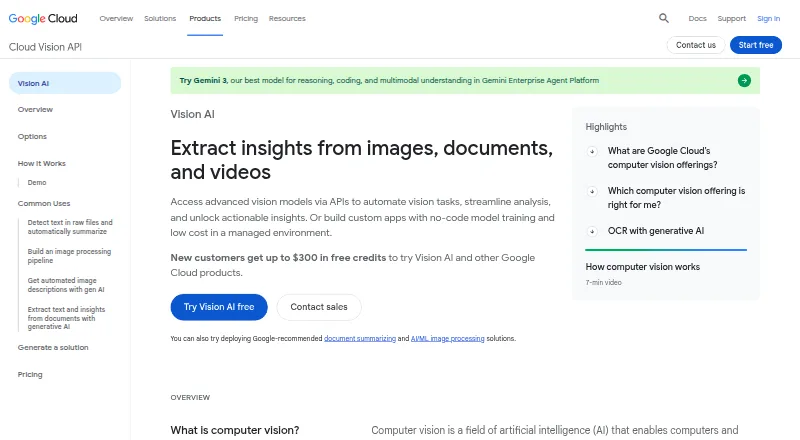
Google Cloud Vision API is a managed cloud service for developers who need pretrained computer-vision features in applications. REST and RPC interfaces support image and document analysis, including generalized image labels, object localization, face detection, landmark and logo detection, optical character recognition, document and handwriting text detection, SafeSearch, image properties, crop hints, and web detection. It is a broad fit for teams building recognition workflows without deploying their own computer-vision models.
Pricing is usage-based rather than subscription-based, with charges calculated by feature units processed each month. The standard pay-as-you-go tier starts at $1.50 per 1,000 units, and the first 1,000 units each month are free for eligible standard features. A high-volume standard-features tier is priced at $0.60 per 1,000 units and covers text, document text, face, landmark, logo, image properties, and related features. Object localization is priced at $2.25 per 1,000 units, while web detection is priced at $3.50 per 1,000 units. This structure suits workloads where usage and feature selection can be estimated, but it requires attention to which analysis capabilities are being processed.
The main strength is breadth within a single API: applications can combine classification, localization, OCR, facial landmarks, explicit-content likelihood attributes, and image-related web entities. Object localization returns labels and bounding polygons, while OCR supports both ordinary images and dense documents or handwriting. The trade-off is that the product is an API rather than a complete end-user application, so implementation depends on developer integration. It also offers face detection rather than face recognition. Choose it for managed, cloud-based image analysis across several recognition tasks; consider another option if you need a visual application, self-hosted deployment, or face-recognition capability.
Your product? Our editors can test Google Cloud Vision API in depth and publish a review, labelled as paid · from $149/mo →
Google Cloud Vision API pricing
All 4 Google Cloud Vision API plans and prices →
Google Cloud Vision API fact sheet
| Free plan | Yes |
|---|---|
| Paid from | $0.60/unit usage-based |
| Object detection | Yes |
| Image classification | Yes |
| Face recognition | No |
| OCR | Yes |
| Custom models | Not verified |
| Deployment options | Cloud |
| Included image volume | Not verified |
| Deployment | Cloud |
| Support | Community, Docs |
| Built for | Small business, Mid-market, Enterprise (editorial estimate) |
| Pricing | Free plan (source) |
| Website | cloud.google.com |
| Facts checked | 21 Sep 2026 |
Alternatives to Google Cloud Vision API
- OpenCVA free, broad computer vision library for developers building image and video applications.9.3
- Amazon Rekognition Face SearchA broad AWS-native toolkit for face search, image analysis, OCR, and custom models.9.1
- Baidu AI Image RecognitionA broad computer vision service for teams needing category recognition and private deployment.8.9


See all Google Cloud Vision API alternatives →
Google Cloud Vision API vs the competition
- Google Cloud Vision API vs OpenCV
- Google Cloud Vision API vs Amazon Rekognition Face Search
- Google Cloud Vision API vs Baidu AI Image Recognition
- Google Cloud Vision API vs Roboflow
- Google Cloud Vision API vs Chooch AI Vision Platform
- Google Cloud Vision API vs Cognex VisionPro



Compare Google Cloud Vision API with any tool side by side →
Also Ranked In
Google Cloud Vision API is ranked in 2 of our directories.
Used Google Cloud Vision API? Be the first to review it
The editor score above is our own research. What this page doesn't have yet is a reader's view — what you used Google Cloud Vision API for, what worked and what didn't. No stars are seeded and no review is paid for; an editor reads every one before it appears.
Write a reviewTwo minutes · verified accounts only · read by an editor before it appears
Featured on iTechGuides

Google Cloud Vision API is listed in our AI Image Recognition Software directory. Add the badge to your site — it links back to this page.
<a href="https://www.itechguides.com/products/google-cloud-vision-api/"><img src="https://www.itechguides.com/best/badge/google-cloud-vision-api.svg" alt="Featured on iTechGuides" width="230" height="46"></a>
Reviewed by iTechGuides Editors · Editorial team · Updated Oct 2026
Advertiser disclosure: iTechGuides is reader-supported. Vendors can pay for top positions in our rankings and for a place on other products' pages, and we may earn a commission when you click some links. Bought places stand at the number bought; this page and our disclosure say so. Paying vendors may get a fuller, more detailed review from our editors, and that review can change their score. How we rank.
Last updated · How we research and update