GGRS
GGRS: A focused Rust/WebAssembly library for peer-to-peer rollback sessions, not matchmaking. Ranked #25 of 29 in Game Networking Middleware by our editors (6.5/10); pricing: Open source; best for rust browser games needing peer-to-peer rollback.
At a glance
- Editor score6.5 / 10
- PricingOpen source
- Best forRust browser games needing peer-to-peer rollback
- Paid fromFree
- MatchmakingNo
- Facts checked21 Sep 2026
Where it wins
- Rollback, re-simulation, and remote-input prediction
- Spectator sessions, sync tests, and checksum desync detection
- UDP socket plus custom transport integration for browser projects
Where it doesn't
- No matchmaking signalling
- No NAT traversal
- Requires external infrastructure for connection setup
Our verdict on GGRS
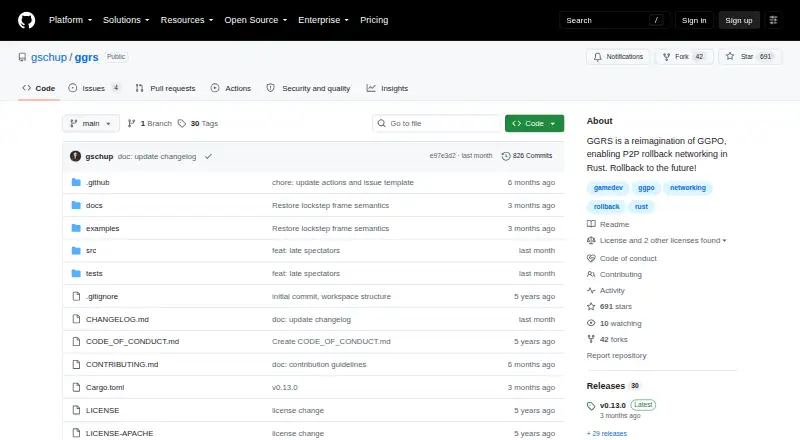
GGRS is an open-source Rust library for adding peer-to-peer rollback networking to multiplayer games. It is aimed at developers building Rust or WebAssembly/browser games that need synchronized sessions, remote-input prediction, and rollback after misprediction. The library supports peer-to-peer multiplayer, spectator sessions, and local determinism sync tests, making it a focused option for games whose networking model depends on rollback rather than a hosted backend.
Its standout feature is the rollback workflow. GGRS predicts remote inputs, then rolls back and re-simulates game state when those predictions are wrong. Time synchronization supports coordinated sessions, while checksum-based desync detection helps identify divergent game state. The published feature set also includes a non-blocking UDP socket and a custom transport trait. Browser and WebAssembly projects can adapt WebRTC sockets such as Matchbox, and integrations include Matchbox, Bevy GGRS, and the Godot GGRS Wrapper.
GGRS is open source rather than a hosted networking service, so teams must assemble the surrounding connection infrastructure. It does not provide matchmaking signalling or NAT traversal; those functions require external infrastructure such as Matchbox. That makes it a good fit for developers who want control over a Rust rollback layer and can supply the rest of the networking stack. Teams seeking an all-in-one service for player discovery, signalling, or connectivity management should choose a broader alternative instead.
Your product? Our editors can test GGRS in depth and publish a review, labelled as paid · from $149/mo →
GGRS pricing
GGRS fact sheet
| Free plan | Not verified |
|---|---|
| Paid from | Free |
| Network model | P2p |
| Supported platforms | Rust; WebAssembly/browser |
| Matchmaking | No |
| Rollback netcode | Yes |
| Max players per session | Not verified |
| Transport protocols | UDP; custom transports |
| Deployment | Cloud |
| Platforms | Web |
| Support | Community, Docs |
| Built for | Solo, Small business, Mid-market (editorial estimate) |
| Integrations | 3 integrations: Matchbox, Bevy GGRS, Godot GGRS Wrapper |
| Pricing | Open source |
| Website | github.com |
| Facts checked | 21 Sep 2026 |
GGRS integrations
GGRS lists 3 integrations on its own site.
- Matchbox
- Bevy GGRS
- Godot GGRS Wrapper
Alternatives to GGRS
- ColyseusFlexible multiplayer middleware spanning networking, matchmaking, accounts, persistence, and live operations.9.4
- SmartFoxServerA broad, mature backend for studios building real-time multiplayer games.9.2
- Photon QuantumA focused Unity framework for deterministic simulation, rollback, and authoritative validation.9.0



Used GGRS? Be the first to review it
The editor score above is our own research. What this page doesn't have yet is a reader's view — what you used GGRS for, what worked and what didn't. No stars are seeded and no review is paid for; an editor reads every one before it appears.
Write a reviewTwo minutes · verified accounts only · read by an editor before it appears
Featured on iTechGuides

GGRS is listed in our Game Networking Middleware directory. Add the badge to your site — it links back to this page.
<a href="https://www.itechguides.com/products/ggrs/"><img src="https://www.itechguides.com/best/badge/ggrs.svg" alt="Featured on iTechGuides" width="230" height="46"></a>
Reviewed by iTechGuides Editors · Editorial team · Updated Oct 2026
Advertiser disclosure: iTechGuides is reader-supported. Vendors can pay for top positions in our rankings and for a place on other products' pages, and we may earn a commission when you click some links. Bought places stand at the number bought; this page and our disclosure say so. Paying vendors may get a fuller, more detailed review from our editors, and that review can change their score. How we rank.
Last updated · How we research and update