
GameFabric
GameFabric: Infrastructure-focused orchestration for deploying, scaling, monitoring, and protecting game servers. Ranked #24 of 27 in Game Backend Services by our editors (6.8/10); pricing: Pricing on request; best for infrastructure teams managing game servers.
At a glance
- Editor score6.8 / 10
- PricingPricing on request
- Best forInfrastructure teams managing game servers
- Multiplayer networkingYes
- Facts checked20 Sep 2026
Where it wins
- Deploys across bare metal, GameFabric Cloud, and customer cloud accounts
- Supports automatic scaling, scale-to-zero, allocation, and infrastructure portability
- Includes monitoring, profiling, audit logs, and SteelShield DDoS protection
Where it doesn't
- Pricing is individually quoted through contact sales
- The optional Allocator service is ordered separately
- Matchmaking is handled through integrations rather than provided natively
Our verdict on GameFabric
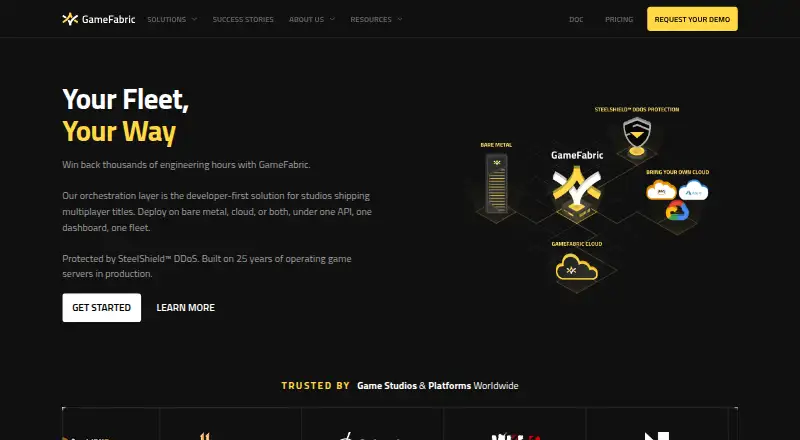
GameFabric is a multiplayer game server orchestration platform from Nitrado for studios running online connected games, including session-based titles and persistent worlds. It supports deployment, hosting, scaling, monitoring, protection, and allocation across bare-metal infrastructure, GameFabric Cloud, and customer cloud accounts. Web management, a REST API, Terraform and OpenTofu providers, and integrations with Agones and Kubernetes give infrastructure teams several ways to manage operations. Its deployment model suits hybrid environments, from indie teams through AAA organizations.
The platform’s strongest fit is infrastructure automation. Teams can manage capacity with automatic scaling and scale-to-zero, then use the optional Allocator service for server allocation. Bring-your-own-cloud support covers AWS, Azure, and Google Cloud, while Terraform and OpenTofu support helps incorporate GameFabric into infrastructure workflows. Monitoring, profiling, dashboards, and audit logs provide operational visibility, and SteelShield adds UDP and TCP DDoS protection. Prometheus and Grafana integrations extend the monitoring ecosystem, while Amazon GameLift FlexMatch can connect matchmaking capabilities to the broader stack.
GameFabric is a focused choice for teams that need control over game-server deployment and infrastructure across multiple environments. Its contact-sales pricing means buyers will need an individual commercial discussion rather than a published plan comparison, and the Allocator is a separately ordered option. The platform integrates with a matchmaker instead of supplying the matchmaking system itself, so teams seeking an all-in-one backend should account for that boundary. Choose GameFabric when server orchestration, portability, scaling, and infrastructure operations are central requirements; consider another product when native matchmaking is the primary need.
Your product? Our editors can test GameFabric in depth and publish a review, labelled as paid · from $149/mo →
GameFabric pricing
GameFabric fact sheet
| Free plan | Not verified |
|---|---|
| Paid from | Not verified |
| Multiplayer networking | Yes |
| Player accounts | Not verified |
| Matchmaking | No |
| Cloud data | Not verified |
| Live-ops tools | Yes |
| Deployment model | Hybrid |
| Deployment | Cloud |
| Platforms | Web |
| Support | Email, Phone · 24/7 |
| Built for | Small business, Mid-market, Enterprise (editorial estimate) |
| Integrations | 10 integrations: Agones, Kubernetes, Prometheus, Grafana, Amazon GameLift FlexMatch, Terraform … |
| Pricing | Pricing on request (source) |
| Website | gamefabric.com |
| Facts checked | 20 Sep 2026 |
GameFabric integrations
GameFabric lists 10 integrations on its own site.
- Agones
- Kubernetes
- Prometheus
- Grafana
- Amazon GameLift FlexMatch
- Terraform
- OpenTofu
- AWS
- Azure
- Google Cloud
Alternatives to GameFabric
- PlayFabA broad managed backend for games, from player accounts and multiplayer to LiveOps.9.4
- brainCloudA broad game backend with free access, low-cost entry pricing, and hybrid deployment.9.1
- BeamableA broad backend for multiplayer, commerce, social systems, and LiveOps.9.0


See all GameFabric alternatives →
Also Ranked In
GameFabric is ranked in 3 of our directories.
Used GameFabric? Be the first to review it
The editor score above is our own research. What this page doesn't have yet is a reader's view — what you used GameFabric for, what worked and what didn't. No stars are seeded and no review is paid for; an editor reads every one before it appears.
Write a reviewTwo minutes · verified accounts only · read by an editor before it appears
Featured on iTechGuides

GameFabric is listed in our Game Backend Services directory. Add the badge to your site — it links back to this page.
<a href="https://www.itechguides.com/products/gamefabric/"><img src="https://www.itechguides.com/best/badge/gamefabric.svg" alt="Featured on iTechGuides" width="230" height="46"></a>
Reviewed by iTechGuides Editors · Editorial team · Updated Oct 2026
Advertiser disclosure: iTechGuides is reader-supported. Vendors can pay for top positions in our rankings and for a place on other products' pages, and we may earn a commission when you click some links. Bought places stand at the number bought; this page and our disclosure say so. Paying vendors may get a fuller, more detailed review from our editors, and that review can change their score. How we rank.
Last updated · How we research and update