
Windows Errors? Fix Them Before They Spread
Repair common Windows errors and clear accumulated junk for a smoother, more stable PC - no reinstall needed.Free scan · no reinstallOutdated Drivers Are Slowing You Down
One free scan finds every outdated or missing driver and matches the right update for your exact hardware.Free scan · exact hardware matchiTechGuides is reader-supported. When you buy through links on our site, we may earn an affiliate commission. As an Amazon Associate I earn from qualifying purchases. Learn more
An AI system that senses its surroundings and acts on them is only as safe as the physical application it runs in: the task, the workspace, the people who come near it, and the safeguards that keep the machine away from them. Reducing that risk means defining the system’s intended use, mapping hazards and exposed people, testing the complete application under realistic conditions, choosing and verifying engineering safeguards, and keeping a working way to intervene or stop the system after launch. No single framework, product, or safeguard makes a physical AI system safe. The steps below work only together.
Keep AI risk management and machinery safety separate, then connect them
Two bodies of guidance cover this work, and they answer different questions. Treating them as one leads either to an AI evaluation that ignores the robot cell or to a safety assessment that ignores how the AI actually behaves.
| Question | AI system risk management | Machinery and workplace safety |
|---|---|---|
| Main reference cited here | NIST AI RMF 1.0 (NIST AI 100-1) and the NIST AI RMF Playbook | OSHA’s robotics technical manual, U.S. workplace guidance on robot applications and safeguarding |
| Status | Voluntary. NIST says AI RMF 1.0 is being revised, and its framework page references an April 7, 2026 concept note for a critical-infrastructure profile. The Playbook is based on AI RMF 1.0 and is due for updating after the revision. | U.S. guidance. It is not a complete statement of every jurisdiction’s legal requirements and does not replace an application-specific professional assessment. |
| Unit of analysis | The AI system, its task, and the context it was designed for | The robot application: its tasks, usage, hazards, installation area, and the workers exposed to, operating, or maintaining it |
| What it asks you to produce | Documented intended use and limits, test evidence, failure behavior, monitoring, and intervention procedures | An application risk assessment, selected safeguards, verification records, and trained verification of internal safety functions where they apply |
The meeting point is the work cell. The AI-side process produces the system description, performance limits, and monitoring evidence that the application assessment needs. The application assessment produces the hazard and safeguard requirements the AI system must operate within. Neither replaces the other.
The lifecycle path, stage by stage
The eight stages below run in order at first deployment. Repeat them whenever the software, the task, the environment, or the layout of the work cell changes.
#1 Best Overall

- EASY INSTALLATION: Light grating security device is easy to install and disassemble, easy to use. Reliably the safety of persons or objects
- MULTI-AREA : Available in two for your choice. Safety sensor light screen can be used for multi-area , etc.
- STRONG ANTI-INTERFERENCE: Safety sensor can , it has shock and strong anti-interference
- : Light curtain sensor switch made of aluminum alloy material, and long service life
- WIDE USE: Safety light curtains suitable for forging machine tools, automation equipment, shearing machines, hydraulic machines, robots, industrial robots, packaging equipment, production lines, solid garages and other automation equipment
1. Define the system and its intended use
Start with a written description of the physical system as a whole, not only the model. Cover:
- The AI model and its version, along with the data and training regime it was built from
- The robot or physical platform, including its sensors and actuators
- Software interfaces and communication links, and what the system does if one of them drops
- Operating modes, such as automatic and setup
- The task, the environment, and the conditions the system is expected to meet
- Foreseeable conditions outside normal operation, such as a changed lighting condition, a person entering the cell, or a part arriving out of position
NIST frames the performance of an AI-enabled robot in relation to three things at once: the AI algorithm, the robot system, and the task. A description that covers only one of them will miss the risks that sit between them.
Plan safety at this stage. NIST AI 100-1, in its section on safe AI systems, states: “Employing safety considerations during the lifecycle and starting as early as possible with planning and design can prevent failures or conditions that can render a system dangerous.”
Rank #2
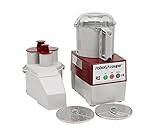
- SMOOTH "S" BLADE: The smooth "s" Blade that comes with the bowl assembly allows you to blend ingredients, emulsify liquids and chop to a coarse texture. (5/32" Slicing disc and 5/64" Grating disc included)
- 2.9 LITER BOWL: The 2.9 L Grey plastic batch bowl is great for processing multiple ingredients together at once and has a clear top which allows the user to see the product inside.
- BUTTON CONTROL PANEL: This food processor has an easy-to-use on/off switch which takes all the assumptions out of processing, while the pulse option allows for more specific execution.
- MAGNETIC SAFETY SYSTEM: The Robot Coupe R2N boasts a lever-activated auto restart, making them more user-friendly and optimizing throughput.
- CONTINUOUS FEED HEAD: When you need to process bulk quantities of a particular ingredient in a particular way, the continuous feed head on this processor gets the job done!
Write the intended use as a short statement that someone could check against the floor: what the system does, where it does it, which people may be nearby, and what it must not do.
2. Map tasks, hazards, and the people exposed
OSHA’s manual states that a robot application risk assessment analyzes tasks, usage, hazards, the area where the robot is installed and used, and the activities of workers who are exposed to, operate, or maintain it. Those activities go well beyond normal production. Include:
- Normal production cycles
- Setup and changeover
- Maintenance and inspection
- Jam clearing and recovery after a fault
- Cleaning
- Foreseeable entry into the work area, including entry that is not authorized but is predictable
Record each hazard against the activity, the people who perform it, and the place where it happens. The same cell can present a different hazard during maintenance than during production, because the people, the motions, and the access points differ.
Rank #3
- Genuine OEM replacement part
- Robot Coupe is the foodservice industry leader in the development and refinement of food processors
- Use genuine OEM parts for safety reliability and performance
- Country of origin: France
3. Test the full application under representative conditions
A model that performs well in evaluation does not establish that the deployed system is safe. NIST’s physical AI work says test methods should represent different data, training, and deployment regimes, along with manufacturing use cases. Test what will actually run:
The Tool Desk
Outbyte Driver Updater FREEScan for outdated or missing drivers - takes under a minuteDriver Scan →Outbyte PC Repair FREERepair Windows errors before they cause bigger problemsFix Now →- The complete robot system, including the real controller, sensors, and interlocks, not the model in isolation
- Expected operating conditions and reasonable variations of them, such as lighting changes, part variation, and cycle changes
- Data collection and preprocessing that match the deployment, not only the training set
- Simulation and in-domain testing, which NIST AI 100-1 names among practical approaches to AI safety
Test results describe behavior under the conditions tested. NIST notes that controlled-environment risk measurements may differ from the risks present in operational real-world settings, so a passing test is evidence for the conditions it covered, not a guarantee for the site.
4. Choose layered engineering safeguards
Prefer appropriate physical separation and engineering safeguards. Use administrative measures, such as procedures and training, as additional controls rather than as the main protection.
Rank #4

- Genuine OEM replacement part
- Robot Coupe is the foodservice industry leader in the development and refinement of food processors
- Use genuine OEM parts for safety, reliability, and optimal performance
- Approved by original equipment manufacturer (OEM)
- Intended only for designed and specified use
For non-collaborative robot applications, OSHA’s manual identifies guards, interlocked guards, light curtains, mats, safety scanners, and safety vision systems. Light curtains are one type of presence-sensing device. None of these is a default. Each suits some hazards and workspaces and not others, so the choice follows the application assessment. Compare candidates on these criteria:
- The task and the hazard the safeguard addresses
- Who may be exposed, and whether people enter the workspace during operation
- The operating environment
- Access to the robot workspace, both routine and emergency
- Whether the safeguard’s performance has been validated for this application and its installed conditions
- Maintainability: whether the safeguard can be inspected, cleaned, and repaired without being defeated
- System failure behavior: what the robot does if the safeguard, a sensor, or the controller fails
- Whether the system can be stopped or intervened in while the safeguard is active
Where a safeguard depends on AI perception, the validated performance of the installed safeguard governs the decision. Accuracy measured during model testing does not carry that weight on its own.
5. Set operating limits and define failure behavior
Write down the envelope the system was designed for: the conditions, objects, and ranges in which its performance was tested, and the points where it has not been tested. NIST’s AI RMF Core covers validity, reliability, generalizability, safe failure, and safety evaluation beyond the system’s knowledge limits. Those topics translate directly into a limits document.
Best Value

- Genuine OEM replacement part
- Robot Coupe is the foodservice industry leader in the development and refinement of food processors
- Genuine OEM provides safety, reliability, and optimal performance
- Approved by original equipment manufacturer (OEM)
- Intended only for designed and specified use
For each element that can fail, define the behavior: perception, communications, the model, and surrounding conditions. For example, if the perception system loses its view of the cell, the written response should be a defined safe state rather than continued motion. The specific response belongs in the application assessment, and it should be written before commissioning rather than improvised on the floor.
6. Verify and maintain safeguards
OSHA’s manual calls for visual validation and documentation of some safeguards, and for trained verification of some built-in safety functions. In practice:
- Check physically that external safeguards are present, correctly positioned, and working, and record the check
- Have trained professionals verify the internal safety configurations where safety functions are built into the robot or its controller
- Keep verification records with the application assessment
- Reassess after any material change to software, task, environment, or work-cell layout
7. Monitor operation and keep human intervention and a safe stop
NIST AI 100-1 names rigorous simulation and in-domain testing, real-time monitoring, and the ability to shut down, modify, or have human intervention into systems that deviate from intended or expected functionality. The framework’s own wording is: “Other practical approaches for AI safety often relate to rigorous simulation and in-domain testing, real-time monitoring, and the ability to shut down, modify, or have human intervention into systems that deviate from intended or expected functionality.”
Recommended Free Tools
In operation, that means:
- Choose monitoring signals that match the hazards, and define what a deviation from the envelope looks like in those signals
- Name who can intervene, and confirm they can reach a stop within the time the hazard allows; NIST’s AI RMF Core calls for considering response time
- Keep a way to stop or modify the system that does not depend on the AI system behaving correctly
- Revisit the risk controls using the operating record, since real-world risk can differ from controlled measurements
8. Govern the work across the lifecycle
Use the four NIST AI RMF functions, Govern, Map, Measure, and Manage, as a voluntary organizing structure. The AI RMF Playbook offers suggested actions for each function. Adapt them to your sector and to the machinery requirements that apply to the installation. ISO/IEC 23894:2023 provides organization-level guidance on integrating AI risk management into how an organization develops, produces, deploys, or uses AI-enabled products, systems, and services.
Assign ownership explicitly: who approves the intended use, who owns the application assessment, and who holds stop authority. Where in-house capability is limited, a qualified robotics systems integrator or a machine-safety assessment provider can carry out application-level assessment and safeguard verification. NIST describes a practical gap between embodied AI research and systems deployable in manufacturing. That gap sits at the application level, which is where the steps above apply.
Independent reader supportYour contribution helps us test, update, and keep practical guides available for everyone.What these steps do not establish
The guidance cited here describes a general risk-management and industrial robotics approach. It does not provide a site-specific engineering design or a legal compliance determination for any jurisdiction. It also does not quantify how much risk each step removes, so treat the steps as necessary practice rather than as a measured reduction in incidents.
Quick Recap
Product prices and availability are accurate as of the date/time indicated and are subject to change. Any price and availability information displayed on Amazon at the time of purchase will apply.

