
iTechGuides is reader-supported. When you buy through links on our site, we may earn an affiliate commission. As an Amazon Associate I earn from qualifying purchases. Learn more
Peptide liquid crystals are not one single class of material. The phrase can describe peptides that form ordered liquid-crystalline phases, peptide amphiphiles organized with help from a liquid-crystal template, or liquid-crystal interfaces that respond to biological interactions. A reported example of the second approach uses aqueous lyotropic chromonic liquid-crystal templates and magnetic fields to direct peptide-amphiphile assembly. That distinction matters: peptide self-assembly does not automatically produce a liquid crystal.
What are peptide liquid crystals?
The term covers related but distinct ways peptide materials and liquid-crystalline order can interact. Liquid crystals combine molecular order with fluid-like behavior. Their arrangement can respond to external stimuli, making them useful as templates or responsive interfaces. In peptide research, the key question is whether the peptide itself forms an ordered phase, whether a liquid crystal helps organize a peptide material, or whether a liquid-crystal surface detects a biological interaction.

- Peptide forming an ordered phase: the peptide-containing material itself exhibits liquid-crystalline order.
- Liquid-crystal template: a liquid crystal provides an ordered environment that guides the assembly of a separate peptide material.
- Biological sensing interface: a liquid-crystal material is engineered to change its ordering in response to biological interactions.
These mechanisms should not be treated as interchangeable. For an overview of peptide-amphiphile structures and applications, see the 2006 review in Soft Matter. A separate review covers liquid-crystal materials and biological applications, including sensing at engineered interfaces: Liquid Crystalline Materials for Biological Applications.
What’s actually slowing this PC down?
Pick the symptom - the matching free tool is one click away.
How can liquid-crystal templates direct peptide self-assembly?
Peptide amphiphiles combine a functional headgroup and an assembly-promoting tail
A peptide amphiphile has a hydrophilic peptide headgroup attached to a hydrophobic segment. The peptide can carry a bioactive sequence, while the hydrophobic tail helps drive self-assembly and orient the headgroup. Depending on molecular design and conditions, peptide-amphiphile assemblies can include micelles and nanofibers, among other structures. The broader principles and biomedical motivations are discussed in the RSC review by Kokkoli and colleagues and a 2020 review of biomimetic peptide self-assembly.
#1 Best Overall
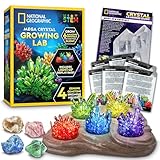
- FAST-GROWING CRYSTALS IN 6 COLORS - Grow blue, red, purple, green, yellow, and glow in the dark crystals! Crystal chemistry has never been so fast (grows in 3 - 4 days), fun, and colorful, making this the perfect educational activity or gift!
- GROWING IS EASY – Easy-to-follow instructions and the 2 included silicone growing chambers make growing your crystals easier than ever!
- NIGHT LIGHT DISPLAY – Show off 5 of your favorite home-grown crystals in the USB-powered (cable included) light-up display! This fun kids STEM activity can help inspire a lifelong love of science and learning.
- INCLUDES REAL CRYSTAL SPECIMENS – Start or expand your rock collection with 4 real gemstone specimens: rose quartz, fluorite, blue calcite, and quartz geode. Learn about the gemstones in the kit with the included full-color Learning Guide.
- AMAZON EXCLUSIVE - Blue Marble has developed this product exclusively for Amazon.
An ordered liquid-crystal environment can act as a guide
A Soft Matter study reports directing peptide-amphiphile assembly with aqueous lyotropic chromonic liquid-crystal templates in magnetic fields: Directed peptide amphiphile assembly using aqueous liquid crystal templates in magnetic fields. In this strategy, the liquid-crystal template supplies an ordered environment for organizing peptide amphiphiles. The liquid-crystal phase is the template; the reported approach should not be described as proof that every peptide amphiphile forms its own liquid-crystalline phase.
The available publication information establishes the template type and use of magnetic fields, but does not give enough detail here to specify the peptide formulation, field strength, phase diagram, or quantitative performance. Those details are essential for reproducing or comparing a particular experiment and should not be inferred from the title alone.
Rank #2

- GROW VIBRANT COLORED CRYSTALS - Grow crystals in 3 amazing colors: blue, purple, and green. With this engaging and educational science experiment for kids, chemistry has never been so fun and colorful!
- NIGHT LIGHT DISPLAY - Show off your crystals on the patent-pending light-up display. With 7 single color modes, rainbow color mode, and 3 brightness levels to choose from, your crystal treasures will shine!
- COMPLETE SCIENCE KIT – Contains all you need! Growing powder, clear seed rocks, growing chamber, light-up display, and easy-to-follow instructions. Our uniquely flexible growing chamber allows you to easily remove your crystals for display without damage!
- START A ROCK COLLECTION – This kit comes with 3 real gemstone specimens, including a geode, green fluorite, and blue calcite, along with a detailed learning guide explaining how crystals grow and more! Makes an excellent STEM gift for boys and girls.
- AWARD-WINNING PRODUCTS - Blue Marble, winner of the Toy Association's prestigious Toy of the Year Award, proudly develops products that foster education, imagination, and creativity, with a U.S. support team to ensure a stellar experience!
How do these systems differ from liquid-crystal biosensors?
Liquid-crystal interfaces can be designed to respond to biological interactions through changes in material ordering. That makes them a potential sensing approach, but it is distinct from using a liquid-crystal template to direct peptide assembly. The biological-applications review discusses several kinds of liquid-crystal materials and interfaces; it should not be read as evidence that all of them use the same phase or mechanism as the aqueous lyotropic chromonic template in the peptide-amphiphile study.
One especially important distinction is lyotropic versus thermotropic. The peptide-assembly example specifically uses an aqueous lyotropic chromonic template. Other liquid-crystal interface work may concern different material classes, including thermotropic systems. A comparison should name the liquid-crystal type and clarify whether it forms the peptide’s phase, serves as a template, or functions as a sensing interface.
What are peptide-amphiphile materials being studied for?
Reviews describe peptide-amphiphile research in soft bioactive materials, tissue-engineering scaffolds, regenerative medicine, and targeted drug delivery. These are broader research areas, not evidence that liquid-crystal-templated peptide assemblies are approved therapies, established clinical interventions, or marketed products. A 2026 review addresses co-assembling peptide materials and their applications, but its broad scope likewise does not establish clinical readiness for this specific templating strategy: Peptide-based co-assembling materials: bridging fundamental science and versatile applications.
Independent reader supportYour contribution helps us test, update, and keep practical guides available for everyone.How to evaluate a peptide liquid-crystal study
When comparing papers, check whether they are actually investigating the same kind of system. Useful questions include:
Rank #4

- GROW CRYSTAL COVERED TREES - Watch as crystals grow from the branches of the included evergreen and cherry trees like magic; you’ll see the first crystals in minutes and trees will be fully covered in as little as 6 hours.
- YOU CHOOSE THE COLORS - This is more than just a science kit! Color each tree any way you’d like with the 5 watercolor pens in the kit and grow crystals in the colors you’ve chosen. It's a craft project and crystal kit all in one!
- REAL SPECIMEN INSIDE - After the crystals are grown, you'll enjoy examining the genuine geode specimen in the kit! A full-color learning guide is included and is packed with fascinating facts about crystals. This STEM craft kit is unforgettable!
- COMPLETE ACTIVITY SET - Because the crystals absorb the ink from the markers and grow in the colors drawn, this kit combines the science of a crystal growing lab with the creativity of an art project, making this a great activity for girls and boys.
- What is the molecular design? Identify the peptide sequence, any bioactive component, and whether the material is a peptide amphiphile.
- What kind of liquid crystal is involved? Distinguish lyotropic from thermotropic materials and identify the specific role of the liquid-crystal phase.
- What does the liquid crystal do? Does it form the peptide-containing ordered phase, template a separate assembly, or act as a responsive biological interface?
- How is alignment or response induced? Record any reported stimulus or alignment method, such as the magnetic fields used in the cited template study.
- What structure is observed, and how is it identified? Look for the reported morphology and the evidence used to establish it rather than assuming that all assemblies have the same form.
- What application is demonstrated? Separate a proposed use or broad field of interest from an experimentally demonstrated outcome or clinical claim.
The sources cited here do not provide enough directly comparable experimental measurements to rank formulations or claim which one performs best.
Quick Recap
Best Value

- 【Perfect Epoxy Resin Kit】 Includes 32 ounces of clear resin, 32 ounces of clear hardener, 2 pump heads, 5x240-milliliter measuring cups, 2 plastic spatulas, 10 wooden mixing sticks, 4 disposable aprons, 4 disposable tablecloths, 2 pairs of gloves, and an epoxy resin instruction manual. The kit includes everything you need to get started, making it easy for both experienced hobbyists and beginners to get started.
- 【High Quality Resin Epoxy】Crystal clear, easy to mix, less bubbles and self defoaming self-leveling function, safe and non-toxic, filler does not settle after mixing, easy to complete perfect works without worry.
- 【Perfect Works】Glossy surface after the table top epoxy resin is cured, perfect texture, no yellowing and high temperature resistance, wear-resistant and durable, ideal for projects such as desktop coating.
- 【Easy to Use】Epoxy resin 1:1 easy to mix, 8 hours drying 24 hours curing, resin heat dissipation temperature is not high will not damage the mold, easy to use very suitable.
- 【Wide Range of Applications】Ideal for casting, coating, artwork, suitable for coasters, countertops, crafts, jewelry making, painting, molds, woodwork, etc. Create your great works.
Product prices and availability are accurate as of the date/time indicated and are subject to change. Any price and availability information displayed on Amazon at the time of purchase will apply.

