
Quick wins for a faster PC:
Clear out junk files and repair common Windows errorsFree Scan →Fix the driver behind crashes, sound loss and screen glitchesFind Drivers →iTechGuides is reader-supported. When you buy through links on our site, we may earn an affiliate commission. As an Amazon Associate I earn from qualifying purchases. Learn more
OpenKhata describes a setup in which daily billing is stored locally on a Flutter point-of-sale app and synced to the cloud for backup, reconciliation, permissions and shared business access. For a kirana shop, that architecture is intended to keep billing and credit records usable when connectivity is weak, while making the data available for broader management tasks when sync is available. Those are the company’s descriptions, not independently verified performance results.
What a digital khata records—and what it does not
A digital khata is a customer-wise record of credit extended and payments recorded against it. It helps a shop track customer balances, but a ledger entry alone does not issue credit or move money. The distinction matters when an app advertises payment tracking: a payment may simply be entered as a bookkeeping record rather than initiated or processed by the app. One Indian khata app’s privacy policy, for example, says it records manually entered cash, UPI or bank-transfer payments without processing payments or connecting to bank accounts or UPI handles; that policy applies to that app, not OpenKhata. Read the policy.


How OpenKhata describes its local-first setup
OpenKhata says its Flutter POS app stores daily billing locally, then uses cloud sync for backup, reconciliation, subscriptions, permissions and shared business authority. In practical terms, the local record is meant to support work at the counter before a network connection is available; syncing later can make records available for backup and shared operations. OpenKhata does not publicly explain how it resolves conflicting edits, encrypts data, identifies transactions, handles deletions, or restores records after a device is lost. Those are important implementation questions, not documented features that should be assumed. OpenKhata’s About page.
The Tool Desk
Outbyte PC Repair FREEClear out junk files and repair common Windows errorsFree Scan →Outbyte Driver Updater FREEFix the driver behind crashes, sound loss and screen glitchesFind Drivers →Which shop tasks OpenKhata advertises
OpenKhata presents itself as a retail POS and management product, not just an udhar ledger. Its feature list includes customer-wise credit ledgers, partial-payment tracking, invoice creation while offline, automatic sync when connectivity returns, and WhatsApp payment reminders. It also lists billing, inventory management, barcode scanning, staff permissions and reports. These are vendor claims rather than independent test results. See OpenKhata’s feature information.
#1 Best Overall

- Daily Cash Flow Log Book 110 Pages Large Format:Daily Cash Flow Log Book with 110 pages in large 8.5 x 11 Inch format provides ample space for daily income expense tracking supporting long term financial record keeping
- Financial Record Keeping Notebook for Daily Accounting:Helps track cash in cash out balances and transactions making it ideal as a petty cash ledger book for small business store office and home accounting
- Structured Inner Page Accounting Fields:Daily Cash Flow Log Book pages include sheet number month year date from to starting balance date description cash in cash out balance total end date closing balance approved by and signature sections
- Petty Cash Large Ledger Book Spiral Bound:Petty Cash Large Ledger Book with spiral binding allows pages to lay flat for easy writing and efficient daily bookkeeping and cash management tasks
- Professional Cash Flow Ledger with Premium Paper:Daily Cash Flow Log Book uses 80 gsm double sided black and white printed pages with a laminated 300 gsm cover ensuring durability for long term financial tracking
This broader feature set may matter if a shop wants billing and stock workflows alongside credit tracking. Before relying on any app, establish whether each essential task—especially reviewing a balance, creating an invoice, recording a payment and accessing customer details—works without a connection. An offline claim about invoice creation does not by itself establish that every screen or workflow is available offline.
What an offline ledger needs to get right
Capture and review at the counter
Offline operation is useful only if staff can both add transactions and inspect the information needed to serve a customer. Check that new credit entries, partial payments, current balances and invoice details behave as expected when the device has no connection. Make sure the app indicates whether a transaction has been saved locally rather than leaving staff to infer that it worked.
Show sync state clearly
When connectivity returns, staff need a visible indication that pending records have synced, or that an error needs attention. Ask what happens if two staff members edit the same customer ledger on different devices before either device reconnects. OpenKhata’s public description mentions reconciliation but does not publish its conflict rules or the way it surfaces sync failures.
Plan for backup and device loss
Local storage can keep work moving during an outage, but a record that exists only on one device remains vulnerable if the device is damaged or lost before it syncs. Ask how often backups occur, how long they are retained, whether a shop can export its ledger, and how records can be restored to a replacement device. OpenKhata says cloud sync supports backup, but its public pages do not specify retention or a recovery procedure.
Account for shared staff and devices
Where several people handle sales or credit, check which actions each staff role can perform and whether changes can be attributed to a staff member. A shared business record is useful only if access is controlled and the shop can understand what changed. OpenKhata lists staff permissions and shared business authority, but the public description does not detail audit history or the exact permission model.
Do not confuse an offline ledger with an offline payment
Recording that a customer paid is different from completing a payment while disconnected. The Reserve Bank of India distinguishes the digital rupee from UPI: “e₹ is a digital form of ₹ whereas UPI is a means of payment.” Its FAQ, updated October 1, 2026, says offline e₹ functionality is intended to allow transactions with limited or no connectivity, but different solutions are still being explored. The FAQ describes retail and wholesale pilots; it does not establish offline e₹ as universally available. RBI Digital Rupee FAQ.
Rank #4

- EFFORTLESSLY MANAGE YOUR FINANCES: Dive into the world of efficient financial management with this accounting ledger book. It's your gateway to tracking payments, deposits, and balances, fostering excellent bookkeeping habits to reach your financial aspirations.
- UNLEASH THE POWER OF UNDATED TRACKING: With an undated accounting book ledger, you're equipped to chronicle every expenditure, regardless of when it occurs. Ample space awaits to meticulously document each transaction, detailing numbers, dates, descriptions, accounts, payment or deposit amounts, and overall balances.
- EMPOWER FINANCIAL SUCCESS: Harness the potential of this accounting log book to analyze your financial endeavors effortlessly. Prepare precise financial statements in no time, allowing you to scrutinize spending and income regularly. Identify and eliminate unnecessary expenses, paving the way for enhanced financial performance and success.
- EXEMPLARY QUALITY: Our accounting ledger book boasts premium quality, crafted from 100gsm paper that minimizes ink leakage, fraying, and shading concerns. The robust and flexible cover shields the pages, while the metal lay-flat twin-wire binding ensures durability and sustained usage.
- VERSATILE UTILITY: Embrace the flexibility of our undated accounting book, enabling you to commence your financial journey anytime, anywhere. Its compact size of 8.6x5.9 inches ensures portability, fitting snugly into any bag for easy access whenever you need it most.
For a kirana shop, therefore, verify whether a ledger app merely records cash, UPI or bank-transfer payments entered by staff, or integrates with a mechanism that actually initiates or processes a payment. Do not treat “offline ledger” as evidence that a customer can pay digitally without connectivity.
How to assess fit before relying on a kirana billing app
- Offline capture: Confirm which transactions and customer details can be created and reviewed with the network disabled.
- Sync visibility: Look for clear pending, completed and failed states, plus an explanation of how duplicate or conflicting edits are handled.
- Recovery and portability: Ask about backup timing, retention, device-loss recovery and export options.
- Staff access: Check role controls and whether the shop can review who changed a ledger entry.
- Customer follow-up: Verify how customer statements and reminders work, including the channel used and whether staff control when reminders are sent.
- Payment meaning: Establish whether the app records payments or also initiates or processes them.
- Device compatibility: Confirm supported phones, operating systems and any required hardware. OpenKhata lists barcode scanning, but its public information does not identify compatible scanner models or device requirements.
Other products’ vendor pages and app listings also describe offline saves, cloud sync, multi-device access or customer reminders. Those claims show useful comparison dimensions, but they do not establish that offline behavior, recovery or reliability is equivalent across apps. Compare the specific workflows above rather than treating “offline-first” as a standardized guarantee.
Best Value
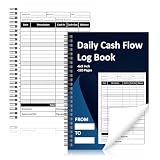
- 1.Daily Cash Flow Log Book 120 Pages Large Format:Daily Cash Flow Log Book with 120 pages in large 6 x 9 Inch format provides ample space for daily income expense tracking supporting long term financial record keeping
- 2.Financial Record Keeping Notebook for Daily Accounting:Helps track cash in cash out balances and transactions making it ideal as a petty cash ledger book for small business store office and home accounting
- 3.Structured Inner Page Accounting Fields:Daily Cash Flow Log Book pages include sheet number month year date from to starting balance date description cash in cash out balance total end date closing balance approved by and signature sections
- 4.Petty Cash Large Ledger Book Spiral Bound:Petty Cash Large Ledger Book with spiral binding allows pages to lay flat for easy writing and efficient daily bookkeeping and cash management tasks
- 5.Professional Cash Flow Ledger with Premium Paper:Daily Cash Flow Log Book uses 80 gsm double sided black and white printed pages with a laminated 300 gsm cover ensuring durability for long term financial tracking
Market context: digital payments are not the same as digital credit ledgers
India’s digital transactions grew by more than 77 percent, from INR 3.1 billion to INR 5.5 billion, in the three years to 2021, according to a 2022 Better Than Cash Alliance report that attributes the figure to government data and says growth was led in large part by UPI. This is historical national context, not a current measure of kirana credit-ledger use. The report also recounts a separate 2018/2019 survey in which retail digital payments accounted for at least 80 percent of total retail payments among more than 6,000 respondents; the survey covered six cities and no rural areas, so it should not be read as representative of rural merchants. Better Than Cash Alliance report.
Quick Recap
Product prices and availability are accurate as of the date/time indicated and are subject to change. Any price and availability information displayed on Amazon at the time of purchase will apply.

