
Free tools Windows power users keep installed
One-click scans. No signup required.
The 2002 “solved, but…” Sound Blaster 16 (SB16) troubleshooting story ended with two separate fixes: FDISK /MBR cleared a hard-disk boot error, and the right DOS driver made the CD-ROM appear. But the TEAC CD-55A still ground and could not read discs. The configuration was repaired; the drive was not. That distinction is useful when restoring any vintage DOS PC.
What happened in the original SB16 restoration?
In a thread that began on February 26, 2002, a user was moving hardware between a Pentium 75 and a Pentium 166. The setup included an ISA Sound Blaster 16 and a TEAC CD-55A 4× CD-ROM drive connected to the card’s Panasonic interface. The user believed the sound card might be a CT2230 or CT2239 based on its available interfaces, but the thread did not conclusively verify the model. The original AnandTech thread and its continuation record the troubleshooting.


There were two problems, not one. A “stage1” message prevented the hard disk from booting; later, the CD-ROM needed a suitable DOS driver and startup configuration. After the user installed the TEAC driver and edited the startup files, DOS assigned the drive a letter. Yet inserting discs caused grinding and no usable data. That points to a drive-side mechanical or optical problem, not a remaining drive-letter configuration issue.
Why an SB16’s CD-ROM connector is not necessarily IDE
“Sound Blaster 16” describes a family of cards, not one fixed hardware design. Depending on the model, a card could provide a Panasonic, Mitsumi, Sony, IDE, or SCSI-2 CD-ROM interface—or no CD-ROM interface at all. Some early interfaces were proprietary. A connector that resembles an IDE ribbon socket does not establish that it uses standard motherboard IDE signaling.
#1 Best Overall
The drive and interface must match. A drive attached to an SB16 Panasonic connector needs a driver and compatible drive for that interface; selecting the card’s Mitsumi or Sony path instead will not make the Panasonic-connected drive work. A regular IDE CD-ROM connected to a motherboard IDE controller is a different arrangement and usually uses a different driver.
Moving an ISA card and drive to another PC can also change resource assignments or reveal a loose cable, wrong jumper, power problem, or failing component. Conversely, a BIOS that does not list an ISA sound card or a proprietary-interface CD-ROM is not by itself evidence that the card is dead: DOS initialization software may be the relevant detection step.
Rank #2
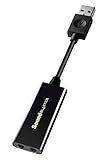
- Power source type: Corded Electric
- Easy Headphone connectivity -- Compatible with all analog headsets, from standard mobile phone earbuds to gaming and studio-grade headphones; Connect your headsets with single or split stereo/mic connector easily without the use of a Y-splitter cable
- Powerful downloadable software -- control panel software gives powerful Audio Enhancements and unprecedented control; Also includes optimized profiles for multiple earphone brands
- No drivers needed -- works straight out of the box
How DOS CD-ROM support is split between two files
DOS CD-ROM support typically has two layers. Creative’s Sound Blaster 16 user guide describes a hardware-dependent device driver and MSCDEX.EXE. The first communicates with the controller and drive; the second provides DOS CD-ROM extensions and assigns a drive letter. The hardware driver must load before MSCDEX.
Hardware-dependent driver in CONFIG.SYS
A Creative example from the guide is:
DEVICE=C:SB16DRVSBCD.SYS /D:MSCD001 /P:220The filename and options depend on the specific card, interface, and drive. Do not copy this line blindly: it illustrates the two-layer setup, not a universal SB16 command.
Rank #3

- HIGH-RESOLUTION AUDIO - Delivers ultra-clear playback with 32-bit / 384 kHz and up to 120 dB SNR
- SURROUND SOUND - Supports discrete 7.1-channel analog output for immersive multi-channel audio on your PC
- VERSATILE CONNECTIVITY - Connects effortlessly to multi-channel PC speaker systems, SPDIF output and headset outputs, mic-in, as well as line-in sources
- ALL-NEW CREATIVE NEXUS APP - AutoEq customization that allows users to simulate the frequency response of various headphones for a tailored listening experience
- COMPACT LOW-PROFILE DESIGN - The card is 10.5 cm in length and comes with a half-height bracket to ensure compatibility with smaller cases and different build needs
MSCDEX in AUTOEXEC.BAT
A corresponding example is:
C:SB16DRVMSCDEX.EXE /D:MSCD001 /V /M:15The /D: name must match the name on the device-driver line. MSCDEX uses that driver interface to expose the drive to DOS; it cannot replace the hardware-specific driver.
Generic IDE example—and its limit
For a standard IDE CD-ROM on a compatible motherboard IDE controller, a third-party driver might be configured like this:
Rank #4
CONFIG.SYS
DEVICE=C:DOSHIMEM.SYS
DEVICE=C:CDROMOAKCDROM.SYS /D:MSCD001
AUTOEXEC.BAT
SET BLASTER=A220 I5 D1 H5 P330 T6
C:DOSMSCDEX.EXE /D:MSCD001 /L:E
This is a template, not a substitute for identifying the controller. OAKCDROM.SYS may suit many ordinary IDE controllers, but it is not automatically right for a proprietary Panasonic, Mitsumi, Sony, or SCSI connection on an SB16. The SET BLASTER line configures sound resources for DOS software; it does not make a CD-ROM visible.
A reliable troubleshooting sequence
- Read the card’s CT number. Check the model printed on the board—examples include CT1730, CT1740, CT1750, CT1770, CT2230, CT2239, CT2290, and CT2919. Do not infer the exact model from the “SB16” name alone. The DOS Days overview of Creative interface variants provides historical context; the original thread’s CT2230-or-CT2239 identification remained an inference.
- Trace the actual CD-ROM connection. Establish whether the drive is connected to motherboard IDE, the SB16 Panasonic/Mitsumi/Sony interface, SB16 SCSI, or a separate controller. Identify the drive model and match it to the controller’s protocol.
- Check the physical setup. Reseat the cable, confirm its orientation, verify the drive and card jumpers, and check power. Confirm the tray, spindle, and drive activity behave normally. A drive may be detected electrically yet be mechanically unusable.
- Test with a clean DOS boot. Use a boot disk or minimal startup files so old hard-disk settings and unrelated drivers do not obscure the result. Load the correct hardware-specific driver in
CONFIG.SYS, then loadMSCDEX.EXEfromAUTOEXEC.BAT. Bethesda’s DOS boot-disk guidance also discusses startup files, MSCDEX, and sound variables. - Test in stages. Note whether the controller initializes, whether the drive is detected, and whether MSCDEX assigns a letter. Then try a known-good disc and a directory listing, such as
E:followed byDIR(substitute the assigned letter). - Stop changing drivers when the evidence points to the drive. If the drive has a letter but repeatedly grinds, seeks, or fails to read multiple known-good discs, test the drive on a known-compatible controller if possible. Grinding alone does not identify which mechanism failed, but repeated physical symptoms make another round of startup-file edits unlikely to help.
What each symptom can—and cannot—tell you
| Symptom | What to investigate | What it establishes |
|---|---|---|
| PC will not POST with the drive attached | Connection to the wrong interface, damaged or shorted cable, jumper or termination settings, power, or faulty drive electronics | There may be a hardware-level problem; a DOS driver has not yet been meaningfully tested. |
| No controller detection | Wrong interface selection, card resources, connection, or unsupported card/controller pairing | The driver may not be communicating with the intended controller. |
| “No drives detected” | Wrong driver, mismatched /D: names, wrong interface, cable or jumper errors, unsupported pairing, or failed drive electronics |
The chain has not reached successful drive detection; this message alone does not identify the failed part. |
| A drive letter appears | Try a known-good disc and list its contents | The driver stack is communicating enough for DOS to expose a drive; it does not prove the drive can read a disc. |
| Grinding or repeated seeking; no disc reads | Drive mechanics, spindle, loading system, sled, or optical reading; test discs and controller separately | Software enumeration may already be working, while the drive remains physically faulty. |
| CD data works but a game has no sound | Sound environment variables, game-specific setup, IRQ/DMA configuration, and available conventional memory | CD-ROM access and sound output are separate configuration layers. |
Why the “stage1” error was a separate issue
The thread’s “stage1” message came from the hard disk’s boot path, not from the CD-ROM. The disk had previously been used in a Linux system, so leftover boot-loader or boot-manager code was a plausible cause. The user reported that FDISK /MBR cleared the boot problem, after which CD-ROM setup continued independently. The thread continuation records that sequence.
Do these 3 things before closing this tab:
1Fix the driver behind crashes, sound loss and screen glitches2Clear out junk files and repair common Windows errors3Scan for outdated or missing drivers - takes under a minuteBest Value

- REFERENCE-GRADE HI-RES AUDIO – Powered by the ESS ES9039Q2M DAC with up to 130 dB SNR, supporting 32-bit / 384 kHz playback for exceptional clarity and detail, far beyond typical onboard audio
- POWER FOR DEMANDING HEADPHONES – Built-in high-performance headphone amplifier delivers up to 350mW @ 32Ω. Easily drives studio-grade headphones
- LOW-LATENCY PERFORMANCE – Supports DSD256 and ASIO 2.3 for high-resolution playback and low-latency audio, ideal for music, gaming, and PC audio workflows.
- PRECISION SOUND PERSONALISATION – 10-band parametric EQ + AutoEq in Creative Nexus add meaningful personalization and offers advanced audio tuning and control
- FLEXIBLE CONNECTIVITY – Coaxial output and optical input for seamless integration with desktop audio setups.
FDISK /MBR rewrites the conventional DOS-compatible master boot record; it does not repair partitions, filesystems, or hardware. It can also replace boot-manager code and disrupt a multi-boot setup. Treat it as a targeted remedy when replacing unwanted or incompatible boot-sector code is intended, not as a general first response to every boot error.
When to keep the original interface—and when not to
Using the SB16’s CD-ROM interface preserves a more period-authentic configuration, but it limits the combinations of card, interface, drive, and driver that will work. A standard IDE drive on a motherboard IDE controller is often simpler to configure; a separate controller is another option when the motherboard or sound-card interface is unsuitable. Neither approach makes every drive universally compatible, so confirm the protocol and DOS driver before changing parts.
If the priority is running DOS games reliably rather than preserving the exact hardware path, a different controller or a disk-image or emulation approach may be more practical. Creative currently lists the Sound Blaster 16 as end of service life, with support limited to existing documentation and online materials: Creative’s SB16 support page.
Quick Recap
Product prices and availability are accurate as of the date/time indicated and are subject to change. Any price and availability information displayed on Amazon at the time of purchase will apply.

