
Recommended Free Tools
Yes: a method developed by researchers at Penn State and MIT, called SIUN, classified sensor signals using a selectively sampled subset instead of the full stream. IEEE Spectrum reported accuracy above 90% in tests using as little as 10% of the original sensor data, though results varied by dataset and a full-data CNN was more accurate on the bearing-fault benchmark.
How SIUN classifies signals without using every sample
SIUN stands for “shift-invariant spectrally stable undersampled network.” Rather than feeding a classifier every available data point, it uses random, seed-based sampling to select a subset. The researchers’ premise is that sensor streams can contain redundancy: for a particular classification task, some observations may be enough to distinguish the relevant patterns.
The method maintains Nyquist-compliant sampling rates while avoiding collection of every point available at that resolution. That distinction matters: SIUN is not a claim that sensors can sample arbitrarily slowly without losing important information. The sampling strategy and the task still have to preserve the signal features needed for classification.
SIUN classifies the selected data; the reported results do not establish that it reconstructs the complete original stream. If an application needs a full-fidelity record for later diagnosis, auditing, or a different analysis, discarding observations may be unacceptable even when the classifier performs well.
#1 Best Overall

- Powerful ESP-32 Board: Unlock the world of Internet of Things (IoT) and advanced electronics with the heart of this kit: the ESP-32 board. It features a powerful dual-core processor, integrated Wi-Fi and Bluetooth 4.2, making it perfect for building connected, smart devices that communicate with your phone or the cloud. It's fully compatible with the Arduino IDE for easy programming.
- Super Starter Kit: This kit contains over 35 different modules and electronic components, including sensors, displays, motors, and input devices. From LEDs and buttons to an OLED screen, servo motor, and keypad, you have everything needed to explore a vast range of projects in one box.
- Step by Step Online Tutorial: Jump right in with our detailed, beginner-friendly tutorial. Access 30+ projects with complete code, clear circuit diagrams, and step-by-step instructions. Learn the fundamentals of electronics, coding, and how to utilize the ESP-32's unique capabilities without any prior experience.
- Hands-on Learning for All Skill Levels: Perfect for students, makers, engineers, and hobbyists. Start with basic circuits and coding, then progress to intermediate and advanced IoT applications. Build practical projects like weather stations, smart home controllers, remote-controlled devices, and interactive gadgets. The skills you learn are the foundation for real-world innovation.
- Quality & Great Support: Elegoo is committed to quality. We provide a clear, detailed tutorial guide, refined code, and a well-organized component kit. All modules are carefully selected for reliability and ease of use. Our dedicated technical support team and active online community are ready to help you succeed in your learning journey.
What the reported benchmarks show
IEEE Spectrum’s 2025 account reports results on a Case Western Reserve University ball-bearing fault dataset and other tested datasets. The figures below describe those reported tests, not a general accuracy guarantee for new sensors or operating conditions.
| Test or comparison | SIUN result | What the comparison means |
|---|---|---|
| Case Western Reserve University ball-bearing fault dataset | 96% accuracy using 30% of the raw data | The reported SIUN result on this dataset; it used a larger share of the raw data than the smallest sampling fraction reported elsewhere. |
| Other tested datasets | Generally 80–90% accuracy with less than 20% of the raw data sampled | Results varied across datasets; “generally” does not mean every test reached the same accuracy. |
| Conventional CNN on the bearing dataset | 99.77% accuracy, compared with SIUN’s 96% | The CNN was more accurate in this comparison, but had more than 3 million parameters; SIUN had fewer than 42,000. |
| Reported compute comparison | Best result: 435.01× fewer FLOPS for SIUN; approximately 8×–27× reductions on other datasets | The 435.01× figure was the largest reported reduction versus a CNN, not a reduction established for every dataset or deployment. |
IEEE Spectrum also reports a result above 90% accuracy using as little as 10% of the original sensor data. That headline result should not be merged with the bearing-dataset result: the latter paired 96% accuracy with 30% of raw data. Accuracy and the fraction sampled depend on the dataset and test setup.
Rank #2

- Perfect choice for beginners to learn, electronics and program.
- The Basic Starter Kit is easy to use and you can learn to program at an introductory level.
- You can use ESP32 modules to control other modules, such as LED,DHT11,OLED module, etc
- The tutorial include codes and lessons.It will teach every users how to assembly Basic Starter Kit for ESP32.
- Please download our tutorial and learn after you receive the goods.
Does sampling less actually cut compute and data costs?
Potentially, but the answer depends on what an application counts as “cost.” Using fewer observations can reduce the volume of data that must be passed to a classifier, and the reported FLOPS comparisons indicate substantially less computation for SIUN than for a conventional CNN in the tested cases. Fewer model parameters may also make deployment on constrained hardware more practical.
Those measures are not interchangeable. FLOPS estimate computational operations; they do not by themselves establish a particular reduction in electricity use, latency, network charges, or total system cost. A deployment comparison should measure the complete pipeline, including how samples are selected, sensor and processor power, data storage or transmission, and the accuracy required for the task.
Quick wins for a faster PC:
Scan for outdated or missing drivers - takes under a minuteDriver Scan →Repair Windows errors before they cause bigger problemsFix Now →Fix the driver behind crashes, sound loss and screen glitchesFind Drivers →Rank #3
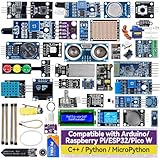
- Wide Compatibility**: Supports Arduino series (R4 WiFi/Minima/R3/Mega 2560), and Raspberry Pi 5/4/3B+/3B/Zero, Raspberry Pi Pico W, ESP32, accommodating a broad range of development platforms. Contains 169 projects
- Diverse Components**: Over 25 sensors, actuators, and display modules for a variety of projects. It's perfect for environmental monitoring, smart home projects, robotics, and game controllers
- Step-by-Step Tutorials**: Comes with comprehensive guides for Arduino, Raspberry Pi, Pico w, ESP32 for each component, including courses in C/C++ and Python/MicroPython programming languages, ideal for both beginners and advanced users to start quickly
- Projects for All Levels**: Offers projects that help users grow from novices to experts in electronics and programming, fostering innovation and creativity
- Dedicated Support: Benefit from our ongoing assistance, including a community forum and timely technical help for a seamless learning experience
- Data retained: state how many observations the system keeps, and whether those discarded observations must be available later.
- Classification quality: test on the actual sensors, fault types, and operating conditions, and decide what error rate is acceptable.
- Compute and model size: compare FLOPS and parameter counts on the target workload, not as substitutes for an end-to-end measurement.
- Deployment constraints: account for power, bandwidth, storage, hardware availability, and the consequences of a missed or incorrect classification.
Can SIUN run on a Raspberry Pi Pico?
The researchers demonstrated the software on a Raspberry Pi Pico. IEEE Spectrum describes the board as costing US$4 and having 264 KB of RAM, a dual-core 133 MHz processor, and operation in the few-milliwatt range in the demonstration. These details support the feasibility of running this particular demonstration on a small edge device; they do not establish that every SIUN model, sensor pipeline, or production workload will fit the same board or draw the same power.
Running classification near the sensor can be useful where sending every measurement to a cloud service is difficult—for example, at a rural manufacturing site with limited connectivity. The researchers also used spacecraft and hypothetical Mars factories as illustrative settings where local compute could matter. Those examples are scenarios, not evidence that SIUN has been deployed in a Mars factory.
Rank #4

- Build a 37-Module Sensor Lab: Add motion, distance, light, sound, temperature, touch, display and control functions to compatible UNO, MEGA, Nano, ESP-32 or STM32 projects for prototyping, classroom experiments and maker builds
- Explore Input Sensors and Motion: Experiment with GY-521 motion sensing, PIR detection, ultrasonic ranging, temperature and humidity, DS18B20, flame, Hall, touch, light, sound, tilt, tracking and obstacle-avoidance modules
- Add Displays, Timing and Control: Use the LCD1602, DS1307 real-time clock, joystick, rotary encoder, relay, buzzers, RGB LEDs and infrared modules to build clocks, alarms, counters, status displays and automated projects
- Follow Guided Projects Materials: Use digital tutorial materials, datasheets, wiring diagrams and example code for compatible UNO R3, MEGA 2560 and Nano boards, then adjust thresholds, timing and logic to create custom experiments
- Module-Only Expansion Kit: Controller board, USB cable, breadboard and jumper wires are not included; use 6.5–9 V DC only with the included power module, verify pin requirements before wiring and keep the laser emitter away from eyes
What is still uncertain before choosing it
The underlying paper is in Scientific Reports; IEEE Spectrum identified it in its 2025 feature. The reported figures here come from that feature, while full paper-level training details and confidence intervals are not established in the available account. A team considering SIUN should therefore validate it against its own baseline rather than assume the published benchmark figures will transfer unchanged.
For safety-critical or maintenance decisions, validation should include how performance changes across operating conditions and how much data can be discarded without losing information needed for future analysis. SIUN’s benchmark trade-off is clear on the bearing dataset: lower reported accuracy than the CNN, alongside a much smaller model and fewer reported operations. Whether that is a better outcome depends on the application’s tolerance for errors and its resource constraints.
Do these 3 things before closing this tab:
1Clear out junk files and repair common Windows errors2Scan for outdated or missing drivers - takes under a minute3Repair Windows errors before they cause bigger problemsQuick Recap
Best Value

- 🚀 Beginner-Friendly ESP32 Starter Kit:Designed for beginners to explore electronics, programming, and IoT concepts, this ESP32 starter kit combines an ESP32 development board with essential electronic modules, providing a practical way to learn through hands-on experiments and simple DIY projects.
- 🧠 Powerful ESP32 WiFi Development Board:Built around the ESP32 ESP-32S microcontroller with integrated WiFi, the development board supports wireless communication, digital control, and sensor-based projects. It helps beginners gain practical experience with microcontrollers and basic IoT applications.
- 🔧 Hands-On Learning with Multiple Modules:The included electronic components and modules allow users to experiment with sensors, outputs, and basic circuit functions. By building and testing different projects, beginners can gradually understand how hardware components work together with microcontroller programming.
- 💻 Arduino IDE Programming Support:Compatible with the Arduino IDE, the ESP32 starter kit provides a familiar programming environment for beginners, students, hobbyists, and makers. Users can write, upload, and test their own programs while developing practical coding and embedded programming skills.
- 🎓 Ideal for Education & DIY Projects:Suitable for STEM education, classroom activities, electronics practice, and home DIY projects, this ESP32 learning kit encourages hands-on exploration. It helps beginners develop foundational skills in programming, circuit building, sensor applications, and IoT concepts.
Product prices and availability are accurate as of the date/time indicated and are subject to change. Any price and availability information displayed on Amazon at the time of purchase will apply.

