
Quick wins for a faster PC:
Scan for outdated or missing drivers - takes under a minuteDriver Scan →Clear out junk files and repair common Windows errorsFree Scan →iTechGuides is reader-supported. When you buy through links on our site, we may earn an affiliate commission. As an Amazon Associate I earn from qualifying purchases. Learn more
Near-field magnetic induction is the transfer of energy or information through changing magnetic flux between nearby circuits, usually coils. Alternating current in a transmitting coil creates a changing magnetic field; when some of that field passes through a nearby receiving coil, it induces a voltage there.
How does magnetic induction work between coils?
- The transmitter creates a changing field. Alternating current through a coil produces a magnetic field that changes over time.
- Some magnetic flux reaches the receiver. The transmitter and receiver’s shapes, spacing, orientation, and circuit design affect how much field links the coils.
- The changing flux induces voltage. A changing magnetic field through the receiver coil produces an electromotive force, or voltage, in that circuit.
- The receiver uses the signal. Its circuit can use the induced electrical energy to power a load, or detect changes in the field to receive information.
Engineers describe the strength of the coil-to-coil link using mutual inductance and a coupling coefficient. Resonant inductive systems tune the transmitter and receiver circuits to a common resonant frequency, which can support the transfer. The details depend on the system design; induction alone does not specify a particular range or performance level. A review of inductive coupling for wireless power transfer and near-field communication discusses these uses.
What does “near field” mean here?
“Near field” describes a technical relationship between a source and the surrounding electromagnetic field, not one universal distance cutoff. The applicable convention depends on the frequency, antenna or coil, and purpose of the analysis. For example, the IEC wireless-power glossary includes an application-specific “short-range near-field” definition based on coil spacing relative to coil radii; it should not be treated as a boundary for every near-field system. IEC 63006:2019 provides that glossary context.
In magnetic induction, the useful link is primarily local coupling through magnetic flux between circuits. Far-field transmission instead carries energy as radiated electromagnetic waves. The distinction is about the dominant coupling mechanism, not a simple claim that one system radiates nothing or that all systems switch modes at the same distance. An IEEE article on near-field communications discusses the distinction between near- and far-field approaches.
#1 Best Overall

- It not only supports Mifare cards and Class A and B cards conforming to the ISO 14443 standard, but also supports NFC and FeliCa contactless technology.
- This is a USB hot-pluggable device that complies with the CCID standard and is ideal for applications such as personal identity security authentication and online micropayments.
- This is a USB full-speed device (12 Mbps), which reads NFC tags at 106 kbps、212 Kbps and 242 Kbps, allowing faster read and write speeds and higher efficiency
- To increase the safety factor, you can choose to configure an ISO7816-3 compliant SAM card slot in the ACR122.
- Widely used in areas such as access control, electronic payment, bus e-ticketing, highway toll collection systems, network verification, logistics, and supply chain management.
How is magnetic induction different from capacitive coupling?
Both are near-field coupling methods, but they use different parts of the electromagnetic field and different structures.
| Method | Field doing the coupling | Typical interface | Common use |
|---|---|---|---|
| Magnetic induction | Changing magnetic field | Coils | Inductive wireless power transfer and magnetic-induction communication |
| Capacitive coupling | Electric field | Electrodes or plates | Capacitive wireless power transfer |
| Far-field transmission | Radiated electromagnetic waves | Antennas | Wireless transmission over distances suited to the system |
These are broad distinctions, not complete descriptions of every design. The National Academies describes inductive systems as coil-to-coil magnetic coupling and capacitive systems as plate-to-plate electric coupling in its overview of wireless power transfer. National Academies, Frontiers of Engineering (2017).
Rank #2

- acr122u nfc reader writer
- 13.56 Mhh support mifare 1k, ntag213, ultralight /ultralightc, Mifare plus, Mifare desfire
- provide SDK and free nfc tool software
- 5 pcs ntag213 nfc tag samples and 2 pcs UID MF1 card
- IEC14443A and ISO18092 protocol compliance
Where is near-field magnetic induction used?
Wireless charging
Inductive wireless power transfer uses magnetic coupling between transmitting and receiving coils. Handheld-device charging and stationary electric-vehicle charging are documented examples. A charging pad is one familiar illustration: its coil creates a changing field that can induce voltage in a compatible device’s receiving coil. Not every system described as wireless charging necessarily uses the same design.
Do these 3 things before closing this tab:
1Scan for outdated or missing drivers - takes under a minute2Clear out junk files and repair common Windows errors3Fix the driver behind crashes, sound loss and screen glitchesShort-range communication
Near-field magnetic-induction communication uses coupled coils to carry information. A transmitter can modulate the magnetic signal, and a receiving circuit can detect those changes. Resonant coils may be used, but protocols and system designs vary. Magnetic induction is therefore a mechanism, not a synonym for any one wireless standard.
Rank #3

- 【2-in-1 CAC & NFC Smart Card Reader】2-in-1 contact and contactless card reader equipped with integrated USB-A & USB-C dual-head cable. Supports CAC, PIV, military ID, chip credit/debit cards and NFC ID badges. Only one reading mode can be activated at a time to guarantee stable data reading. No extra adapter required for different device ports.
- 【Full Certification & Broad Card Support】 Certified FCC, CE, VCCI, CCID and Microsoft WHQL. Contact interface follows ISO7816 Class A/B/C with T0/T1 protocol; NFC module supports ISO14443 A/B and MIFARE. Compatible with SLE, AT88SC memory smart cards, meeting PC/SC 2.0 and EMV standards for high-security military and government authentication.
- 【Plug & Play Multi-OS Reader】No driver needed for immediate use. Works on Windows, mac OS, Linux and Android devices. Standard CCID hardware compatible with common card management tools. Please be aware that third-party decoding software and official card middleware are not included in the package.
- 【Durable & Travel-Friendly Construction】Comes with 95cm reinforced strain-relief cable, LED light and buzzer prompt. Compact lightweight body supports USB 2.0 480Mbps high-speed transmission. Perfect for daily office, business trips and field identity verification for military and government users.
- 【Application & Reliable After-Sales Service】Great for tax declaration, pension inquiry, vehicle registration and access control. ❗Not compatible with health insurance cards. Package: 1×Smart Card Reader, 1×User Manual. 24-month warranty and lifetime technical support; free return for quality defects.
Other research applications
Near-field electromagnetic induction has also been studied in applications including tomography, communication, and wireless power transfer. A peer-reviewed article on near-field electromagnetic induction discusses examples of this research.
Is near-field magnetic induction the same as NFC?
No. Magnetic induction is a physical coupling mechanism; NFC is a communication technology with its own protocol and system design. Technologies can share inductive coupling without being interchangeable. Similarly, wireless charging and short-range data communication can both use magnetic coupling while serving different purposes and operating according to different designs.
Rank #4

- The card and keychain sent are CUID cards,with serial port which can be directly plugged into USB and then drive CH340E
- New PN5321 IC
Does the term say whether a device is safe?
No. The coupling mechanism by itself does not establish whether a particular product or exposure is safe. Exposure assessment requires measurements and methods suited to the system and conditions. OSHA notes that the relationship between electric and magnetic fields in the near field can be complex, and both may need to be measured when characterizing exposure. OSHA’s electromagnetic-field memo describes this measurement consideration.
IEC/IEEE 63184:2025 specifies assessment methods for fields from stationary wireless power transfer systems over 3 kHz to 30 MHz, with a focus on inductive systems. Its scope describes an assessment method; it does not, on its own, establish the safety of a specific device or exposure.
Quick Recap
Best Value
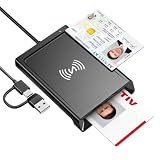
- 2-in-1 NFC & CAC Reader: This credit card reader Combines contact CAC card slot and contactless NFC sensing area in one compact unit; reads inserted military CAC/PIV government smart cards and tap-to-scan NFC IDs, access badges, debit & credit chip cards; only operate one card mode at a time for stable data reading.
- Full Standard Protocol Compliance: This nfc reader writer Passes FCC CE VCCI CCID Microsoft WHQL certification; contact slot supports ISO7816 Class A/B (5V/3.3V), T=0/T=1 transmission; NFC area works with ISO14443 A/B, MIFARE series and T=CL protocol cards, built for high-security identity authentication scenarios.
- Plug-And-Play: No extra driver installation required for most mainstream operating systems; This smart card reader fully functional on Windows XP and newer, macOS 11.1+, Linux Fedora FC8+, Android USB-A devices; recognized as standard CCID hardware by OpenSC, NFCtools and common card management tools.
- Wide Applications: This cac reader military is ideal for military staff, government contractors, IT security specialists and daily users; fits tax filing, pension inquiry, vehicle registration, criminal record verification, office access control and secure digital login; note: matching third-party card decoding software is not included, incompatible with medical health insurance cards.
- Portable Durable Build: This cac reader for iphone is Equipped with reinforced integrated USB-A/C cable and rugged anti-slip plastic housing; built-in LED light and buzzer give clear audio-visual prompt once card signal is captured; lightweight compact body easy to carry for office, field work and travel use, USB 2.0 480Mbps fast data transfer.
Product prices and availability are accurate as of the date/time indicated and are subject to change. Any price and availability information displayed on Amazon at the time of purchase will apply.

