
iTechGuides is reader-supported. When you buy through links on our site, we may earn an affiliate commission. As an Amazon Associate I earn from qualifying purchases. Learn more
To connect n8n with Ollama and MCP, first decide which direction tool access should flow: an n8n workflow or AI Agent can use tools from an external MCP server, or an external MCP client can use workflows exposed by n8n. Then configure Ollama with an address reachable from the n8n process and match the MCP endpoint, transport, and authentication to the feature you chose. Those distinctions matter more than changing settings at random.
Choose the n8n MCP feature that matches the direction of access
“MCP tool” can mean several different n8n features. Choose by who serves the tools and where n8n should use them:
| Feature | Direction | Where the tools are used |
|---|---|---|
| MCP Client node | External MCP server → n8n | As a step in an n8n workflow. The node fetches available tools; the workflow supplies their inputs manually or as JSON. Documented authentication options include bearer, generic header, multiple headers, and OAuth2. n8n MCP Client documentation. |
| MCP Client Tool node | External MCP server → n8n | As a tool available to an n8n AI Agent. Choose this when the agent itself should decide when to call an external MCP tool. n8n MCP Client Tool documentation. |
| MCP Server Trigger | n8n → external MCP client | Exposes connected n8n tool nodes or workflows to an MCP client. It supports SSE and streamable HTTP, not stdio. n8n MCP Server Trigger documentation. |
| Instance-level MCP | External MCP client → selected n8n workflows | Provides centralized access to workflows made available through the n8n instance, rather than configuring one MCP Server Trigger in a workflow. n8n instance-level MCP documentation. |
These options are not interchangeable. For example, an MCP Client Tool connects an agent to tools served elsewhere; an MCP Server Trigger exposes n8n tools outward. Establish this direction before investigating URLs or credentials.
PC Slower Than It Used to Be?
A free scan shows the junk files, broken settings and background clutter dragging Windows down - then fixes them in one click.Free scan · Windows 10 & 11Crashes, No Sound, or Screen Glitches?
Random freezes, missing sound and display glitches usually trace back to one bad driver. Find and replace yours safely.Free scan · under a minutePoint n8n at an Ollama address it can reach
The n8n Ollama credential documentation lists http://localhost:11434 as the default base URL. Use the configured OLLAMA_HOST value instead if Ollama listens elsewhere. The credential guidance also suggests trying 127.0.0.1 when a local n8n server has connection trouble. n8n Ollama credential documentation.
#1 Best Overall

- 【Low Power for Always-On AI Workflows】At just 15W TDP, the GEEKOM A7 uses far less power than a traditional 350W desktop, helping reduce electricity costs, heat, and cooling noise during extended operation. That efficiency makes it ideal for keeping cloud AI assistants and AI Agent tasks running in the background—automating document summaries, email polishing, meeting notes, content rewriting, research, and scheduled workflows throughout the day. The energy savings can help recoup the device cost in about 1 year, making A7 a practical choice for 24/7 AI task hosting and efficient everyday computing.
- 【Ryzen 7 7730U – More Than a Low-Power PC】Think low power means less performance? Not here. The Ryzen 7 7730U mini computer packs 8 cores, 16 threads, and up to 4.5GHz, giving you the power to handle multitasking, dozens of tabs, video calls, and creative work smoothly. AMD Radeon Graphics supports 4K playback, multi-display work, photo editing, and casual gaming without a dedicated GPU. Compared with the Ryzen 7 5825U and Ryzen 5 7430U, it delivers up to 20% higher performance for faster response and smoother everyday computing—all in a compact, energy-efficient Mini desktop.
- 【Lock In More Memory Before It Costs More】32GB gives you the headroom most demanding tasks need today—and room to grow tomorrow. Built for heavy multitasking, content creation, large projects, and AI-assisted workloads, the GEEKOM mini pc starts you with twice the memory of a typical 16GB setup, so you can skip an immediate upgrade. With AI driving greater demand for memory, starting with 32GB is a smarter way to stay ready for what’s next. The 500GB PCIe Gen4 x4 SSD delivers fast storage, with support for up to 64GB RAM and 4TB SSD storage when you need more.
- 【Premium Metal Design & 3-Year Warranty】Why settle for plastic? The GEEKOM mini desktop features a premium aluminum alloy chassis that resists daily wear and helps dissipate heat during extended use. Rigorous quality testing and CE, FCC, and RoHS compliance support dependable performance, backed by a 3-year limited warranty and professional support for long-term peace of mind.
- 【One Mini PC, All Your Ports】Stay connected with dual USB-C ports, 5 USB 3.2 ports, dual HDMI 2.0, and a 2.5G LAN port for fast, flexible connectivity. The USB-C ports support high-speed data transfer, display output, and peripheral power, while Wi-Fi 6E keeps streaming, file transfers, and online work fast and reliable. From multiple peripherals to high-resolution displays, everything you need stays within easy reach.
The important test is reachability from the n8n process—not whether Ollama is reachable from your browser or host shell. If n8n and Ollama run in separate containers, localhost inside the n8n container points back to that container, not automatically to Ollama. The cited n8n credential guidance says the Ollama port may need to be exposed with OLLAMA_ORIGINS, or OLLAMA_HOST set to an address accessible to the other container. Verify the right address for your deployment before changing unrelated workflow settings.
Set the MCP endpoint, transport, and authorization
When an MCP Server Trigger exposes n8n
Use the test URL shown in the MCP Server Trigger while testing, and the production URL for the active workflow endpoint. The node supports SSE and streamable HTTP; it does not support stdio. A client configured for an unsupported transport will not connect simply because the URL is correct. n8n MCP Server Trigger documentation.
Rank #2

- EVOLUTION RYZEN AI MAX+ 395 MINI PC - GMKtec EVO-X2 is the next evolution in AI mini PC Ryzen Strix Halo series. Thanks to AMD Simultaneous Multithreading (SMT) the core-count is effectively doubled, to 32 threads. Ryzen AI Max+ 395 has 64 MB of L3 cache and can boost up to 5.1 GHz, depending on the workload. The Ryzen AI Max+ 395 is currently rated as the "most powerful x86 APU" on the market for AI computing.
- AI NPU with XDNA 2 ARCHITECTURE - Powered by 16 “Zen 5” CPU cores, 50+ peak AI TOPS XDNA 2 NPU and a truly massive integrated GPU driven by 40 AMD RDNA 3.5 CUs, the Ryzen AI MAX+ 395 is a transformative upgrade and delivers a significant performance boost over the competition. The Ryzen AI Max+ 395 excels in consumer AI workloads like the llama.cpp-powered application: LM Studio. Shaping up to be the must-have app for client LLM workloads, LM Studio allows users to locally run the latest language model without any technical knowledge required and unleash their creativity and productivity.
- AMD RADEON 8090S iGPU GAMING PC - The AMD Radeon RX 8060S offers all 40 CUs with up to 2.9 GHz graphics clock and uses the new RDNA 3.5 architecture. The powerful iGPU is positioned between an RTX 4060 and 4070 laptop GPU and therefore enables gaming in FHD at maximum details in most demanding games. The 8060S can also utilize the full 128GB pool, which is perfect for running LLMs such as Deepseek 70B Q8, which runs comfortably on this machine.
- EIGHT CHANNEL LPDDR5X - LPDDR5X is a new ground breaking memory small form factor installed on-board. With blazing speeds up to to 8000MT/s, it runs 1.5x faster than the DDR5 SODIMMs; 90% better performance over DDR5 SODIMMs in video conferencing and photo editing; 30% better performance in productivity apps; 12% better performance in digital content workloads.
- QUAD SCREEN 8K DISPLAY SUPPORT - EVO-X2 AI Mini PC support 4-screen 4K/8K output via HDMI 2.1 (8K@60Hz), DisplayPort 1.4 (4K@60Hz), and dual USB 4 40Gbps Transfer speed (supporting PD3.0/DP1.4/DATA). Ideal for gaming, video editing, and multitasking, it provides expansive and crisp multi-display support.
When an external client connects to instance-level MCP
In n8n, go to Settings > Instance-level MCP > Connect a client and copy the server URL from the connection dialog. Client-specific configuration differs; the n8n connection examples note that plain HTTP may be appropriate for a local HTTP installation. n8n instance-level MCP documentation.
Recommended Free Tools
For instance-level access, check each of these items:
Rank #3

- LOW ENERGY HIGH PERFORMANCE MINI PC - The Intel Core Ultra 5 125U is part of the Ultra 5 lineup, using the Meteor Lake architecture with BGA 2049. Intel Hyper-Threading technology is available and effectly doubles the core-count of the P-Cores, to a total of 14 threads. Core Ultra 5 125U has 12 MB of L3 cache and operates at 1300 MHz by default, but can boost up to 4.3 GHz, depending on the workload. With a TDP of 15 W, the Core Ultra 5 125U consumes very little energy but outputs high performance efficiency
- 32GB DDR5 RAM + 512GB SSD - The K15 mini computer is equipped with Dual 16GB (Total 32GB) SO-DIMM DDR5 4800MHz memory sticks. 512GB PCIE 4.0 SSD Drive with 3x M.2 2280 Expansion slots. Each slot capable of reading up to 8TB. (24TB MAX)
- QUAD SCREEN 4K DISPLAY SUPPORT - K15 Mini PC support 4-screen 4K/8K output via HDMI 2.1 (8K@60Hz), DisplayPort 1.4 (4K@60Hz), and USB Type-C Transfer speed (supporting PD3.0/DP1.4/DATA). Ideal for gaming, video editing, and multitasking, it provides expansive and crisp multi-display support
- OCULINK PORT - The Oculink port on the rear interface enables higher bandwidth capabilities, better frame rates and lower lag. The standard also operates at PCIe x4 speeds, compared to Thunderbolt's x3. Gamers and content creators can benefit from Oculink's higher bandwidth, resulting in better performance and lower lag for eGPU setups
- DUAL NIC FAST 2.5GBE + WIFI 6E + BT 5.2 - Dual Ethernet 2.5GbE LAN port design provides more applications, such as firewall, multichannel aggregation, soft routing, file storage server. Built-in WIFI 6E / Bluetooth 5.2 is more stable and efficient to connect multiple wireless devices such as projector, printer, monitor, speakers and etc
- MCP is enabled on the n8n instance.
- The target workflow is marked Available in MCP.
- The client’s OAuth or API-key configuration matches the instance’s authentication settings.
- The n8n instance is reachable by the client; a cloud-hosted client may require public accessibility.
- Any proxy, load balancer, or web application firewall preserves the MCP routing headers required by n8n.
n8n’s documentation identifies per-client connection examples from version 2.33.0 and MCP routing headers in its CORS policy from version 2.36.0. Check the live documentation and your installed version before relying on those version-specific details. n8n instance-level MCP documentation.
Independent reader supportYour contribution helps us test, update, and keep practical guides available for everyone.Account for streaming proxies and queue-mode routing
MCP connections that stream events can fail even when the node and URL are configured correctly. If an MCP Server Trigger is behind nginx, n8n says to disable proxy buffering for the MCP endpoint. Its documentation also calls out gzip compression, chunked transfer encoding, and the forwarded Connection header as proxy considerations. n8n MCP Server Trigger documentation.
Rank #4
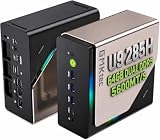
- EVOLUTION CORE ULTRA 9 285H MINI PC - GMKtec EVO-T1 is the next evolution in AI mini PC Ultra 9 series. The Core Ultra 9 285H offers 16 cores (six P-cores + eight E-cores + two LPE-cores) and 16 threads with a turbo clock of 5.4 GHz. It is currently one of the best value for performance AI mini PC computers.
- AI NPU - The 285H features an Intel AI Boost NPU, capable of up to 13 TOPS (Tera Operations per Second) for INT8 calculations, which is designed to accelerate AI tasks.
- INTEL ARC 140T GAMING PC - The Arc 140T GPU includes 8 Xe cores and supports features like DirectX 12, OpenGL 4.5, and OpenCL 3, making it capable of handling modern games and creative applications. It also supports Quick Sync Video for efficient video encoding and decoding, as well as AV1 encoding and decoding.
- 64GB DDR5 RAM + 1TB SSD - The EVO-T1 is equipped with Dual 32GB (Total 64GB) SO-DIMM DDR5 5600MHz memory sticks. 2TB PCIE 4.0 SSD Drive with 3x M.2 2280 Expansion slots. Each slot capable of reading up to 4TB. (12TB MAX)
- QUAD SCREEN 8K DISPLAY SUPPORT - EVO-T1 AI Mini PC support 4-screen 4K/8K output via HDMI 2.1 (8K@60Hz), DisplayPort 1.4 (4K@60Hz), and USB Type-C Transfer speed (supporting PD3.0/DP1.4/DATA). Ideal for gaming, video editing, and multitasking, it provides expansive and crisp multi-display support.
In queue mode, n8n documents expected behavior with a single webhook replica. If you use multiple webhook replicas, direct all /mcp* traffic to one dedicated webhook replica. Persistent SSE or streamable HTTP connections can break or deliver events unreliably when requests are routed among replicas. n8n MCP Server Trigger documentation.
What’s actually slowing this PC down?
Pick the symptom - the matching free tool is one click away.
Troubleshoot one connection layer at a time
Record the relevant configuration before changing it. Then isolate failures in an order that distinguishes a wrong MCP direction from a network, authorization, or streaming problem:
- Write down the setup. Note the exact n8n node or instance-level feature, MCP server implementation, product versions, authentication method, and whether each service runs locally, in containers, or behind a proxy.
- Confirm who serves the tools. Use an MCP Client or MCP Client Tool when n8n consumes an external server’s tools. Use MCP Server Trigger or instance-level MCP when an external client consumes n8n tools or workflows.
- Check the endpoint and transport together. Confirm you copied the URL for the selected feature and that the client supports the transport it uses. For MCP Server Trigger, use its test URL during testing and its production URL for the active endpoint; do not configure stdio.
- Verify Ollama from n8n’s environment. Set the credential base URL to the address reachable from the n8n process or container, not an address that is only reachable from another machine or container.
- Check access and exposure. For instance-level MCP, confirm MCP is enabled, the workflow is Available in MCP, and the client’s OAuth or API-key settings are correct. For an MCP Client node, check the authentication option configured for the external server.
- Inspect the network path. Review proxy streaming behavior and, in queue mode with multiple webhook replicas, route MCP traffic to one dedicated replica. For instance-level MCP, check that intermediate proxies preserve required routing headers.
- Use logs and a minimal tool call. Inspect n8n logs and try one small call to identify whether the failure occurs at connection, authorization, tool discovery, or execution.
This sequence is a practical way to narrow down the failing layer; it is not a claim that every setup encounters every issue. The exact error, server implementation, versions, and deployment topology determine which branch matters.
Quick Recap
Product prices and availability are accurate as of the date/time indicated and are subject to change. Any price and availability information displayed on Amazon at the time of purchase will apply.

