
iTechGuides is reader-supported. When you buy through links on our site, we may earn an affiliate commission. As an Amazon Associate I earn from qualifying purchases. Learn more
A multimeter is an electrical test instrument that combines measurements such as AC/DC voltage, current, resistance, continuity, and diode behavior in one device. The three rules that prevent most mistakes are simple: measure voltage in parallel, measure current in series, and test resistance, continuity, and diodes only on de-energized circuits.
Multimeters range from compact hobby meters to high-resolution bench instruments and rugged CAT-rated tools for electricians and industrial technicians. The right choice depends less on brand or display size than on the circuit’s voltage, fault energy, measurement category, required accuracy, and whether a different instrument—such as a clamp meter or oscilloscope—would be safer or more informative.
Key takeaways
- Voltage is measured in parallel, current is measured in series, and resistance, continuity, diode, and capacitance tests normally require a de-energized circuit.
- A current jack can create a near-short circuit if the probes are placed across a voltage source, so the red lead must be returned to the voltage jack after current measurements.
- CAT ratings describe the electrical environment and transient energy a meter is designed to withstand; a voltage number alone does not establish safety.
- True RMS improves AC measurement accuracy on many distorted waveforms, but bandwidth, frequency range, crest factor, and the meter’s accuracy specification still matter.
- A continuity beep indicates resistance below the meter’s threshold; it does not prove that a wire, connector, or fuse can carry its intended load.
- A basic multimeter cannot replace an oscilloscope, clamp meter, insulation tester, LCR meter, or power-quality analyzer when the measurement requires one of those instruments.
What is a multimeter?
A multimeter, also called a volt-ohm-milliammeter or VOM, is a test instrument that combines several electrical measuring functions. Common digital multimeters measure voltage, current, resistance, continuity, and diode behavior; advanced models may also measure frequency, capacitance, temperature, and duty cycle. Keysight’s digital-multimeter overview describes DMMs as instruments for measuring voltage, current, resistance, temperature, capacitance, and other parameters.
A multimeter measures a defined electrical quantity between its probes or through its current input. A multimeter does not automatically identify the cause of a fault, show a circuit’s waveform, assess insulation quality, or prove that a battery can deliver its rated current. Good troubleshooting comes from choosing the correct function, connecting the meter correctly, and interpreting the result in the context of the circuit.
Popular on Amazon
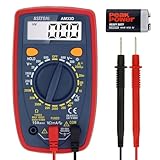
- Additional Tips - The following incorrect operations may cause the multimeter not to show results: Firstly, the plugs of test leads are not fully inserted or not inserted into the correct sockets. Secondly, the manual rotary switch is not placed in the correct position. In addition, this meter can not test all AC Current and below 100mV AC Voltage. Please check the user manual carefully before measurement.
- Versatile Digital Multimeter - Accurately measures AC/DC Voltage, DC Current, Resistance, and Diode. This Multimeter is a really useful tool for solving industrial and household electrical issues. Suitable for Household Outlets, Fuses, Batteries (including Vehicles), Automotive Circuit Troubleshooting, Charging Systems, Testing electronics in Cars etc.
- Troubleshooting with Accuracy - This Multimeter has a sampling speed of 2 times per second; Built-in a backlight LCD display with 3 ½ digits (1999 count) 0.6”, and high polarity including negative and positive readings.
- Ensures Safety - Double fuse is anti-burn and protects from overloading. The silicone cover can protect the multimeter from failing damage and prevent electric shocks. And low battery indication will be displayed when battery power is low.
- Ease of Use - Support Data Hold and Continuity Buzzer. Includes Convenient feature like LCD Backlit Screen makes it easy to use in dimly light areas. Batteries/Set of Test Leads/User Manual are Included.
Digital versus analog multimeters
A digital multimeter displays a numerical value and commonly offers high input impedance, auto-ranging, overload protection, and functions such as capacitance, frequency, temperature, logging, or diode testing. A digital display is convenient for precise readings, but rapidly changing digits can make fluctuations difficult to interpret.
An analog multimeter moves a needle across a scale. Needle movement can make trends, ripple, and fluctuations easier to see, and some technicians prefer the immediate visual response. Analog meters are generally less convenient for precise readings and may load a circuit more heavily, so neither display type is universally best for every diagnostic task. An oscilloscope is usually more informative than either type when waveform shape, ringing, noise, or transients matter.
Handheld versus bench multimeters
A handheld multimeter is portable and designed for field troubleshooting. A bench DMM is typically used on a workbench, in a laboratory, in production, or in automated test equipment, where resolution, accuracy, reading speed, interfaces, and repeatability matter more than portability. Keysight’s DMM range presents bench instruments for engineering, validation, manufacturing, and automated test applications.
What’s actually slowing this PC down?
Pick the symptom - the matching free tool is one click away.
| Meter type | Best suited to | Main strengths | Important limitation |
|---|---|---|---|
| Basic handheld DMM | Hobby work, batteries, low-voltage circuits, simple household checks | Portable, affordable, voltage/resistance/continuity functions | May lack advanced protection, logging, low-pass filtering, or high accuracy |
| Professional handheld DMM | Electrical, HVAC, automotive, and maintenance troubleshooting | Better protection, ruggedness, True RMS, range of field features | Still cannot replace specialized instruments |
| Industrial handheld DMM | Motors, drives, plant equipment, and distribution systems | Transient protection, filtering, peak capture, durability | More expensive and often excessive for hobby electronics |
| Bench DMM | Laboratory, engineering, production, and automated test | Resolution, accuracy, speed, interfaces, stable measurements | Not designed as a general field or mains-work tool |
| Specialty meter | Automotive, intrinsically safe, HVAC, or other defined applications | Functions and approvals matched to a specific environment | Less versatile outside its intended use |
What can a multimeter measure?
A multimeter’s exact functions vary by model, but the following functions are common.
| Function or symbol | What it measures or indicates | Typical uses |
|---|---|---|
| V⎓ or V— | DC voltage, or potential difference with fixed polarity | Batteries, power supplies, electronic circuits |
| V~ | AC voltage | Mains and alternating-current circuits |
| A⎓ | DC current | Battery-powered and electronic circuits |
| A~ | AC current | Alternating-current loads |
| Ω | Resistance | Resistors, wires, switches, heating elements |
| Continuity symbol | Whether resistance is below a model-specific threshold | Wires, fuses, connectors, switches, circuit traces |
| Diode symbol | Approximate forward voltage and polarity behavior | Diodes and some semiconductor junctions |
| Hz | Frequency | Oscillators, power signals, automotive and HVAC diagnostics |
| F | Capacitance | Capacitors and basic component checks |
| °C/°F | Temperature with a compatible probe | Thermal and HVAC troubleshooting |
Many advanced meters also provide duty-cycle measurement, minimum/maximum/average recording, low-impedance voltage mode, True RMS AC measurement, low-pass filtering for variable-frequency drives, data logging, wireless connectivity, or computer interfaces. Keysight’s handheld DMM documentation lists functions including AC/DC voltage and current, resistance, frequency, capacitance, diode test, continuity, and temperature while noting that features vary by model.
Which multimeter ports, controls, and symbols matter?
The rotary selector chooses the measurement function. The display shows the value, unit, polarity, range, battery state, and warning symbols. Buttons may select manual or auto-ranging, alternate functions, hold, backlight, minimum/maximum recording, or low-impedance mode.
The terminals are just as important as the dial:
Black lead  → COM
Red lead    → V/Ω/Hz/continuity/diode jack for most measurements
Red lead    → mA/μA jack for low-current measurements
Red lead → A or 10 A jack for high-current measurements| Terminal or control | Purpose | Safety reminder |
|---|---|---|
| COM | Common reference for the black lead | Normally remains connected to the black lead |
| V/Ω/Hz | Voltage, resistance, frequency, continuity, diode, and often capacitance | Use this terminal for most measurements |
| mA/μA | Lower-current measurements | Usually fused; observe the time and current limits |
| A or 10 A | Higher-current measurements | Often has a separate fuse and a limited measurement duration |
| Range | Chooses auto-ranging or a manual measurement range | Use the highest suitable range when the value is unknown |
| Hold or Min/Max | Freezes or records readings | Confirm that an old held value is not mistaken for a live reading |
An input-jack alert can warn that the red lead is in a current terminal, but the alert is only a reminder. Check the lead position and selector yourself before every measurement. The voltage/resistance terminal is not interchangeable with a current terminal.
Recommended Free Tools
How do you measure DC voltage with a multimeter?
To measure DC voltage, connect the black lead to COM, connect the red lead to the V/Ω terminal, select V⎓ or V—, and place the probes across the two points whose potential difference you want to measure.
- Inspect the meter, leads, probe insulation, and probe tips for damage.
- Insert the black lead into COM.
- Insert the red lead into the V/Ω terminal.
- Select DC voltage, marked V⎓, V—, or DCV.
- Choose the highest manual range above the expected voltage, or use auto-ranging if the meter supports it.
- Touch the black probe to the circuit reference or negative point.
- Touch the red probe to the positive or higher-potential point.
- Read the display and remove the probes carefully.
A minus sign usually means that the red and black probes are reversed relative to the measured polarity. A negative display does not by itself indicate a failed battery or circuit.
A nominal 1.5 V battery can read somewhat above or below its label voltage when unloaded, and a 9 V battery should show a positive reading close to its nominal value when the probes are connected correctly. Open-circuit voltage does not establish how well a battery will perform under load.
How do you measure AC voltage safely?
To measure AC voltage, connect the black lead to COM, connect the red lead to V/Ω, select V~ or ACV, and place the probes across the two points being compared. Mains measurements require a meter, leads, and accessories rated for the electrical environment.
Windows Errors? Fix Them Before They Spread
Repair common Windows errors and clear accumulated junk for a smoother, more stable PC - no reinstall needed.Free scan · no reinstallOutdated Drivers Are Slowing You Down
One free scan finds every outdated or missing driver and matches the right update for your exact hardware.Free scan · exact hardware match- Inspect the meter and leads before connecting them.
- Keep the black lead in COM and the red lead in V/Ω, never in a current jack.
- Select AC voltage and choose a range above the expected voltage when using manual ranging.
- Keep fingers behind the probe guards.
- Place the probes across the two conductors or test points, not in series.
- Read the display, then remove the probes without touching exposed metal.
The maximum voltage printed on a meter is not the complete safety specification. CAT category, fuse design, input protection, construction, probe ratings, lead ratings, and independent safety certification all matter. IEC 61010-2-033:2023 specifies safety requirements for handheld multimeters capable of measuring mains voltage.
Also popular on Amazon

- VERSATILE FUNCTIONALITY: Measures AC/DC voltage up to 600V, 10A DC current, 2MΩ resistance; additional features include continuity, diode test and battery test
- LEAD-ALERT PROTECTION: LEDs on the meter illuminate to indicate proper test lead placement, enhancing accuracy and safety during measurements
- BACKLIT DISPLAY: LCD shows clear readings in low-light conditions for enhanced visibility
- BATTERY TEST: Battery test mode can be used for checking if batteries are working
- CONVENIENT FEATURES: Test lead holders on the back of the meter, kickstand and optional magnetic hanger (Cat. Nos. 69445 or 69417) for hands-free operation
Do not open energized equipment or casually probe household mains wiring if you lack the training, authorization, procedures, and protective equipment required for the work. A low-voltage educational measurement is not equivalent to live work inside a panel or appliance.
How do you measure resistance?
To measure resistance, turn circuit power off, discharge stored energy, isolate the component where practical, and place the probes across the component using the Ω function.
- Turn off and disconnect circuit power.
- Discharge capacitors and verify that hazardous voltage has been removed.
- Isolate the component or disconnect at least one leg when parallel paths could affect the result.
- Put the black lead in COM and the red lead in V/Ω.
- Select Ω.
- Touch the probes across the component or conductor.
- Wait for the reading to stabilize.
Near-zero resistance indicates a low-resistance path, but not necessarily a perfect conductor. OL or a very high reading can indicate an open circuit or a value beyond the selected range. A changing reading can result from a charging capacitor, semiconductor behavior, poor contact, or another component connected in parallel.
Resistance testing on a powered circuit can damage the meter and produce a misleading result. Fluke’s service documentation instructs users to disconnect power and discharge high-voltage capacitors before resistance, continuity, or diode tests.
How do you test continuity?
To test continuity, de-energize and discharge the circuit, select the continuity function, verify the meter’s beep by touching the probes together, and then place the probes across the wire, fuse, switch, connector, or trace.
- Turn circuit power off and discharge stored energy.
- Select the continuity symbol, often combined with a diode symbol.
- Touch the probes together to confirm a beep or very low reading.
- Place the probes across the item being tested.
- Interpret the beep according to the meter’s threshold and the circuit’s purpose.
A continuity beep means that the measured resistance is below that meter’s continuity threshold. A beep does not prove that a wire can carry its intended load, that a connector has low resistance under load, or that a connection will remain reliable while vibrating or heating. A corroded joint can pass a basic continuity test and still cause a voltage drop during operation.
How do you measure current with a multimeter?
Current is measured in series: the circuit must be opened at one point and the meter must become part of the current path. Current mode is the most common dangerous beginner mistake because the meter presents a low-resistance path through its shunt and fuse.
Do these 3 things before closing this tab:
1Repair Windows errors before they cause bigger problems2Scan for outdated or missing drivers - takes under a minute3Clear out junk files and repair common Windows errors- Turn the circuit power off.
- Move the red lead from V/Ω to the appropriate fused mA/μA or A terminal.
- Select AC or DC current and start on the highest suitable range.
- Break the circuit at one point.
- Connect the meter in series so the circuit current flows through the meter.
- Turn power on and read the result.
- Turn power off before disconnecting the meter or changing the circuit.
- Move the red lead back to V/Ω immediately after the current measurement.
Never place a meter in current mode directly across a battery, outlet, power supply, or other voltage source. The current input can create a near-short circuit, blow the fuse, damage the meter, produce an arc, or cause injury. Manufacturer safety guidance warns against connecting a probe to a voltage source while the leads are plugged into current input jacks.
Use a clamp meter when the circuit cannot conveniently be opened, current is high, inrush current must be captured, or the work involves mains or industrial equipment. A clamp meter measures current around a conductor and does not replace every multimeter function.
What is burden voltage?
Burden voltage is the voltage drop caused by the meter’s internal shunt resistance while the meter measures current. Burden voltage can alter the behavior of a low-voltage or battery-powered circuit, so the circuit may not operate exactly as it would without the meter connected. Low burden voltage is an important specification for sensitive electronics measurements.
How do you test a diode?
Diode mode applies a small test current and displays an approximate forward-voltage drop, helping identify polarity, open junctions, and shorted junctions.
Quick wins for a faster PC:
Scan for outdated or missing drivers - takes under a minuteDriver Scan →Repair Windows errors before they cause bigger problemsFix Now →Fix the driver behind crashes, sound loss and screen glitchesFind Drivers →- Turn off power and discharge stored energy.
- Disconnect or isolate the diode when parallel circuit paths could affect the reading.
- Connect the black lead to COM and the red lead to V/Ω.
- Select the diode symbol.
- Measure in one direction, then reverse the probes.
A normal forward-voltage reading does not prove that a diode works correctly at its operating current or reverse voltage. In-circuit readings can be distorted by parallel components, and some LEDs require more test voltage than a particular meter can provide. A diode test can also examine some transistor junctions, but it is not a full semiconductor characterization.
Also popular on Amazon

- Versatile Digital Multimeter - Accurately measures AC/DC Current, AC/DC Voltage, Capacitance, Frequency, Duty Cycle, Resistance, Diode, Continuity and Temperature.
- Thoughtful Design - Support Data Hold, Large LCD Backlit Screen, Auto Shut-off and Kickstand make the process of measurements easier. Professional level is reflected in some features include Auto-Ranging capability, and True RMS for measuring both AC Current and Voltage.
- Suitable For Many Occasions - This Multimeter is a golden partner to help to troubleshoot a variety of automotive and household electrical problems safely and accurately.
- Ensure Safety - Double ceramic fuse is anti-burn and protects from overloading,and it will be more secure and reliable; F400mA/600V and F10A/600V explosion-proof ceramic fuse tubes can protect the multimeter effectively.
- Additional Tips - Please take off the cap before using the test leads. Check the manual for more usage information.
How do you measure capacitance, frequency, and temperature?
Advanced multimeters can measure capacitance, frequency, and temperature, but each function has specific limits and setup requirements.
Capacitance
Disconnect a capacitor, discharge it safely using an appropriate procedure, verify that hazardous voltage is absent, and then connect the meter across the capacitor in capacitance mode. A resistance or capacitance function is not a substitute for a proper high-voltage discharge procedure.
Frequency and duty cycle
Connect the meter as instructed for the relevant voltage or frequency function and remain within the meter’s voltage, frequency, and input limits. A frequency reading tells you the repetition rate; it does not show waveform shape, noise, ringing, or duty-cycle behavior unless the meter specifically supports those measurements.
Temperature
Use only a compatible thermocouple or temperature probe, select the correct temperature unit, and observe the probe’s temperature and electrical-isolation limits. A temperature function is useful for finding overheating, but it does not replace thermal imaging or specialized sensors when surface distribution matters.
What do True RMS, auto-ranging, counts, and accuracy mean?
What does True RMS mean?
True RMS calculates the effective value of AC more accurately than an average-responding meter when the waveform is distorted or non-sinusoidal, within the meter’s stated limits. True RMS does not turn a multimeter into an oscilloscope and does not guarantee accurate results on every waveform.
Bandwidth, frequency range, crest factor, temperature, and whether the meter measures AC-only or AC-plus-DC RMS still affect the result. Fluke’s meter-selection material distinguishes average-responding and True RMS models and discusses counts, accuracy, bandwidth, and measurement functions.
Should you use auto-ranging or manual ranging?
Auto-ranging is convenient when the value is unknown, while manual ranging is often faster and more stable when the approximate magnitude is known. Auto-ranging may hunt between ranges on a changing signal. When using manual ranging, begin on a range higher than the expected value and move downward only after confirming that the signal is within the lower range.
Free tools Windows power users keep installed
One-click scans. No signup required.
What do counts and resolution mean?
Counts describe how many display steps a meter can show on a range. A 6,000-count meter can generally display values up to approximately 5,999 on a range before moving to the next range. Counts describe display resolution, not complete accuracy or safety.
More digits do not automatically mean more accurate measurements. Accuracy is commonly written in a form such as:
±(percentage of reading + number of counts)For a hypothetical specification of ±(0.5% + 2 counts), uncertainty depends on both the measured value and the display resolution. A complete accuracy specification also depends on the function, range, frequency, temperature, calibration state, input conditions, and waveform for AC measurements.
Why does input impedance matter?
Most voltage modes have high input impedance, so the meter draws little current from the circuit. High impedance can reveal ghost or phantom voltage on a disconnected wire through capacitive or inductive coupling.
A low-impedance mode, often called LoZ, intentionally loads the circuit and can help distinguish a driven conductor from a floating one. LoZ can also affect or collapse a legitimate high-impedance circuit, so it should not be used indiscriminately. Fluke describes selectable low-impedance operation on the 117 as a way to help prevent false readings from ghost voltage.
Also popular on Amazon

- Accurately Test Full Features: Accurately measures AC/DC voltage, DC current, resistance, continuity test, diode and batteries.
- High Quality & Safety :Our multimeter is designed to safely and accurately troubleshoot a variety of automotive and household electrical problems. Overload Protection on all ranges to ensure long-term service life,Low Battery Indication, Audible continuity sensor checks that the circuit or wires conduct electricity. Double insulation with a good angled stand for hand free use.
- EASY TO USE: 2.7"Large Backlit LCD Display, Data Hold, Easy to Read Large Back-light Screen forvisibility in dimly light areas. Our mutimeter tester is widely used in Car repair, Homeuse, Schools, laboratories, Families and factories, suitable for Car Drivers, Beginners,Professional Electricians, Housewives, Students Use.
- Nice Protective Orange Shell with Stand Built: Our digital multimeter can be hand held or stood using its fold out stand. Removable thick rubber cover is made of kind of non-slip slightly soft plastic that will help with drop protection & minor bumps protection.
- 2 YEARS Quality Guarantee & Included 9V Battery: The compartment lid at the back is easy to remove. Battery/Set of Test Leads/User Manual are Included.They guarantee against faulty materials and workmanship for 2 years-giving you total peace of mind. If there is any issue within24 months of your purchase, we will replace it for vou with no doubt.
What do CAT ratings mean?
CAT ratings describe the electrical environment and expected transient energy, not simply the normal operating voltage. CAT I generally covers protected electronic circuits with limited transient energy; CAT II covers receptacle-connected loads and appliances; CAT III covers fixed installations, building distribution, feeders, panels, and industrial equipment; and CAT IV covers the service entrance and source of an installation.
| Category | Typical environment | Why it matters |
|---|---|---|
| CAT I | Protected electronic circuits and limited-energy sources | Lower expected transient energy |
| CAT II | Receptacle-connected loads and appliances | Higher transients than protected electronics |
| CAT III | Fixed building wiring, distribution, panels, feeders, and industrial equipment | Higher-energy installation transients |
| CAT IV | Utility service entrance and the source of an installation | Highest typical transient environment in this classification |
CAT III 600 V and CAT II 1,000 V are not automatically interchangeable. The CAT III environment can expose a meter to more hazardous transient energy even when the normal voltage is lower. The meter’s voltage rating, CAT category, input protection, fuses, test leads, probes, and certification must all suit the application. Fluke’s safety guide explains that withstand capability depends on working voltage, impulse transients, and source impedance, while Keysight’s safety guidance discusses CAT ratings, high-energy transients, input protection, fuses, and leads.
Which safety features should you evaluate?
- CAT rating and working-voltage rating appropriate to the installation.
- High-energy input protection and correctly rated replaceable fuses.
- Independent laboratory certification where required by the work environment.
- Shrouded terminals, finger guards, and insulated probes.
- Leads and accessories with ratings matching the meter and circuit.
- Input-jack alert, overload protection, and low-battery warning.
- Rugged construction and an appropriate IP rating for dust or moisture.
- Specific intrinsically safe approval for explosive atmospheres.
A meter and its leads form a safety system. A high-rated meter connected to damaged, poorly rated, or incompatible leads is not a safe setup. An ordinary rugged or waterproof meter is not automatically suitable for a hazardous location.
The Tool Desk
Outbyte PC Repair FREEClear out junk files and repair common Windows errorsFree Scan →Outbyte Driver Updater FREEFix the driver behind crashes, sound loss and screen glitchesFind Drivers →What do OL, a negative sign, and unstable readings mean?
| Display behavior | Common meaning | What to check |
|---|---|---|
| OL or overload | Value exceeds the selected range; in resistance mode, it can also indicate an open circuit | Select a higher range and inspect the circuit |
| Negative DC value | Probe polarity is reversed | Reverse the probes or interpret polarity correctly |
| Near-zero voltage or resistance | Low potential difference or low-resistance path | Confirm the selected function and probe contact |
| Unstable digits | Changing signal, noise, poor contact, or unsuitable mode | Improve contact, change range, or use a more suitable instrument |
| No display | Dead battery, incorrect power state, or damaged meter | Check battery, leads, fuse, and the manual |
Display symbols and warning codes vary by model. Consult the exact user manual rather than assuming that every meter uses OL, beep thresholds, or icons in the same way.
Independent reader supportYour contribution helps us test, update, and keep practical guides available for everyone.How should you choose a multimeter?
Choose a multimeter by starting with the electrical environment, then the measurements, protection, accuracy, and accessories required for the work. Do not choose solely by brand, maximum voltage printed on the case, or number of display digits.
| Reader or job | Prioritize | Do not assume |
|---|---|---|
| Beginner or hobbyist | Voltage, resistance, continuity, diode test, fused current input, clear display, suitable CAT rating, replaceable leads | A very cheap meter is suitable for live mains work |
| Electronics repair | Low-voltage accuracy, stable low-current measurement, diode and capacitance modes, fine resolution, low burden voltage | High CAT voltage means high precision |
| Electrician or building maintenance | Appropriate CAT III or CAT IV protection, True RMS, backlight, durable leads, LoZ, and supplemental voltage detection | Non-contact detection proves a circuit is dead |
| Industrial maintenance | True RMS, low-pass filtering where required, Min/Max, peak capture, ruggedness, environmental tolerance, calibration support | A general-purpose meter gives useful VFD readings in every situation |
| Automotive technician | DC voltage/current, resistance, diode, frequency, duty cycle, temperature, Min/Max, and current-clamp compatibility | Open-circuit battery voltage proves battery health |
| Laboratory or engineering | Specified accuracy, counts, reading speed, interfaces, automation, calibration data, and low burden voltage | Handheld convenience is more important than repeatability |
| Hazardous-location worker | Specific intrinsically safe certification for the location and substance involved | Ruggedness or waterproofing alone is sufficient |
Are example professional meters worth considering?
Product fit depends on the job, not on a universal “best” ranking. During the research pass on August 18, 2026, the U.S. Fluke pages showed these observed prices; prices, stock, currency, and regional availability can change.
| Model | Best fit | Not the best fit | Observed U.S. official price on August 18, 2026 |
|---|---|---|---|
| Fluke 107 | Compact general-purpose voltage, current, resistance, and continuity work; CAT III 600 V | High-energy industrial troubleshooting, laboratory precision, or extensive logging | $160.99 |
| Fluke 117 | Electricians and building maintenance; True RMS, CAT III 600 V, backlight, non-contact detection, selectable LoZ | Simple low-voltage hobby work where the extra features are unnecessary; does not replace a clamp meter or oscilloscope | $304.99 |
| Fluke 175 | Professional troubleshooting with True RMS, frequency, capacitance, diode, continuity, auto/manual ranging, and Min/Max/Average | Occasional household checks where the cost is difficult to justify | $453.99 |
| Fluke 87V | Industrial maintenance, motor drives, plant automation, distribution, low-pass filtering, analog bar graph, and Peak Capture | Basic electronics or occasional household checks | $561.99 to $579.99 observed across page variants; verify current price |
The listed Fluke examples illustrate use-case matching rather than a universal ranking. The Fluke multimeter catalog, manufacturer manuals, and model data sheets should be checked for the exact CAT rating, fuse, lead, measurement, and regional specifications before purchase.
PC Slower Than It Used to Be?
A free scan shows the junk files, broken settings and background clutter dragging Windows down - then fixes them in one click.Free scan · Windows 10 & 11Outdated Drivers Are Slowing You Down
One free scan finds every outdated or missing driver and matches the right update for your exact hardware.Free scan · exact hardware matchWhen is a multimeter the wrong tool?
| Need | Better instrument | Why a basic multimeter is insufficient |
|---|---|---|
| Measure current without opening a conductor | Clamp meter | A handheld meter normally must be inserted in series |
| See waveform shape, noise, ringing, or transients | Oscilloscope | A numerical reading hides time-domain behavior |
| Assess cable or motor insulation | Insulation resistance tester or megohmmeter | Ordinary resistance mode uses the wrong test method and voltage |
| Measure detailed inductance, capacitance, or impedance | LCR meter | Basic capacitance mode may not characterize components under relevant conditions |
| Analyze harmonics, sags, swells, or disturbances | Power-quality analyzer | A DMM does not record the necessary power-quality behavior |
| Measure RF behavior | Network analyzer or appropriate RF instrument | Voltage and frequency readings do not describe RF impedance or transmission behavior |
| Provide an early warning of nearby AC voltage | Non-contact voltage detector, used only as a supplement | It is not a sole means of proving that a circuit is de-energized |
| Precision automated measurements | Bench DMM | Bench instruments generally provide stronger resolution, speed, interfaces, and repeatability |
What are the most common multimeter mistakes?
The red lead is in the wrong jack
If the red lead remains in a current jack and the probes are placed across a voltage source, the meter can short the source through its current input. A blown fuse is a common result, but arcing, equipment damage, and injury are possible. Return the red lead to V/Ω after every current measurement.
Resistance or continuity is measured on a live circuit
Power off the circuit, discharge capacitors, and verify the absence of hazardous voltage before resistance, continuity, diode, or capacitance testing. If the meter behaved abnormally, inspect the meter and fuse and verify the meter on a known-safe source before using it again.
The current rating is exceeded
Estimate the current first, begin on the highest range, and observe the meter’s fuse and time limits. Use a clamp meter for high-current or difficult-to-interrupt circuits. Never bypass a blown fuse or substitute a higher-rated fuse; replace it only with the exact type and rating specified by the manufacturer.
A continuity beep is treated as proof of a good wire
Continuity only shows that resistance is below a threshold. Test voltage drop under load, inspect the connection, or use a more appropriate procedure when load capacity, intermittent faults, insulation, or corrosion matters.
A battery is judged by open-circuit voltage alone
Open-circuit voltage, loaded voltage, internal resistance, state of charge, and state of health are different properties. A battery can show nominal voltage with no load and collapse when current is demanded.
Also popular on Amazon

- VERSATILE FUNCTIONALITY: Measures AC/DC voltage up to 600V, 10A AC/DC current, 50MΩ resistance; additional features include continuity, temperature, capacitance, frequency/duty cycle and diode test
- LEAD-ALERT PROTECTION: LEDs on the meter illuminate to indicate proper test lead placement, enhancing accuracy and safety during measurements
- BACKLIT DISPLAY: LCD shows clear readings in low-light conditions for enhanced visibility
- ACCURATE MEASUREMENTS: Auto-ranging and True Root Mean Squared (TRMS) technology provides precise and accurate measurements
- CONVENIENT FEATURES: Test lead holders on the back of the meter, kickstand and optional magnetic hanger (Cat. Nos. 69445 or 69417) for hands-free operation
A component is tested in-circuit
Parallel resistors, semiconductor junctions, capacitors, and powered subcircuits can change resistance and diode readings. Isolate at least one component leg or consult the schematic when the in-circuit result does not make sense.
A disconnected wire shows voltage
Ghost voltage can result from capacitive coupling, inductive coupling, or an open neutral. Use an appropriately rated low-impedance function or an established proving procedure when suitable, and do not assume that a non-contact detector or an unexpected meter reading proves the circuit is safe.
How do you verify a meter before mains testing?
Use a known voltage source or a suitable proving unit to confirm that the meter is functioning before relying on a measurement, and repeat the verification afterward when the applicable safety procedure calls for it. Fluke’s safety guidance discusses proving the instrument, ghost voltage, safety selection, and related precautions.
For mains work, also use properly rated leads and probes, keep fingers behind guards, avoid crowded or unstable probing, use required PPE, and follow the site’s safe-isolation and authorization procedures. Do not work alone when the applicable procedure prohibits it. Non-contact voltage detection is a supplemental warning feature, not proof that no hazardous voltage is present.
Frequently Asked Questions
Can a multimeter measure wall outlet voltage?
A properly rated multimeter can measure wall outlet voltage when the meter, leads, probes, CAT category, and working-voltage rating match the electrical installation. Live mains testing should be performed only by someone with the required training, authorization, procedures, and protective equipment; do not treat a non-contact detector as proof that an outlet is safe.
Can I measure current without disconnecting a wire?
A conventional multimeter normally measures current by being inserted in series, which requires opening the circuit. Use a suitably rated clamp meter when the conductor cannot conveniently be opened or when current is high.
Why does my multimeter show OL?
OL commonly means that the measured value exceeds the selected range; in resistance mode, OL can also indicate an open circuit. Select a higher range, verify the function, and inspect the component or conductor.
Is CAT III 600 V safer than CAT II 1,000 V?
Neither label is universally safer because the labels describe different electrical environments and voltage limits. CAT III 600 V is intended for higher-transient fixed-installation environments than CAT II 1,000 V, so the correct choice depends on the installation, working voltage, meter protection, fuses, and leads.
Does True RMS make every multimeter reading accurate?
True RMS can improve AC measurement accuracy on distorted waveforms within the meter’s specified frequency, bandwidth, crest-factor, and accuracy limits. True RMS does not show waveform shape and does not replace an oscilloscope.
Why does a multimeter show voltage on a disconnected wire?
A high-impedance multimeter can detect ghost voltage caused by capacitive or inductive coupling, or by an open neutral. An appropriately rated low-impedance function may help distinguish a floating conductor from a driven one, but the result must be interpreted using an established safe-testing procedure.
The Bottom Line
A multimeter is most useful when the measurement method matches the electrical quantity: voltage across a circuit, current through a circuit, and resistance or continuity on a de-energized circuit. Choose the meter for the environment and hazard level first, then compare True RMS behavior, accuracy, counts, burden voltage, functions, accessories, and logging. When the job involves high current, insulation, waveforms, RF, or power quality, select the specialized instrument designed for that task.
Quick wins for a faster PC:
Repair Windows errors before they cause bigger problemsFix Now →Fix the driver behind crashes, sound loss and screen glitchesFind Drivers →Clear out junk files and repair common Windows errorsFree Scan →
