
iTechGuides is reader-supported. When you buy through links on our site, we may earn an affiliate commission. As an Amazon Associate I earn from qualifying purchases. Learn more
The safest MSI Afterburner download comes from MSI.com or Guru3D.com. MSI lists 4.6.6 as the final release and 4.6.7 as beta, while Guru3D identifies the beta as 4.6.7 Beta 3, build 17352. Install RivaTuner Statistics Server only when you need an in-game monitoring overlay or its related framerate tools.
MSI Afterburner is a free graphics-card utility for monitoring, overclocking, undervolting, supported fan control, on-screen display, profiles, and video capture. The controls available on your system depend on the GPU, firmware, driver, and board design.
Key takeaways
- The safest MSI Afterburner download sources are MSI.com and Guru3D.com; MSI warns that spoofed sites may distribute modified installers or steal data.
- MSI lists version 4.6.6 as the final release and 4.6.7 as beta; Guru3D identifies the beta as 4.6.7 Beta 3, build 17352, updated June 19, 2026.
- RivaTuner Statistics Server, or RTSS, is not required for Afterburner to launch, but it is needed for Afterburner’s in-game hardware-monitoring overlay.
- Afterburner can expose overclocking, undervolting, monitoring, fan-curve, profile, and capture controls, but available controls depend on the GPU, firmware, driver, and board design.
- Overclocking and undervolting require baseline measurements and stability testing because unstable settings can cause artifacts, crashes, shutdowns, or no useful performance improvement.
Where should you download MSI Afterburner?
The genuine MSI Afterburner download should come from MSI.com or Guru3D.com. MSI identifies those two sources in its technical documentation and warns that fake download sites can distribute modified installation programs or attempt to steal user data. Avoid software aggregators, unofficial mirrors, “cracked” packages, and pages that advertise an unexplained “latest version.”
What’s actually slowing this PC down?
Pick the symptom - the matching free tool is one click away.
Use MSI’s official MSI Afterburner product page first when you want the publisher’s release-channel information. Guru3D is the other legitimate distribution source identified by the available guidance; its MSI Afterburner download page provides the current beta listing.
#1 Best Overall

- Chipset: NVIDIA GeForce GT 710; Maximum displays: 2
- Video memory: 2gb DDR3/memory clock: 1600 MHz/memory interface: 64 bit
- 300w system power supply requirement; Interface is PCI express 2.0 x16 uses x8
- Connectors: VGA, dvi d dual link, HDMI; Form factor: Low profile.Avoid using unofficial software
- HDMI connectors is maximum resolution 4096 x 2160 at 24 hertz; DVI connectors is maximum resolution 2560 x 1600 at 60 hertz
| Source | Use it for | Safety decision |
|---|---|---|
| MSI.com | Publisher information, official release-channel labeling, and download guidance | Preferred first source |
| Guru3D.com | Authorized Afterburner distribution and the more specific beta build listing | Legitimate alternative |
| Download aggregators and unofficial mirrors | Unverified repackaged or mirrored installers | Do not use |
What is the latest MSI Afterburner version?
The latest MSI Afterburner release depends on whether you want the final channel or the beta channel. MSI’s product page lists 4.6.6 (Final), released in October 2025, and 4.6.7 (Beta), released in February 2026. Guru3D’s more specific listing identifies the beta as MSI Afterburner 4.6.7 Beta 3, build 17352, updated June 19, 2026.
That means MSI Afterburner 4.6.7 should not be described as the stable final release. Choose 4.6.6 Final when stability and the final release channel matter more than testing newer beta changes. Choose 4.6.7 Beta only when you specifically need the beta channel or are willing to troubleshoot beta software.
Release pages can change. Before publishing or installing from a page labeled “latest,” verify the exact version, build number, channel, and date on the MSI version listing or the Guru3D beta listing.
| Channel | Version listed in the research | Status | When to choose it |
|---|---|---|---|
| Final | 4.6.6 | Final release; October 2025 listing | Choose this for the conservative, stable channel |
| Beta | 4.6.7 Beta 3, build 17352 | Beta; Guru3D update dated June 19, 2026 | Choose this for beta testing or a change not present in the final channel |
How do you install MSI Afterburner?
Download the installer from MSI.com or Guru3D.com, start the installer, and review the components before completing setup. Keep the RivaTuner Statistics Server component selected if you want an in-game monitoring overlay. Afterburner can run without RTSS, so users who only need desktop monitoring or tuning do not necessarily need to install the companion component.
- Open the MSI or Guru3D download page and confirm that the page identifies MSI Afterburner rather than an unrelated utility or repackaged bundle.
- Download the installer and start it using your operating system’s normal application-installation process.
- During setup, leave RivaTuner Statistics Server selected if you want an on-screen display, framerate limiter, or RTSS application profiles.
- Finish the installation, then open MSI Afterburner from the Start menu or installed application shortcut.
- If Windows security software displays a warning, do not bypass the warning automatically. Recheck the download source and installer provenance instead of obtaining a replacement from an unofficial mirror.
Afterburner supports many graphics cards, including cards made by manufacturers other than MSI. Support for a particular control is not universal, however. GPU firmware, the driver, the board design, and the manufacturer’s restrictions determine whether voltage, power, clock, or fan controls are available.
Why is RivaTuner Statistics Server included with Afterburner?
RivaTuner Statistics Server, commonly called RTSS, provides the component that displays Afterburner’s hardware-monitoring data inside games. RTSS is not required for Afterburner to launch, but MSI says RTSS is needed for the in-game monitoring display. RTSS can also provide framerate and frametime monitoring, on-screen display support, capture functions, and framerate limiting for DirectX, OpenGL, and Vulkan applications, according to Guru3D’s RTSS documentation.
Rank #2

- NVIDIA GEFORCE RTX 5080 GPU - The 5080 offers the best of Blackwell architecture for incredible 4th gen RTX ray-tracing capabilities (4K/UHD) & comes with a large 16 GB of GDDR7 memory (30 Gbps); DLSS 4.0 enhanced frame rate performance supported
- MSI SHADOW EDGE - The RTX 5080 16G SHADOW 3X OC is a factory-overclocked GPU variant of the RTX 5080 16G SHADOW 3X; This is an enhanced option for gamers & creators looking for a graphics card with an optimal value-to-performance ratio
- TRIPLE TORX FAN 5.0 COOLING - TORX Fan 5.0 technology features paired blades & ZERO FROZR (0 RPM mode); A nickel-plated copper baseplate, heat pipes, large heatsink & thermal pads maximize heat dissipation
- SPARTAN DESIGN - A sturdy backplate with flow-through design reinforce the chassis, while internally an enhanced PCB includes premium electrical safeguards
- FUNDAMENTAL & EFFICIENT - The 2.5 slot card (PCIe 5.0 x16) is 303mm long, weighs 1046 grams & has a recommended PSU wattage of 850 or higher (16-pin, 360W power consumption); Rear ports include 3 x DisplayPort 2.1b & 1 x HDMI 2.1b (4K/480Hz)
Keep both Afterburner and RTSS running when you need the overlay. If you only adjust settings or watch the desktop monitoring panel, RTSS may not be necessary.
How do you enable the MSI Afterburner in-game overlay?
Enable the overlay by selecting metrics in Afterburner’s Monitoring settings and marking each chosen metric for on-screen display; RTSS then controls much of the overlay’s presentation and application behavior.
- Open MSI Afterburner and select the Settings button.
- Open the Monitoring tab.
- Select a metric such as GPU temperature, GPU usage, GPU clock, memory clock, voltage, or framerate.
- Enable Show in On-Screen Display for each metric you want to see in a game.
- Open RTSS to adjust the overlay’s position, size, appearance, and game-specific application profile.
- Start the game while both Afterburner and RTSS are running.
Showing a metric in Afterburner’s Monitoring tab does not automatically guarantee that the metric will appear in every game. The game, graphics API, anti-cheat system, competing overlays, and RTSS profile can all affect whether the display is injected successfully.
What can MSI Afterburner control?
MSI describes Afterburner as a free graphics-card utility for one-click or manual overclocking, undervolting, hardware monitoring, custom fan profiles, on-screen display, and video capture. The MSI Afterburner technical guide documents these features and explains that the utility can work with GPUs from manufacturers other than MSI.
| Feature | What it is useful for | Important limitation |
|---|---|---|
| Hardware monitoring | Viewing GPU temperature, voltage, clocks, memory information, and related activity | Available readings vary by GPU, driver, firmware, and board |
| Overclocking | Adjusting GPU and memory behavior to test for additional performance | A setting is not guaranteed to be stable or beneficial in every game |
| Undervolting | Using the voltage/frequency curve editor to seek a preferred balance of performance, power, and temperature | The useful curve and available voltage controls vary by hardware |
| Fan curves | Creating software-controlled automatic fan behavior where supported | Laptop and firmware-controlled fans may not accept a custom curve |
| On-screen display | Showing selected metrics while playing a game | Requires RTSS and may be restricted by anti-cheat or conflicting overlays |
| Profiles | Saving tuning settings for repeat use | Profiles should be retested after driver, game, or hardware changes |
How should you test an overclock or undervolt safely?
Start with a baseline, change one group of settings at a time, and monitor GPU clock, memory clock, voltage, and temperature while running a benchmark or stability-testing application. MSI’s overclocking and undervolting guide recommends watching for visual artifacts, crashes, shutdowns, and other signs of instability.
Crashes, No Sound, or Screen Glitches?
Random freezes, missing sound and display glitches usually trace back to one bad driver. Find and replace yours safely.Free scan · under a minutePC Slower Than It Used to Be?
A free scan shows the junk files, broken settings and background clutter dragging Windows down - then fixes them in one click.Free scan · Windows 10 & 11- Record normal temperature, clock, voltage, and performance behavior before changing settings.
- Make a small change rather than applying an aggressive preset immediately.
- Run a repeatable benchmark or stability test while watching the monitoring values.
- Test the games or applications that matter to you, because a setting can pass one workload and fail another.
- Stop and reduce the setting if you see artifacts, crashes, driver resets, shutdowns, or other instability.
- Save a profile only after the settings remain stable under your intended workloads.
Afterburner exposes controls and measurements; Afterburner does not guarantee a performance increase. Results depend on the individual GPU sample, cooling system, power limit, driver, game, and silicon characteristics.
Rank #3
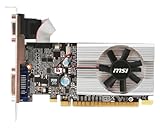
- Dual core center
- MSI Afterburner Overclocking Utility
- Low Profile Design-One slot thermal and low profile design work perfect with slim or smaller system
- Military Class Concept Components
Why is my GPU still too hot?
Afterburner can measure temperature and adjust a supported fan curve, but software cannot overcome every cooling limitation. Check case airflow, dust, the existing cooler, ambient temperature, load, and whether the graphics card’s firmware permits manual fan control. Laptop GPUs often have manufacturer-controlled fan behavior that Afterburner cannot override.
If a desktop graphics card has a failing or inadequate cooler fan, a compatible GPU cooling fan or model-specific replacement may be worth comparing before relying on a more aggressive Afterburner fan curve. Compatibility depends on the exact graphics-card model and cooler design; do not assume that a replacement fan fits every GPU.
Why is the MSI Afterburner overlay not working?
Overlay failures are commonly caused by RTSS not running, an unselected monitoring metric, an incorrect RTSS application profile, a competing overlay utility, or an anti-cheat restriction—not necessarily by a damaged Afterburner installation.
- Confirm both applications are running. Afterburner and RTSS must be active for the normal monitoring overlay workflow.
- Check the metric. In Settings > Monitoring, select the metric and confirm Show in On-Screen Display is enabled.
- Check the RTSS profile. Confirm that the game appears in RTSS and that its profile is not disabling the overlay.
- Temporarily disable competing OSD tools. Other third-party overlay utilities can conflict with RTSS.
- Check anti-cheat restrictions. Some online games restrict third-party overlays or block a connection while RTSS is running. Follow the game publisher’s rules rather than trying to bypass them.
- Reinstall only after checking the above. If an update caused the conflict, use a clean uninstall and reinstall with profiles removed, following the distributor’s guidance. Guru3D documents RTSS’s compatibility and limitation considerations on its RTSS download page.
Does MSI Afterburner work on laptops?
MSI Afterburner can work with many laptop GPUs, but laptop manufacturers commonly control cooling, voltage, power, and fan behavior through firmware or system software. A laptop may therefore show fewer controls than a desktop graphics card, and a custom fan curve may be unavailable even when temperature monitoring works.
Do not treat a missing voltage slider, power limit, or fan-control option as proof that the installation is broken. The missing control may be a hardware, firmware, driver, or manufacturer limitation.
Independent reader supportYour contribution helps us test, update, and keep practical guides available for everyone.How do you avoid a fake MSI Afterburner installer?
Use the domain and the release labeling as the first checks. MSI and Guru3D are the two legitimate sources identified in the supplied technical guidance, while unofficial pages can modify installers or use the Afterburner name to distribute unwanted software.
Rank #4

- TORX 4.0: fan blades work in pairs to create optimal levels of concentrated air pressure
- Supports NVIDIA AI acceleration, DLSS3, DLSS2, Raytracing and Reflex, as well as NVIDIA encoder, broadcast and studio
- ROBUST DESIGN: A robust backplate with continuous flow design reinforces the chassis, while internally an optimized printed circuit board (PCB) offers top-quality electrical protections
- Afterburner: Take full control with card overclocking software graphics card overclocking software
- Precision engineered copper baseplate for GPU and square section contact heat pipes
- Type or carefully verify msi.com or guru3d.com before downloading.
- Reject pages that redirect through several unrelated domains or offer cracked, portable, or “pre-activated” editions.
- Compare the displayed version and channel with the official listings; do not assume the newest-looking number is a final release.
- Do not disable security software merely to run an installer from an unverified source.
- If an installer behaves unexpectedly, stop the installation and obtain a fresh copy from MSI or Guru3D instead of searching for another mirror.
Which MSI Afterburner download should you choose?
Choose MSI Afterburner 4.6.6 Final from MSI.com when you want the final release channel. Use Guru3D when you want the authorized alternative distribution page or the specifically listed 4.6.7 Beta 3, build 17352. Install RTSS only when you need the in-game overlay, framerate tools, or related RTSS features, and treat overclocking or undervolting as hardware-specific experiments that require monitoring and stability testing.
Frequently Asked Questions
Is RivaTuner Statistics Server required for MSI Afterburner?
No. MSI Afterburner can launch and provide desktop tuning or monitoring without RivaTuner Statistics Server. RTSS is needed for Afterburner’s in-game hardware-monitoring overlay and also provides related framerate, frametime, capture, and limiting features.
Is MSI Afterburner 4.6.7 the final stable version?
MSI lists 4.6.6 as the final release and 4.6.7 as beta. Guru3D specifies the beta listing as 4.6.7 Beta 3, build 17352, updated June 19, 2026, so 4.6.7 should not be presented as the stable final release.
Does MSI Afterburner work with non-MSI graphics cards?
Yes, MSI Afterburner supports many graphics cards made by manufacturers other than MSI. Individual controls such as voltage, power, and fan adjustment depend on the GPU, firmware, driver, and board design, and laptop systems may restrict fan behavior.
Why is my MSI Afterburner overlay not showing?
A missing overlay is often caused by RTSS not running, a metric not being marked “Show in On-Screen Display,” an incorrect RTSS game profile, a competing overlay, or an anti-cheat restriction. Check those conditions before performing a clean reinstall.
Quick wins for a faster PC:
Repair Windows errors before they cause bigger problemsFix Now →Fix the driver behind crashes, sound loss and screen glitchesFind Drivers →The Bottom Line
For a safe MSI Afterburner download, use MSI.com or Guru3D.com and distinguish 4.6.6 Final from the 4.6.7 beta channel. RTSS is optional for Afterburner itself but needed for the in-game overlay. Every tuning, voltage, and fan-control result depends on the specific GPU and should be tested rather than assumed.
Quick Recap
Product prices and availability are accurate as of the date/time indicated and are subject to change. Any price and availability information displayed on Amazon at the time of purchase will apply.

