
Recommended Free Tools
Mars’s north and south poles both grow seasonal carbon-dioxide frost in winter. The key difference appears in summer: the north’s lasting cap is mainly water ice, while the south’s water ice remains beneath a relatively thin layer of carbon dioxide. The poles also have distinct observed surface patterns, but the sources do not establish one complete explanation for why they differ.
Seasonal frost is not the same as the summer remnant
Each Martian winter brings a seasonal cap of frozen carbon dioxide, mixed with smaller amounts of water-ice frost and dust. As spring warms the surface, the carbon dioxide sublimates—that is, it changes directly from solid to gas. The cap retreats, leaving behind whatever ice persists through summer. NASA/JPL describes that lasting summer deposit as a residual cap; its boundary can vary from one summer to another, so “permanent” does not mean unchanging. (NASA/JPL, “What is a ‘Residual’ Polar Cap?”; NASA Science, “Carbon-Dioxide Frost Settling from Seasonal Outbursts on Mars”)
Some seasonal carbon dioxide can become trapped beneath an ice slab. When gas escapes, it may carry dust that later settles in bright fan-shaped deposits; some gas can also refreeze. These seasonal processes describe the winter frost and its retreat, not the full composition of the summer remnant. (NASA Science)
How the summer caps differ in composition
| Feature | North pole | South pole |
|---|---|---|
| Seasonal winter cap | Carbon-dioxide frost, with smaller amounts of water-ice frost and dust. | Carbon-dioxide frost, with smaller amounts of water-ice frost and dust. |
| Summer remnant | Mainly water ice; NASA/JPL’s radar report describes the remaining north cap during northern summer as all water ice. | Water ice beneath a relatively thin, persistent carbon-dioxide cover, according to NASA/JPL’s 2015 radar report. |
Older descriptions of the south as mostly carbon dioxide refer to its enduring surface cover, not necessarily the whole deposit. NASA’s North Polar Cap page, for example, describes the north as mainly water ice and the south as mostly carbon dioxide. NASA/JPL’s 2015 radar account adds the important distinction that water ice is also present at the south pole beneath a relatively thin carbon-dioxide layer in southern summer. The south is therefore not best described simply as a solid block of dry ice. (NASA Science, “North Polar Cap”; NASA/JPL, “NASA Radar Finds Ice Age Record in Mars’ Polar Cap”)
#1 Best Overall
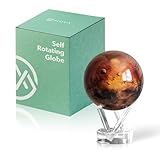
- Mars in Motion – A Realistic Look at the Red Planet - Golden-red surface tones with volcanic ridges and weathered terrain bring Mars to life. An inspiring piece for space lovers and science fans alike.
- Self-Rotating Technology Powered by Light - MOVA’s patented design silently spins the globe using ambient light and the Earth’s magnetic field — no batteries or cords required.
- Premium Build with Seamless Movement - A fluid-suspended inner globe rotates within a clear acrylic outer shell, offering a smooth, almost magical visual experience.
- Perfectly Sized for Personal Spaces - Measuring 4.5 inches in diameter (about softball size), it fits beautifully on desks, shelves, and side tables as a compact cosmic accent.
- Gift-Worthy for Dreamers and Thinkers - A thoughtful present for science enthusiasts, educators, students, and anyone fascinated by space. MOVA Globes spark imagination and lasting conversations.
What the polar surfaces look like
North: relatively flat, pitted terrain
A NASA/JPL comparison describes the north residual cap as relatively flat and pitted, with a “cottage-cheese” appearance. Other archived observations describe pits, cracks, and knobs. These are descriptions of specific observed terrain, not a claim that every part of the north polar region has the same texture. (NASA/JPL, “The Difference Between the Martian Poles? It’s the ‘Cheese’”; NASA NTRS, “Residual Polar Cap Differences”)
South: pits, troughs, and mesas
The same NASA/JPL comparison describes larger pits, troughs, and flat mesas at the south pole, using “Swiss cheese” as a visual analogy. The phrase refers to the pattern of landforms, not the material. An archived NASA technical report also describes layered terrain modified by collapse and erosion, including troughs and polygonal depressions. (NASA/JPL; NASA NTRS)
Rank #2

- Mars in Motion – A Realistic Look at the Red Planet - Golden-red surface tones with volcanic ridges and weathered terrain bring Mars to life. An inspiring piece for space lovers and science fans alike.
- Self-Rotating Technology Powered by Light - MOVA’s patented design silently spins the globe using ambient light and the Earth’s magnetic field — no batteries or cords required.
- Premium Build with Seamless Movement - A fluid-suspended inner globe rotates within a clear acrylic outer shell, offering a smooth, almost magical visual experience.
- More to Explore - Our larger Mars globe offers richer surface detail and stronger visual presence, ideal for offices and display cabinets.
- Gift-Worthy for Dreamers and Thinkers - A thoughtful present for science enthusiasts, educators, students, and anyone fascinated by space. MOVA Globes spark imagination and lasting conversations.
Why the two poles differ
The observed asymmetry is clear, but the sources do not settle on one complete cause. Researchers have modeled how seasonal retreat, solar energy, and atmospheric-pressure behavior might contribute. Those efforts should not be mistaken for a definitive explanation of every difference between the poles. (NASA NTRS, “Residual Polar Cap Differences”)
Polar deposits also preserve layers that provide context for Mars’s changing climate. NASA describes northern retreat exposing the water-ice remnant and layered terrain interpreted as evidence of past climate change. A NASA technical paper discusses how long-term shifts in Mars’s axial tilt can affect polar deposition. These observations do not mean a visible layer can be assigned neatly to one particular year or event. (NASA Hubble image description; NASA NTRS, polar stability paper)
Free tools Windows power users keep installed
One-click scans. No signup required.
Rank #3

- Globe Diameter : 24cm / 9.5"
- Item Size : 9.5"D X 14"H X 10"W / D 24cm X H 36cm X W 26cm / Diameter X Height X Width
- Name : Explorer Red Mars Globe, 24cm/9.5"
- Color : Red (Mars surface) / Uses images from NASA
- Base Material : Plastic Dark Brown (ABS)
What changing south-polar mesas do—and do not—show
NASA describes south-polar dry-ice mesas whose pits enlarge as carbon dioxide turns to vapor, exposing an older surface that is likely water ice. Nearby flat surfaces can accumulate new dry ice, and NASA notes that the total frozen carbon dioxide at the South Pole may even be increasing. Local erosion of a mesa therefore does not establish that the south-polar carbon-dioxide inventory as a whole is shrinking. NASA also distinguishes these processes from Earth-like climate change. (NASA Science, “The Changing Ice Cap of Mars”)
Quick Recap
Rank #4

- Size : 12"D X 18"H X 13"W / D 30cm X H 45cm X 33cm
- Material(Globe / Meridian / Base) : Plastic Dark Brown (ABS)
- Technique : Vacuum formed (Erasable markers ; Write-on, wipe-off)
- Language : Latin & English, Color : Red, Scale : 1 / 22,640,000, Rotation axis : 23.5°
- Over 600 place names including. Includes illustrations.(Landers/Rovers)
Product prices and availability are accurate as of the date/time indicated and are subject to change. Any price and availability information displayed on Amazon at the time of purchase will apply.

