
iTechGuides is reader-supported. When you buy through links on our site, we may earn an affiliate commission. As an Amazon Associate I earn from qualifying purchases. Learn more
With Linkwitz’s factory crossover and EQ settings, Isaac Adams measured a broadly even response in his room from about 45 Hz to 13 kHz and heard particularly strong imaging, ambience, and midrange detail. He also found less bass weight and high-frequency air than in his reference system. Those results describe one setup—not a universal prediction of how every LXmini will measure or sound.
How the LXmini was set up and measured
In Part 4 of his build series, published September 24, 2026, Isaac Adams removed the EQ changes he had made during the previous installment and returned to the kit guide’s settings before measuring and listening. He placed the speakers about 1–2 meters from the rear walls in an equilateral-triangle arrangement. For measurement and initial listening, the triangle was about seven feet on each side. He found that distance produced a distinctly separated, almost headphone-like stereo image, which he did not prefer as much as a less close presentation.
Adams used a miniDSP UMIK-1 USB measurement microphone and Room EQ Wizard (REW). With the manufacturer-supplied crossover and parametric EQ settings, he reported an in-room response centered around 83 dB from approximately 45 Hz to 13 kHz. Output fell quickly outside that span. These are his measurements in his listening room, not a controlled independent test or a guarantee of response in another room. Adams’s measurement and listening report.
Recommended Free Tools
Room response versus near-field response
At the listening position, Adams saw peaks between 100 and 600 Hz and dips from 1 to 6 kHz. He attributed these irregularities to room interaction and cancellation between the speakers when the microphone was slightly off-center. Near-field measurements lacked most of those peaks and dips, but showed a noticeable peak around 10 kHz. Near-field results should not be read as a direct substitute for what a listener hears across the room; Adams noted that they showed more bass energy than his listening-position measurements.
#1 Best Overall
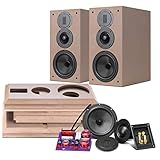
- THIS IS UNASSEMBLED DIY SPEAKER KIT, NOT FINISHED SPEAKER. Requires manual assembly, wood glue, soldering iron AND external amplifier to work
- High-fidelity Sound System – This DIY speakers kit with many components that are much more expensive high-end systems. Perfect as rear/side surround home theater speakers for a 5.1, 7.1 or 11.1 setup.DIY Bluetooth speaker kit for home theater
- 3 Way Bookshelf Speakers - Adopts three-way fourth-order speaker system reverse-phase design, with a luxurious and elegant appearance, high-end components included easy to set up and more stable excellent performance.wooden enclosure DIY speaker building kit
- Low Frequency - 6.5-inch large-diameter mid-bass unit L6-4R. Its diaphragm is made of all-black Kevlar fibre, an ultra-light and high-strength integrated composite material, a fatigue-resistant long-stroke rubber diaphragm folding ring, a highly compliant centering support piece, a unique magnetic circuit system with phase plug design, and a large magnetic steel drive unit.
- The mid-range unit uses a professional DN Series soft dome mid-range unit, with a high-quality diaphragm coated on the outside with a special damping material, and an independent dome mid-range unit to avoid the mid-range defect caused by the connection of the two frequency bands. The sound is sweet, natural and smooth.
Response tilt and distortion
He described an approximately 3 dB tilt from the low end to 13 kHz, which he heard as a slightly warm balance with substantial bass. His distortion measurements showed predominantly second-harmonic distortion, with even- and odd-order distortion decreasing as frequency increased, plus a second-order hump around 1,350 Hz. He suggested that a nonlinearity in the full-range driver’s surround might explain the hump, but presented that as a guess rather than an established cause.
What the measurements mean in the context of the design
The LXmini is an active two-way design. Linkwitz Lab specifies a 700 Hz LR2 electrical crossover between the woofer and full-range driver, with DSP equalization. The manufacturer’s store page lists a 45 Hz to 20 kHz frequency range, but that range is not the same as a claim of flat in-room output or unrestricted loudness across the band. Linkwitz Lab’s LXmini design documentation describes the design and its frequency-dependent radiation pattern.
Rank #2

- Note: This product is designed specifically for DIY speaker projects and includes only the wooden panels; you will need to assemble the cabinet yourself and purchase a speaker kit separately for installation.
- ✅ Acoustic-Grade MDF Construction for Studio-Quality Sound High-density medium-density fiberboard (MDF) eliminates unwanted resonance and vibrations, ensuring your speaker drivers deliver tight, accurate bass, clear midrange, and smooth highs. Internal reinforcing braces further reduce sound distortion, so your custom speakers sound as professional as pre-built models.
- ✅ Unfinished MDF Surface: Your Creative Blank Canvas The raw, unprocessed MDF exterior lets you customize your speakers to match any decor. Paint, stain, wrap in vinyl, or apply real wood veneer to create a modern, vintage, or industrial look. Build speakers that not only sound amazing but also elevate your home’s aesthetic.
- ✅ Beginner-Friendly Assembly with All Hardware Included All panels feature interlocking slots for quick, stable assembly—no advanced woodworking skills required. The kit includes screws, sealing gaskets, and a step-by-step manual, so you can build a pair of cabinets in under an hour with basic tools.
- ✅ Versatile Empty Cabinets for Any Audio Project Perfect for building bookshelf speakers, upgrading old home theater systems, or creating custom desktop monitors. Compatible with most 6.5” 3-way driver sets on the market, giving you full control over your audio setup. Note: This listing is for empty cabinets only—speakers, crossovers, and wiring are not included.
In particular, the LXmini’s cardioid behavior is around the crossover region; its radiation pattern changes with frequency. The store page notes a physical limit on maximum sound level below 150 Hz for the small woofer. Linkwitz Lab’s design documentation says the equalized woofer response is 3 dB down at 45 Hz and identifies woofer excursion as the expected output limitation. A speaker can therefore reach into the low bass while still having limits on how loudly it can reproduce bass without excessive driver excursion.
The Tool Desk
Outbyte Driver Updater FREEScan for outdated or missing drivers - takes under a minuteDriver Scan →Outbyte PC Repair FREERepair Windows errors before they cause bigger problemsFix Now →The active system also needs four amplifier channels for a stereo pair, according to the manufacturer’s store listing, and uses a miniDSP crossover option. The official kit listing describes drivers, DSP, wood parts, and related items; pipes and rubber couplers are excluded from the Madisound kit listing. Construction plans or a license are required under the official documentation. Kit contents, compatible options, and purchase requirements can change, so check the current Linkwitz Lab LXmini store information before ordering.
Rank #3

- Materrial-3.1 High-fidelity bookshelf speakers feature a luxurious, high-grade PVC exterior with a finely textured cabinet surface that offers a warm, smooth feel and a sleek, minimalist design.
- Three-Way Bookshelf Speakers Featuring a three-way, fourth-order speaker system with a phase-inverted design, these speakers boast a luxurious and elegant appearance. They deliver outstanding, stable performance and come fully assembled and ready to use.
- The cabinet features a sleek black finish, exuding an air of sophisticated elegance. Its minimalist design makes it a discreet yet luxurious accent piece when placed in a corner of your living room or study.
- Note:This product includes only one speaker enclosure. A 3.1 speaker unit must be purchased separately to be used with this enclosure.
How Adams tuned the speakers for listening
After evaluating the factory settings, Adams wanted more bass and more high-frequency information. He raised the existing 50 Hz peak by 3 dB and adjusted EQ above 10 kHz, including a broad 8 dB peak at 17 kHz to soften the perceived effect of the rolloff above 13 kHz. He said these changes added bass weight and the high-frequency detail he felt was missing.
Those adjustments are an account of one listener’s preferences in one room, not recommended corrections for every LXmini. The measured room response, placement, listening position, and individual preference all affect whether a change is useful. Anyone experimenting with EQ should treat Adams’s values as an example of personal tuning, not a preset to copy.
Rank #4

- PREMIUM HI-FI STEREO SPEAKERS - Enjoy rich, deep bass and clear highs with these powered bookshelf speakers. Featuring 80W RMS and a 4" woofer with silk dome tweeter, they deliver immersive stereo sound ideal for any setup or studio space
- VERSATILE AUDIO CONNECTIVITY - These Active / Passive bookshelf speakers support Bluetooth 5.3 for seamless wireless streaming, plus optical input, RCA, and subwoofer out. Connect to record player, TV, or PC for flexible use as audio speakers or desk speakers
- CLASSIC WOODEN CABINET DESIGN - Made with an MDF natural wood cabinet and fabric mesh grill, these shelf speakers blend premium tuning and engineering with elegant aesthetics. Great small format speakers for audiophiles who love style and sound
- FULL-RANGE CONTROL & DSP TECH - Fine-tune your listening with independent volume, treble, & bass knobs. DSP digital circuit and 12dB crossover slope enhance sound clarity, making these perfect speakers for record players, enterainment and stereo systems
- COMPACT SIZE, BIG PERFORMANCE - These i bookshelf speakers pair perfectly with any space:. Measuring 7.95" x 6.18" x 9.92", they're ideal for small to medium sized rooms. These active bookshelf speakers upgrade any house or office
What the LXmini sounded like
Adams listened to Dave Brubeck Quartet’s Time Out, Pentangle, The Stooges’ Fun House, and Tegan and Sara’s Love You to Death. Across those selections, he praised the midrange, soundstage, ambience, and imaging, describing instruments and voices as natural-sounding.
Imaging, ambience, and midrange
On “Blue Rondo à la Turk,” he noted saxophone and reed detail. Pentangle selections brought out clear guitar and glockenspiel. These impressions align with his broader praise for stereo separation and the sense of space around instruments, though the close speaker placement also contributed to the presentation he described as headphone-like.
Best Value

- True full-range point source frequency response from 80 to 20,000 Hz
- Angled enclosure puts drivers on-axis for extremely predictable response
- Dayton Audio's famous PS95-8 delivers excellent detail and articulation with low distortion
- Easy to assemble enclosure and filter design makes this kit perfect for beginners
- Compact footprint and bottom ported design takes up minimal desk space
Bass and scale against his reference
On The Stooges, he heard convincing groove and upper-bass authority. Against his Meridian DSP6000 reference speakers, however, he found the LXminis smaller in scale and less capable of delivering bass weight. He also heard less high-frequency “air” than from his reference system, which used a beryllium tweeter.
That comparison is subjective, not a controlled head-to-head: the report does not establish matched playback levels or blind listening conditions. It is best understood as a useful description of what Adams preferred and noticed in his own system, rather than a definitive ranking of the speakers.
Who may appreciate these results
The listening account points to the LXmini’s strengths in spatial presentation and midrange clarity, while also clarifying the trade-offs a prospective builder should consider. The design’s DSP and active crossover allow deliberate system tuning, but the small woofer’s low-frequency output limits and the need for multiple amplifier channels matter when planning a room and setup.
Crashes, No Sound, or Screen Glitches?
Random freezes, missing sound and display glitches usually trace back to one bad driver. Find and replace yours safely.Free scan · under a minuteWindows Errors? Fix Them Before They Spread
Repair common Windows errors and clear accumulated junk for a smoother, more stable PC - no reinstall needed.Free scan · no reinstallQuick Recap
- Room and placement: The reported response changed between the listening position and near field, and the seven-foot triangle shaped the stereo presentation.
- Bass expectations: The design reaches into the low frequencies, but maximum output below 150 Hz is physically limited by the small woofer.
- System requirements: A stereo pair requires four amplifier channels and a compatible miniDSP crossover configuration.
- Tuning: Adams’s EQ changes reflect his tastes and room; the manufacturer settings were the baseline for his measurements.
- Comparisons: His observations against the Meridian DSP6000 are a single reviewer’s account, not a controlled comparison.
Product prices and availability are accurate as of the date/time indicated and are subject to change. Any price and availability information displayed on Amazon at the time of purchase will apply.

