
iTechGuides is reader-supported. When you buy through links on our site, we may earn an affiliate commission. As an Amazon Associate I earn from qualifying purchases. Learn more
A Leidenfrost drop can act as a tiny chemical reactor: vapor generated beneath it lifts it above a hot surface, while reactions in the liquid can produce nanomaterials. In a 2013 proof-of-concept study, researchers reported charge separation and made gold nanoparticles using an aqueous gold-salt solution. The researchers did not establish exactly how the synthesis worked.
What is a Leidenfrost drop?
When a liquid droplet meets a surface far hotter than its boiling point, the liquid at the underside rapidly vaporizes. That vapor forms a cushion that supports the rest of the droplet above the surface. The effect is called the Leidenfrost effect; the suspended droplet is a Leidenfrost drop. A plain-language description of the vapor cushion appears in Chemistry World’s 2013 report.

In the experiments reported by Abdelaziz and colleagues, the effect was observed above 230 °C on aluminum, silicon oxide, and silicon substrates. That temperature describes their experimental materials and conditions, not a universal threshold for every surface or liquid. Their study, published in Nature Communications in 2013, investigated whether the levitating drop could also serve as a reaction environment.
The Tool Desk
Outbyte Driver Updater FREEScan for outdated or missing drivers - takes under a minuteDriver Scan →Outbyte PC Repair FREERepair Windows errors before they cause bigger problemsFix Now →Can chemistry happen inside the levitating droplet?
Yes. The researchers measured charge separation in levitating drops and reported that a salt solution enhanced the measured separation. They used a closed, laboratory-built apparatus to improve measurement accuracy and limit effects from air, impurities, and charge leakage. The paper presents these measurements as experimental findings; they do not by themselves establish a complete account of how every reaction proceeds in a Leidenfrost drop.
How did the study make gold nanoparticles?
- Prepare the solution. The researchers used a 2 mL droplet of 10 mM aqueous tetrachloroauric(III) acid solution at approximately pH 2.3.
- Heat the substrate. They placed the droplet on a hot plate maintained at 270 °C, where it levitated above the hot surface.
- Observe the color change. The droplet changed from yellow to plasmonic red, an indication associated in the study with formation of gold nanoparticles.
- Analyze the product. Transmission electron microscopy (TEM) identified gold nanoparticles in the resulting material.
These conditions describe the specific demonstration in the paper, not a general recipe or guarantee that the outcome will transfer to other solutions, surfaces, or equipment. The reported example used the aqueous gold-salt solution; it should not be recast as proof that every Leidenfrost synthesis requires no additional reducing agent.
What materials did the researchers report?
Beyond the gold nanoparticle demonstration, the paper describes proof-of-concept production of nanoporous gold, nanoscale coatings, and metal–polymer hybrid foams. These examples show the range of applications explored in that study; they do not establish commercial readiness, production throughput, or reproducibility across laboratories.
Rank #2

- 【Expert Nanotechnology Standards】 Leveraging years of industry experience, AerSky provides authentic, high-purity Aerogel. Each 2-4cm natural fragment is carefully selected to ensure structural integrity and the signature "frozen smoke" aesthetic.
- 【Transparent Display Chamber】 A precision-engineered 2.16-inch (55mm) square box, perfect for showcasing high-purity silica aerogel specimens.This display allows for 360-degree viewing of the world’s lightest solid, making it a stunning centerpiece for any desk or lab. The lid can be opened, allowing you to take out the aerogel. After enjoying it, you can place it back inside for storage.
- 【NASA-Grade Scientific Specimen】 Explore the physics of the future. Composed of over 95% air, these Aerogel blocks demonstrate the incredible thermal and optical properties used in aerospace and deep-space exploration.
- 【Engaging STEAM Education】 An unparalleled tool for teaching material science. The generous bottle size makes it easy for students to observe light scattering (Rayleigh scattering) and the surreal transparency of advanced nano-materials.
- 【The Ultimate Collector's Gift】 Perfect for science geeks, educators, and tech enthusiasts. AerSky combines professional-grade material with museum-quality packaging to deliver an unforgettable unboxing experience.
What is known—and not known—about the reaction mechanism?
The authors proposed an explanation involving an overheated interface, rapid evaporation, and water-ion chemistry. However, they explicitly said the exact nanosynthesis mechanism remained unresolved, including the roles of fast evaporation and thermocapillary effects. The results support nanomaterial formation under the reported conditions, but the paper does not settle which processes caused it.
Windows Errors? Fix Them Before They Spread
Repair common Windows errors and clear accumulated junk for a smoother, more stable PC - no reinstall needed.Free scan · no reinstallCrashes, No Sound, or Screen Glitches?
Random freezes, missing sound and display glitches usually trace back to one bad driver. Find and replace yours safely.Free scan · under a minuteIs this a practical or “green” way to make nanomaterials?
The authors characterize the approach as green because it uses water and is presented as a one-step process. The study does not establish lifecycle impacts, comparative environmental performance, commercial scale-up, or broad reproducibility. It therefore supports a laboratory proof of concept, not a conclusion that the method is environmentally superior or ready to replace conventional synthesis.
Rank #3
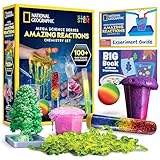
- OVER 100 EXCITING EXPERIMENTS - The science experiments in this kit let kids explore the wonders of hands-on science experiments. They'll make bubbling, color-changing solutions, glowing test tubes, a colorful bouncy ball, glowing worms, and more!
- EVERYTHING KIDS NEED - This kit includes all materials needed to conduct 15 stunning chemistry experiments, including growing a crystal tree, changing the color of liquid with their breath, and more.
- 85 BONUS EXPERIMENTS - Because we know your kids will want to conduct even more science experiments once they get going, we include a bonus experiment guide with 85 additional experiments that can all be done with common household items.
- HANDS-ON STEM - Our science toys are known for being hands-on, and this kids activity kit is no different. Your kids will use real scientific tools, like test tubes, beakers and pipettes, as they explore the fascinating world of chemistry.
- AWARD-WINNING PRODUCTS - Blue Marble, winner of the Toy Association's prestigious Toy of the Year Award, proudly develops products that foster education, imagination, and creativity, with a U.S. support team to ensure a stellar experience!
Reproducing the work also involves more than placing a drop on a household hot plate: the reported chemistry used controlled hot-surface conditions, and its charge measurements relied on a specialized closed apparatus. The paper does not show that consumer equipment alone can reproduce the nanochemistry.
Quick Recap
Best Value
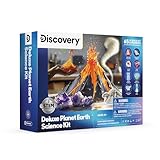
- ✔ 65 EARTH SCIENCE EXPERIMENTS – Includes 25 hands-on science experiments and 40 at-home DIY activities exploring volcanoes, fossils, geology, weather, and crystals.
- ✔ LEARN THROUGH LAVA, SLIME & SNOW – Build and erupt a volcano, make black tar and lava slime, grow crystal lava rocks, create instant snow, and simulate water tornadoes.
- ✔ EXPLORE GEOLOGY, METEOROLOGY & ARCHEOLOGY – Kids will uncover fossils, observe water erosion, track weather, grow crystals, and even break open their own geode.
- ✔ REAL TOOLS & INGREDIENTS INCLUDED – Features a volcano mold, fossil molds, excavation bricks, tornado connector, crystal grow powder, plaster, instant snow, arts and crafts supplies, and more.
- ✔ STEM LEARNING FOR CURIOUS KIDS AGES 8+ – Perfect for home labs, science fairs, and family fun. Encourages critical thinking, creativity, and scientific exploration with clear instructions and adult supervision.
Rank #4

- MASSIVE SCIENCE KIT FOR CURIOUS KIDS - More than 15 experiment activities including dueling water tornadoes, building an erupting volcano, growing a crystal, two geologic dig kits, and more!
- ENOUGH TO GO AROUND - This science lab allows kids to conduct multiple experiments and is great to share with family, friends, or classmates. Enjoy the magic of discovery together!
- THE SECRET IS THE SCIENCE - A detailed, full-color Learning Guide teaches the science at work in the experiments, allowing your child to develop a deep, lasting appreciation for a variety of Earth sciences.
- HASSLE-FREE EXPERIMENTS - Clear, easy-to-follow instructions build young scientists' confidence as they experiment, allowing them to focus on the joy of exploration and discovery.
- AMAZON EXCLUSIVE - Blue Marble has developed this product exclusively for Amazon.
Product prices and availability are accurate as of the date/time indicated and are subject to change. Any price and availability information displayed on Amazon at the time of purchase will apply.

