
Do these 3 things before closing this tab:
1Fix the driver behind crashes, sound loss and screen glitches2Repair Windows errors before they cause bigger problems3Scan for outdated or missing drivers - takes under a minuteiTechGuides is reader-supported. When you buy through links on our site, we may earn an affiliate commission. As an Amazon Associate I earn from qualifying purchases. Learn more
Fiber is often the better fit for working from home when it is available at a reasonable price, particularly if your work depends on video calls, cloud files, remote access, or frequent uploads. Federal Communications Commission (FCC) measurements found lower latency and stronger download-speed consistency for fiber than DSL among the services tested. Those historical results are not a guarantee for every provider or plan today, so the practical choice comes down to what you can order at your address and the plan’s actual upload speed, price, reliability, and terms.
Why fiber often suits remote work better
Remote work uses more than download speed. Video meetings, file transfers, cloud backups, and remote desktop sessions all rely on data moving out from your home connection, while interactive tasks are also affected by latency and connection consistency.
In the FCC’s 13th Measuring Broadband America Fixed Broadband Report, median idle latency for the DSL providers measured ranged from 23 to 34 milliseconds, compared with 7 to 14 milliseconds for fiber providers. For the report’s consistent-download-speed measure, DSL providers ranged from 63% to 72% of advertised speed; the FCC said cable and fiber providers generally performed better on that measure. These are findings from the report’s test set, not predictions for every current service or address. Read the FCC’s 13th Measuring Broadband America Fixed Broadband Report.
Recommended Free Tools
Lower latency can make interactive work feel more responsive, while stronger consistency can help a connection deliver speed more reliably relative to its advertised rate. Neither technology label alone establishes how well a particular plan will perform.
#1 Best Overall
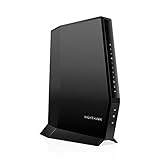
- MAXIMIZE YOUR CABLE INTERNET AND WHOLE-HOME WIFI: A cable modem and WiFi router in one device unlocks the full potential of your home internet with faster downloads, smoother WiFi for gaming and video calls, and reliable coverage in every room.
- APPROVED FOR YOUR PROVIDER AND PLAN: Works with Xfinity internet plans up to 800Mbps, Spectrum up to 1Gbps, and Cox up to 1Gbps. Not compatible with Verizon, AT&T, CenturyLink, DirecTV, DISH, or bundled voice plans. ISP activation required after setup.
- MULTI-GIG DOCSIS 3.1 SPEEDS: Get Gigabit+ cable download speeds on today's fastest plans, with headroom for the upgrades ahead. Real-world speeds depend on your plan and ISP network.
- WIFI 6 COVERAGE FOR THE WHOLE HOME: Stay connected in every room with dual-band AX2700 WiFi 6 covering up to 2,000 sq ft and capacity for 25+ connected devices. Real-world coverage depends on home size, layout, and building materials.
- WIRED CONNECTIONS FOR YOUR FASTEST DEVICES: Four Gigabit Ethernet ports keep gaming consoles, desktops, and streaming devices hardwired for the lowest latency and the most stable connection in your home.
What to compare before choosing a plan
Upload speed
Check the advertised upload speed for the exact plan. It matters when you send large files, join video calls, back up work to the cloud, or connect to a work computer remotely. Ask the provider whether upload and download speeds are symmetrical; do not assume they are simply because the service is fiber.
Latency and consistency
The FCC measurements favor fiber over DSL on the reported latency and consistent-download comparisons, but they describe the providers and services in that report. For a plan you can order now, ask the provider about the specific service and look for terms or performance information that applies to your address.
Rank #2

- ⚠️ CABLE INTERNET ONLY - NOT COMPATIBLE WITH: Fiber (Verizon FiOS, AT&T), DSL, Satellite, or Fixed Wireless. ONLY works with cable providers like Xfinity, Spectrum, Cox. Verify your internet type BEFORE purchase.
- 🚫 NO WiFi INCLUDED - ROUTER REQUIRED: This is a modem ONLY. You MUST buy a separate WiFi router to get wireless internet. Without a router, only ONE device can connect via Ethernet cable. This does NOT replace your current WiFi router.
- 🔌 CABLE INTERNET REQUIRED: Works EXCLUSIVELY with cable internet service (DOCSIS) from providers like Xfinity, Spectrum, or Cox. Will NOT work with fiber (Verizon FiOS, AT&T), DSL, satellite, or fixed wireless internet. Contact your ISP to confirm compatibility BEFORE purchasing.
- 🚀 MULTI-GIG PERFORMANCE: Supports internet plans up to 2.5 Gbps with 2.5 Gbps Ethernet port. Designed for plans 1 Gbps and faster from certified providers: Xfinity (up to 2.33 Gbps), Spectrum (1 Gbps), Cox (2 Gbps). Verify your plan speed and provider compatibility.
- 💡 SETUP REQUIREMENTS: You need: (1) Cable internet service, (2) Separate WiFi router with 2.5 Gbps port for full speeds, (3) ISP activation. This modem cannot create WiFi networks or connect multiple devices without additional equipment.
Total price and service terms
Compare the ongoing monthly price after any introductory offer, installation and equipment charges, data limits, contract or cancellation terms, and support. The FCC map reports availability and advertised speeds; it is not a price comparison or a measure of network performance.
The Tool Desk
Outbyte PC Repair FREEClear out junk files and repair common Windows errorsFree Scan →Outbyte Driver Updater FREEFix the driver behind crashes, sound loss and screen glitchesFind Drivers →How to check what is available at your home
- Open the FCC National Broadband Map and search for your precise service address.
- Review the fixed broadband providers, technologies, and maximum advertised upload and download speeds reported for that location. The map can list fiber, DSL, cable, fixed wireless, and satellite.
- Use the map as a starting point, then ask each provider to confirm that you can order the plan and verify its current speed, price, fees, and terms.
- If the map’s information appears inaccurate, use the map’s process for challenging reported availability.
The map uses information submitted by internet providers through the FCC’s Broadband Data Collection. It displays reported availability, not a guarantee that service will be installed or perform at a particular level. It also does not show affordability or adoption. The FCC explains the map’s scope and limitations in its guide to using the National Broadband Map, updated May 15, 2025.
Rank #3

- ⚠️ CABLE INTERNET ONLY - This modem works ONLY with cable internet providers (Xfinity, Spectrum, Cox). NOT compatible with fiber internet services including AT&T Fiber, Verizon Fios, Frontier Fiber, Google Fiber, or CenturyLink Fiber. Check with your ISP to confirm you have cable (coaxial) service before purchasing.
- 📞 DATA ONLY - NO PHONE SERVICE - This modem does NOT support telephone or voice service of any kind. If your internet plan includes phone service or you need VoIP calling, you must purchase a separate voice-capable modem or VoIP adapter. This device handles internet data only.”
- 🚀 MULTI-GIG PERFORMANCE: Supports internet plans up to 2.5 Gbps with 2.5 Gbps Ethernet port. Designed for plans 1 Gbps and faster from certified CABLE providers: Xfinity (up to 2 Gbps), Spectrum (1 Gbps), Cox (2 Gbps). NOT compatible with fiber internet services. Verify your plan speed and provider compatibility.
- 🔌 MODEM ONLY - NO WIFI INCLUDED - This device is a cable modem with ONE Ethernet port only. It does NOT provide WiFi or wireless connectivity. You MUST connect your own separate WiFi router to this modem to create a wireless network. This is not an all-in-one gateway or combo unit.
- ⚡ DOCSIS 3.1 TECHNOLOGY: Latest cable standard with 32x8 channel bonding for reliable multi-gig speeds. Backward compatible with DOCSIS 3.0 networks. Eliminates monthly modem rental fees (typically $14-20/month). For CABLE internet only - verify compatibility with your cable provider.
When DSL may still be the practical choice
If fiber is not offered at your address, compare the best DSL plan you can actually order with the other fixed broadband options reported for your location. A technology name is not enough to establish which available plan will work best: compare its upload speed, price, terms, and provider-confirmed availability. The FCC map includes DSL, fiber, cable, fixed wireless, and satellite as possible fixed-service technologies.
Quick Recap
How to make the decision
- Choose fiber when: it is available at your home, its ongoing cost and terms are acceptable, and its plan offers upload speeds and service conditions that suit your work.
- Consider DSL when: fiber is unavailable or does not fit your budget, and the specific DSL plan meets your work needs better than the alternatives you can order.
- Before signing up: confirm address-level availability and compare upload speed, recurring price, fees, limits, contract terms, and support directly with the provider.
Product prices and availability are accurate as of the date/time indicated and are subject to change. Any price and availability information displayed on Amazon at the time of purchase will apply.

