
The Tool Desk
Outbyte Driver Updater FREEScan for outdated or missing drivers - takes under a minuteDriver Scan →Outbyte PC Repair FREERepair Windows errors before they cause bigger problemsFix Now →iTechGuides is reader-supported. When you buy through links on our site, we may earn an affiliate commission. As an Amazon Associate I earn from qualifying purchases. Learn more
If IoT data looks poor before machine learning, start by finding where the readings change or disappear—not by cleaning the training table. Telemetry can be lost during export, rejected because its payload conflicts with a schema, distorted by device clocks, or made inconsistent by transformations. Trace a reading through the pipeline first; then validate the dataset and evaluate it in a way that reflects how the model will be used.
Why is my IoT data quality poor before machine learning?
A model can learn only from the data that reaches its input. A bad result may therefore begin before preprocessing: a device can send an unexpected field or type, an export can omit records, or timestamps can put valid readings in the wrong order. Later, transformations can change what values mean, or the sensor and operating conditions can change after the model was trained.
These failures call for different remedies. A missing row caused by an export gap is not an imputation problem; a clock error is not fixed by scaling; and an extreme reading is not necessarily noise. Work from the collection boundary toward the model, using evidence from each handoff.
Do these 3 things before closing this tab:
1Fix the driver behind crashes, sound loss and screen glitches2Clear out junk files and repair common Windows errors3Scan for outdated or missing drivers - takes under a minuteWhere does a reading disappear or change?
Pick one device and one event time. Follow the corresponding reading from the device payload through each system that handles it. Compare both whether the record exists and whether its fields and values stay consistent.
#1 Best Overall

- Build a 37-Module Sensor Lab: Add motion, distance, light, sound, temperature, touch, display and control functions to compatible UNO, MEGA, Nano, ESP-32 or STM32 projects for prototyping, classroom experiments and maker builds
- Explore Input Sensors and Motion: Experiment with GY-521 motion sensing, PIR detection, ultrasonic ranging, temperature and humidity, DS18B20, flame, Hall, touch, light, sound, tilt, tracking and obstacle-avoidance modules
- Add Displays, Timing and Control: Use the LCD1602, DS1307 real-time clock, joystick, rotary encoder, relay, buzzers, RGB LEDs and infrared modules to build clocks, alarms, counters, status displays and automated projects
- Follow Guided Projects Materials: Use digital tutorial materials, datasheets, wiring diagrams and example code for compatible UNO R3, MEGA 2560 and Nano boards, then adjust thresholds, timing and logic to create custom experiments
- Module-Only Expansion Kit: Controller board, USB cable, breadboard and jumper wires are not included; use 6.5–9 V DC only with the included power module, verify pin requirements before wiring and keep the laser emitter away from eyes
- Device payload: Find the raw message and record its event timestamp, field names, casing, types, units, and structure.
- Broker or IoT service: Confirm that the message arrived and was accepted, rather than assuming that a successful device connection proves every telemetry message was ingested.
- Export destination: Check whether the record was written and whether export was enabled when it arrived.
- Curated table: Compare the row and values with the exported record. Look for filters, joins, type conversions, and deduplication that could remove or alter it.
- Feature-generation output and model input: Confirm that the expected feature is present, has the expected type and unit, and was derived from the intended time window.
If the reading is present at one stage but absent at the next, investigate that boundary before changing the model. For Azure IoT Central, documented causes of telemetry not appearing as expected include a mismatch between device data and its template, invalid JSON, and field names, casing, or types that do not match the declared model. Its troubleshooting guidance also distinguishes export gaps from preprocessing issues: data arriving while export is off or temporarily disabled may be retrievable through the service’s REST API. Microsoft Learn’s Azure IoT Central troubleshooting guide covers these cases.
Does the payload match the dataset contract?
Write down what each feature means and how it is represented before training. A useful contract defines the measurement, unit, type, shape, timestamp meaning and format, valid range, and why the feature matters to the prediction task. It should also identify acceptable missingness where that is known. Compare incoming payloads and prepared datasets against the contract rather than relying on column names alone.
- Names and structure: Check spelling, casing, nesting, and required fields against the device template or dataset schema.
- Types and shapes: Verify that numbers are numbers, timestamps use the expected representation, and arrays or structured values have the expected dimensions.
- Units and ranges: Confirm that values use the documented units and are plausible for the sensor and application. A value in a different unit can look like an outlier while still being consistently wrong.
- Parsing: Test JSON parsing directly. Azure IoT Central’s documentation warns that its cited validation commands and Raw data view do not detect malformed JSON.
- Pipeline integrity: Where relevant, test for duplicates, incorrect joins, and fields lost during transformations.
When a field has the wrong type, correct the device payload or deliberately revise the schema. Silent coercion can conceal a contract violation and make later comparisons harder. Google Cloud’s ML guidance recommends checking feature completeness, names, types, shapes, time formats, ranges, and missing values. Its data-curation guidance also emphasizes documenting fields, automating quality tests, and keeping training and serving data consistent.
Rank #2

- 37 Sensors kit
- 37 Sensors Assortment Kit for Arduino MCU Education
- Touch sensor moduleHeartbeat detection module
- Infrared sensor receiver module
Are clocks, cadence, and event times trustworthy?
For every timestamp field, establish whether it records when the sensor measured something or when a system received it. Those times answer different questions. Record the timezone and format, sort by event time before making time windows or labels, and inspect each device for out-of-order or duplicate timestamps, late arrivals, sudden cadence changes, and gaps.
Device clocks can drift, particularly while equipment is stored or disconnected. AWS IoT Core’s security guidance recommends using an NTP client and synchronizing device time before connecting where possible; a factory-set clock alone may not stay accurate. A gap in event time could reflect a device outage, transmission delay, export problem, or a genuine change in sampling cadence. Compare device and ingestion times and check the collection path before deciding which explanation fits.
There is no universal cadence or timestamp tolerance for every IoT task. Set checks around the device’s expected reporting behavior and the prediction window. A timestamp error that seems small in isolation can still place a reading in the wrong feature window or make a future event appear to precede its cause.
Rank #3

- Ultimate Sensor Kit for Arduino Beginners: The kit features the original Arduino Uno R4 Minima board, 30+ high-quality sensors and modules, and free video lessons co-created with educator Professor Joselito. With over 50 engaging projects (30 basic, 17 IoT, and 10 advanced fun projects), beginners aged 8+ can dive into the world of electronics and programming with ease. Certified RoHS compliant, it guarantees safety and quality for all learners, making it the perfect choice for both education and innovation
- Powered by the Arduino Uno R4 Minima: R4 Minima is a major upgrade from the Uno R3. With a 32-bit ARM Cortex-M4 processor, 256 KB Flash memory, and 48 MHz clock speed, it offers faster performance and greater memory. It also features higher-precision ADC (14-bit), a built-in DAC, CAN bus support, and a wider power input range (6-24V), making it more powerful and versatile for all users
- 30+ Sensors for Infinite Creativity: With 30+ high-quality sensors and modules, plus a battery for portable applications, this kit is ideal for IoT, environmental monitoring, and smart automation projects. It includes step-by-step tutorials, sample codes, and progressive online lessons, making learning seamless for beginners and advanced users alike. Fully compatible with other Arduino boards like Uno R3 and Nano, it offers endless customization and innovation opportunities
- Engaging Projects for Every Skill Level: Featuring 50+ projects (30 basic, 17 IoT, 10 advanced fun), this kit supports IoT platforms like Blynk and IFTTT, enabling smart automation and real-world applications. With Arduino C++ programming, step-by-step guidance, and hands-on coding exercises, it’s perfect for students, teachers, and engineers to learn, build, and innovate at any level
- Dedicated Support for Beginners: Alongside online resources and video tutorials, SunFounder provides technical support and troubleshooting forums to help beginners solve programming challenges with ease
What do missing readings and outliers mean?
Measure missingness per feature and device, not just as one percentage for the whole dataset. Compare it across time periods, device models, firmware versions, and export destinations. A concentrated gap can point to a particular device cohort or pipeline boundary; an overall average can hide it.
What’s actually slowing this PC down?
Pick the symptom - the matching free tool is one click away.
Missing data can mean transmission loss, downtime, an inapplicable measurement, or a real physical state. The appropriate response depends on that cause and on what the model must predict. Depending on the evidence, you might repair collection, exclude a feature, preserve a missingness indicator, or impute values. No single treatment is established as best for all IoT data. Google Cloud’s guidance recommends checking missing-value fractions and notes that substantial missingness can affect training, but it does not supply a universal threshold for fixing or dropping a feature.
Investigate extreme values in device and application context before clipping or deleting them. An outlier may indicate a sensor fault, a unit or schema error, a legitimate rare event, or a change in operating conditions. scikit-learn’s preprocessing documentation explains that outliers can make some scaling approaches unsuitable and that robust alternatives may fit some datasets better. The choice depends on the model and data; a statistical rule alone cannot establish that a reading is wrong.
Rank #4

- Complete Project-Based Learning Path – Build 13 progressive projects (LED blink → button control → PIR motion sensor → music playback → motorized doors/windows → SK6812 RGB lighting → fan control → LCD display → gas alarm → temperature/humidity monitor → RFID door unlock → Morse code access → WiFi control → mobile APP remote control). Each project builds on the previous one, ensuring you understand both the electronics and the programming logic behind every smart home feature.
- Master Two Industry-Standard Languages – Learn to code in both Arduino C++ and MicroPython with 13 detailed tutorials for each language. Compare how the same hardware behaves under different programming approaches – a valuable skill for any aspiring engineer. Perfect for classrooms teaching multiple coding languages or self-learners who want flexibility.
- Build a Real WiFi-Controlled Smart Home – Assemble the wooden house structure and integrate sensors to create a functioning smart home system. Control lights, fans, door servos, and RGB lighting directly from your mobile APP (iOS/Android) . Experience how IoT works in real life – from manual control to automated responses based on temperature, humidity, motion, and gas detection.
- Comprehensive Online Wiki with No Guesswork – Our detailed online tutorials (also accessible via the packaging) include wiring diagrams, full code explanations, and step-by-step assembly guides for every project. Whether you're a complete beginner or a teacher preparing lessons, the structured content eliminates confusion and helps you succeed from project 1.
- Everything You Need to Get Started – (TIPS: Batteries are NOT Included)This kit includes the ESP32 development board, expansion board, wooden house parts, all sensors and modules (DHT11, PIR motion, gas sensor, RFID, SK6812 RGB, servo motors, fan, LCD1602, etc.), and connection cables. NOTE: 6x AA batteries are required (NOT Included). The kit is unassembled – you'll build it yourself following our online tutorials, making the learning experience truly hands-on.
Does evaluation reflect the model’s real job?
If the model forecasts future readings or predicts future events, use a chronological split: train on earlier observations and test on later ones. Randomly mixing time-dependent observations can let future conditions inform a prediction that is supposed to be made earlier. Random splits may suit some tasks with independent rows, but they should not be the default for a future-prediction question.
- Sort records using the timestamp that represents the prediction task, usually event time rather than arrival time.
- Choose training, validation, and test periods so that each evaluation period follows the data used to fit the model.
- Fit normalization, bucketization, imputation, or any other data-dependent transformation using the training partition only.
- Apply those same fitted parameters unchanged to validation, test, and serving data. Do not recalculate them from later partitions.
- Check that serving inputs have the same fields, units, and transformation steps as the model received during training.
Using test data to fit transformations can make performance estimates overly optimistic. scikit-learn’s guidance on common pitfalls describes this leakage risk and recommends fitting transforms on training data, then applying them to other data. Google Cloud likewise recommends newer test data for time-series evaluation and training-only transformation statistics in its predictive ML guidance.
How do you keep quality checks useful as the fleet changes?
A dataset can pass checks today and change as sensors age, devices are replaced, firmware changes, or export paths are modified. IoT time series are often temporally correlated, and their distributions can shift. A review of IoT analytics discusses distribution change and concept drift as risks to model performance. The review’s arXiv record describes these dynamics in IoT analytics.
Best Value
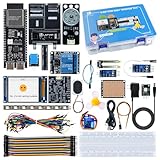
- 【High-Performance ESP32-S3 Microcontroller】 Equipped with revolutionary MCP protocol technology, the kit delivers a native AI voice control experience, perfectly adapting to various AIoT application scenarios, suitable for beginners, educators and makers.
- 【8 Versatile Hardware Modules Included】Comes with RGB LED module (full-color dimming, breathing light effect), WS2812 smart light strip (8 programmable LEDs), DHT11 sensor (real-time temperature and humidity monitoring), SG90 servo, DC fan, dual relay, raindrop and soil sensor, meeting diverse project needs.
- 【Zero-Threshold AIoT Control】Adopts innovative MCP protocol, allowing AI models to directly recognize hardware functions without complex programming. Pre-compiled firmware supports plug-and-play after burning, with an extensible architecture for secondary development.
- 【Multi-Scenario Application Coverage】Widely applicable to STEM education (learning IoT, AI interaction, embedded programming), smart home prototype verification, maker project development, and smart agriculture (soil monitoring, automatic irrigation systems).
- 【Comprehensive Learning & Technical Support】Provides an online document center with detailed quick-start guides and free professional technical support to answer questions and assist in problem-solving, helping users get started quickly.
Keep repeatable checks for schema, completeness, types, ranges, missingness, duplicates, and device coverage at the pipeline boundaries where failures can first be detected. Track the device, firmware or schema version, feature definitions, units, and transformation version alongside data and model outcomes. When a check or outcome changes, compare those records to distinguish a pipeline change from a shift in the operating environment.
Where checks run depends on the deployment. Device or edge checks can help when local processing or low delay matters, while constrained devices may not have resources for heavier analysis; cloud or offline checks can handle more demanding validation. The right choice depends on the use case. The diagnostic order stays the same: establish what the device sent, find where records or meanings diverge, validate time and values, and only then decide what preprocessing and evaluation are appropriate.
Quick Recap
Product prices and availability are accurate as of the date/time indicated and are subject to change. Any price and availability information displayed on Amazon at the time of purchase will apply.

