
iTechGuides is reader-supported. When you buy through links on our site, we may earn an affiliate commission. As an Amazon Associate I earn from qualifying purchases. Learn more
Increasing a VMware disk takes two steps: expand the virtual disk in VMware, then extend a partition or volume inside the guest operating system. The extra capacity does not become usable filesystem space automatically. Back up the VM and remove or consolidate snapshots before expanding; the correct interface and whether the VM must be powered off depend on the VMware product, version, and virtual controller.
Before you expand a VMware disk
- Identify the setup: determine whether you use Workstation or Player, or vSphere/ESXi; note the guest OS, target disk, controller type, and desired final capacity.
- Back up the VM: make sure you have a valid backup before changing disk capacity.
- Remove or consolidate snapshots: do not expand a snapshot-backed virtual disk. Broadcom warns that doing so can corrupt snapshots and cause data loss, regardless of VM power state. See Broadcom’s snapshot best practices.
- Check available capacity: verify datastore free space and confirm the requested size is supported by the VMware platform, datastore, and guest OS.
Expand the virtual disk in VMware
Choose the procedure for your VMware product. These paths are not interchangeable, and labels or eligibility can vary by release.
Workstation or Player
Broadcom documents this GUI path for Workstation 7 and later and Player 3.x and later:
Recommended Free Tools
- Power off the VM and open its settings.
- Select Hard Disk.
- Choose Utilities > Expand.
- Enter the desired total disk capacity and select Expand.
The hosted command-line pattern shown by Broadcom is vmware-vdiskmanager -x 100Gb vm.vmdk. Replace 100Gb with the intended capacity and vm.vmdk with the correct disk path. Confirm that the VM is backed up and has no snapshots before using the command. See Broadcom’s virtual machine disk-size procedure.
#1 Best Overall

- Get NVMe solid state performance with up to 1050MB/s read and 1000MB/s write speeds in a portable, high-capacity drive(1) (Based on internal testing; performance may be lower depending on host device & other factors. 1MB=1,000,000 bytes.)
- Up to 3-meter drop protection and IP65 water and dust resistance mean this tough drive can take a beating(3) (Previously rated for 2-meter drop protection and IP55 rating. Now qualified for the higher, stated specs.)
- Use the handy carabiner loop to secure it to your belt loop or backpack for extra peace of mind.
- Help keep private content private with the included password protection featuring 256‐bit AES hardware encryption.(3)
- Easily manage files and automatically free up space with the SanDisk Memory Zone app.(5). Non-Operating Temperature -20°C to 85°C
vSphere or ESXi
For ESXi 6.5 or later, Broadcom documents using the vSphere Client or ESXi Host Client to edit the VM settings, select its SCSI hard disk, and increase the size. The cited procedure does not support expanding IDE virtual disks through the vSphere Client flow. Clustered disks have a separate command-line caveat, so do not assume the ordinary GUI steps apply to them. Consult Broadcom’s procedure for the applicable release and disk type.
Power state and disabled size controls
Broadcom’s general guidance is to power off the VM and remove snapshots before expansion. It lists hot-extension exceptions for PVSCSI beginning with vSphere 7.0 and NVMe beginning with vSphere 8.0.1; whether an online change is permitted depends on the exact release and controller. Use the documentation for your environment rather than assuming every VM can be expanded while running.
Rank #2

- Capacity Display Variance: 250GB external ssd often appears as around 232GB on Windows. MacOS can show full 250 GB capacity. This is binary calculation difference and doesn’t affect SSD hard drive actual physical storage
- 1050 MB/s Speed: Instantly access to your files with blazing-fast 10Gbps external SSD read up to 1050MB/s and write up to 1000MB/s. LED Light indicates USB SSD instant activity
- Data Security: Solid state drives S.M.A.R.T. health diagnostics and adaptive TRIM optimizing data block management ensures consistent write speeds and extends the longevity of the portable SSD
- USB-C & USB-A Cable: Both cables featuring rapid USB 3.2 Gen2, this USB SSD effortlessly bridges devices, enabling seamless cross-platform file transfers and backup between computers, smartphones, tablets and iPhone
- Always Fast: No slowdowns for large file transfers. With SLC caching (25% of current available capacity allocated as high-speed cache), this external SSD delivers steady 10Gbps for transfers within the cache capacity
If the size field is grayed out or expansion fails, check whether the VM is powered on, whether snapshots exist, and whether the disk type and controller are supported. Broadcom’s troubleshooting article, updated January 27, 2026, covers common causes of the disabled size option: Troubleshooting a grayed-out disk size field.
Make the added space available in the guest OS
After VMware reports the larger virtual disk, the guest may need a disk rescan or reboot to detect the new capacity. Then extend the guest partition or volume and, where applicable, its filesystem. Broadcom explains that increasing a VMDK does not itself enlarge the guest partition or filesystem in its disk-size procedure and partition-extension guidance.
Rank #3
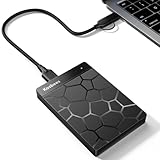
- 【Plug-and-Play Expandability】 With no software to install, just plug it in and the drive is ready to use in Windows(For Mac,first format the drive and select the ExFat format.
- 【Fast Data Transfers 】The external hard drives with the USB 3.0 cable to provide super fast transfer speed. The theoretical read speed is as high as 110MB/s-133MB/s, and the write speed is as high as 103MB/s.
- 【High capacity in a small enclosure 】The small, lightweight design offers up to 500GB capacity, offering ample space for storing large files, multimedia content, and backups with ease. Weighing only 0.35 Lbs, it's easy to carry "
- 【Wide Compatibility】Supports PS4 5/xbox one/Windows/Linux/Mac and other operating systems, ensuring seamless integration with game consoles,various laptops and desktops .
- Important Notes for PS/Xbox Gaming Devices: You can play last-gen games (PS4 / Xbox One) directly from an external hard drive. However, to play current-gen games (PS5 / Xbox Series X|S), you must copy them to the console's internal SSD first. The external drive is great for keeping your library on hand, but it can't run the new games.
Windows
In a supported Windows configuration, open Disk Management, locate the volume, and use Extend Volume if the unallocated capacity is available for that volume. Broadcom also describes DiskPart for data disks or when using a helper VM. The available option depends on the disk layout and Windows configuration; follow the applicable Broadcom Windows guidance.
For Windows to use capacity beyond 2 TB on a disk, the disk needs GPT partitioning rather than MBR. This is a partitioning requirement, not a guarantee that every VMware release, datastore, or guest supports every large disk size. See Broadcom’s large-capacity VMDK guidance.
Rank #4

- MADE FOR THE MAKERS: Create; Explore; Store; The T7 Portable SSD delivers fast speeds and durable features to back up any endeavor; Build your video editing empire, file your photographs or back up your blogs all in an instant
- SHARE IDEAS IN A FLASH: Don’t waste a second waiting and spend more time doing; The T7 is embedded with PCIe NVMe technology that brings fast read and write speeds up to 1,050/1,000 MB/s¹, making it almost twice as fast as the T5
- ALWAYS MAKE THE SAVE: Compact design with massive capacity; With capacities up to 4TB, save exactly what you need to your drive – from large working files to game data and everything in between
- ADAPTS TO EVERY NEED: Whether using a PC or mobile phone, count on the T7 for extensive compatibility²; It’s a true team player when it comes to heavy-duty application usage or file-saving
- HI RESOLUTION VIDEO RECORDING: Record Ultra High Resolution (4K 60fs) videos directly onto the T7 Portable SSD with your favorite camera or mobile devices; Supports iPhone 15 Pro Res 4K at 60fps video and more³
Linux
Rescan the device or reboot if needed, then use tools appropriate to the distribution, partition layout, filesystem, and any volume manager in use. The correct sequence differs between setups—for example, a plain partition and a logical volume do not use identical steps—so identify those details before changing partitions or filesystems. Broadcom’s general guidance confirms that guest filesystem growth is a separate operation, but does not establish one Linux command sequence for every configuration.
Quick wins for a faster PC:
Repair Windows errors before they cause bigger problemsFix Now →Fix the driver behind crashes, sound loss and screen glitchesFind Drivers →Clear out junk files and repair common Windows errorsFree Scan →If the guest still shows the old capacity
- Confirm VMware shows the intended larger VMDK capacity.
- Rescan disks in the guest or reboot if the guest has not detected the larger device.
- Check that you extended the correct partition or volume, not just the virtual disk.
- Inspect the partition layout: unallocated space may not be adjacent to the partition you want to extend.
- Check for an unresolved snapshot chain or a disk/controller limitation.
Verify the result at both layers: the configured disk capacity in VMware and the usable volume or filesystem capacity inside the guest.
Best Value

- Capacity Display Variance: 500GB external ssd often appears as around 465GB on Windows. MacOS can show full 500 GB capacity. This is binary calculation difference and doesn’t affect SSD hard drive actual physical storage
- 1050 MB/s Speed: Instantly access to your files with blazing-fast 10Gbps external SSD read up to 1050MB/s and write up to 1000MB/s. LED Light indicates USB SSD instant activity
- Data Security: Solid state drives S.M.A.R.T. health diagnostics and adaptive TRIM optimizing data block management ensures consistent write speeds and extends the longevity of the portable SSD
- USB-C & USB-A Cable: Both cables featuring rapid USB 3.2 Gen2, this USB SSD effortlessly bridges devices, enabling seamless cross-platform file transfers and backup between computers, smartphones, tablets and iPhone
- Always Fast: No slowdowns for large file transfers. With SLC caching (25% of current available capacity allocated as high-speed cache), this external SSD delivers steady 10Gbps for transfers within the cache capacity
If you expanded the disk too far
Do not expect to reverse the change with an in-place shrink: vSphere does not support shrinking a VMDK in place. Broadcom’s workaround, updated August 26, 2026, calls for a full backup and describes migrating the VM or copying data to a correctly sized new disk. See Broadcom’s VMDK shrink workaround.
Quick Recap
Product prices and availability are accurate as of the date/time indicated and are subject to change. Any price and availability information displayed on Amazon at the time of purchase will apply.

