
Use a staged detector: let a low-cost energy or reduced-precision periodicity check flag a possible Wi-Fi packet, verify that candidate with stronger correlation, and wake full-precision synchronization and channel processing only after it passes. This reduces work during idle monitoring without asking a cheap, interference-prone trigger to make the final packet decision.
Why a staged detector fits the WLAN preamble
In legacy OFDM WLAN, the short-training field (STF) contains repeated samples. A receiver can test for that periodic structure to identify a likely packet and begin coarse synchronization before it processes later fields. The long-training and signaling fields then support finer synchronization and channel estimation. This sequence gives a receiver an opportunity to defer more expensive work until a packet is plausible.
The useful design distinction is between waking up and confirming a packet. An inexpensive test can narrow down when the receiver should spend more power, but it should not be treated as conclusive when interference or noise can produce a similar signal.
How the detection methods compare
| Method | Role in a staged receiver | Cost and trade-off |
|---|---|---|
| Energy or RSSI gate | Flags a rise in received energy as a candidate. | Typically the lowest-cost trigger, but interference can cause false alarms and an energy rise alone does not establish that a WLAN preamble is present. |
| Sign-bit correlation or autocorrelation | Tests for repeated structure with reduced-precision samples. | Can reduce multiplier and ADC/baseband activity while preserving a useful periodicity test; it is still a screening stage, not necessarily a final decision. |
| STF I/Q autocorrelation | Checks whether successive portions of the received I/Q signal repeat at the expected interval. | More selective for the waveform structure than energy alone. A WARP reference design exposes I/Q autocorrelation packet detection; a 2025 MILD implementation reports a 16-sample autocorrelation lag at a 20 MHz full-clock rate. |
| Matched-filter or stronger correlation verification | Confirms a candidate before waking full-precision processing. | Requires more processing than a simple gate, but can limit false busy declarations and unnecessary wake-ups. |
| Neural detection on a modified preamble | Uses neural processing of L-LTF for packet detection and coarse carrier-frequency offset (CFO) in PRONTO, which removes L-STF from a modified waveform. | Can reduce preamble overhead in the reported experiments, but requires a specialized waveform and added model, memory, and accelerator considerations; it is not a drop-in replacement for a standards-compatible receiver. |
These methods occupy different points in a cost-confidence trade-off. Detection probability, false-alarm rate, acquisition latency, timing and CFO error, BER impact, energy per monitored sample, hardware operations, and robustness to SNR, multipath, frequency offset, and interference are useful comparison measures. No universal threshold or chip-independent energy-per-detection figure is established: the outcome depends on the RF front end, ADC, AGC, bandwidth, and implementation.
#1 Best Overall
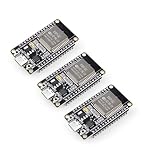
- Dual-Core Performance Up to 240 MHz: Run sensor processing, wireless communication, automation logic and connected-device tasks on a 32-bit dual-core ESP32 platform designed for responsive embedded and IoT projects
- Built-in Wi-Fi and Bluetooth 4.2: Connect to 2.4 GHz Wi-Fi networks or use Bluetooth Classic and BLE for wireless sensors, smart devices, remote controls, home automation and other connected projects
- Flexible Power-Saving Modes: ESP32 power-management features support dynamic clock scaling and low-power operating modes, helping developers reduce energy use in compatible sensing, monitoring and connected-device applications, suitable for battery-powered Internet of Things (IoT) devices.
- USB-C Programming with CP2102: Connect through USB-C for power, sketch uploads and serial monitoring, while GPIO, UART, SPI and I2C interfaces support sensors, displays, motor drivers and other modules (USB-C cable not included)
- Over-the-Air Update Support: Configure OTA functionality through a compatible ESP-32 software framework to update deployed firmware over Wi-Fi without reconnecting the board by USB for every revision
Build the low-power path in stages
- Start with a documented PHY. Use a reference implementation such as WARP to establish the packet-detection and synchronization path, then identify which operations currently run during idle monitoring.
- Add a cheap candidate trigger. Monitor RSSI or energy, or use a reduced-precision sign-bit test. Treat a trigger as a reason to inspect more samples, not as proof that the signal is a WLAN packet.
- Check STF repetition. Apply I/Q autocorrelation to the candidate and record its detection time. A 2025 MILD implementation provides one example using a 16-sample lag at a 20 MHz full-clock rate; that implementation detail is not a universal WLAN setting.
- Verify before waking the full receiver. Add stronger correlation or matched-filter verification to reject candidates that do not meet the chosen confidence criterion.
- Defer full-precision processing. Enable detailed timing, CFO estimation, channel processing, and subsequent demodulation only after the candidate has passed verification. Hardware gating can keep baseband processing and the ADC idle in the monitoring state until detection, as described in a patent implementation.
- Measure the trade-offs on the target platform. Sweep thresholds with representative SNR, CFO, multipath, and interference traces. Record detection and false-alarm curves, acquisition latency, CFO error, BER, and energy; choose the operating point according to the application’s throughput and missed-packet tolerance.
Choose thresholds for the receiver’s environment
A higher detection threshold can reduce false detections, but it also increases the risk of missing packets. There is no single threshold supported for all chipsets and conditions. Set and validate the threshold against the actual receiver, signal bandwidth, interference, SNR range, and application requirements rather than copying a value from an unrelated implementation.
- Use energy gating primarily to avoid unnecessary processing when the channel appears idle.
- Use periodicity correlation to distinguish a likely STF from energy that lacks the expected repetition.
- Use a verification stage when false packet declarations cause meaningful power use or throughput loss.
- Include difficult conditions in evaluation; a clean, high-SNR trace alone cannot establish robustness to frequency offset, multipath, or interference.
What neural preamble detection does—and does not—establish
PRONTO is a specialized approach that changes the waveform: it removes L-STF and uses neural processing of L-LTF for packet detection and coarse CFO. The IEEE PRONTO authors reported up to 40% preamble-length reduction with no BER degradation in their experiments. Their 2023 publication also reports that L-STF can account for up to 40% of preamble length and up to 32 microseconds. Those figures describe the authors’ design and results, not a general saving available to an unmodified Wi-Fi receiver.
Rank #2

- 2.4GHz Dual Mode WiFi + Bluetooth Development Board
- Support LWIP protocol, Freertos;ESP32 is a safe, reliable, and scalable to a variety of applications
- SupportThree Modes: AP, STA, and AP+STA
- Ultra-Low power consumption, Compatible with Arduino IDE
- 1PCS 30Pin ESP32 Development Board 2.4GHz WiFi Dual Cores Microcontroller Integrated with Antenna RF Low Noise Amplifiers Filters
The arXiv version of the PRONTO study reports 100% packet-detection accuracy in its experiment and coarse CFO errors as small as 3%. These are experiment-specific results; they do not establish equivalent performance across every 802.11 amendment, bandwidth, or RF environment. A neural detector should therefore be evaluated with its modified waveform and training conditions kept distinct from a legacy-compatible receiver path.
For a standards-compatible receiver, staged energy gating, STF correlation, verification, and deferred processing are the practical starting point. Neural processing is relevant when the design can control both the waveform and receiver, and when its added model and hardware requirements are acceptable.
Recommended Free Tools
Quick Recap
Best Value

- The ESP32 1.9'' LCD board has all the features of the traditional ESP32 Devkit V1 module,with the same exact peripheral ports,offers seamless integration with a 1.9-inch LCD display, eliminating the need for frustrating wires and breadboards.Display features a high-resolution 170x320 full color with ST7789 driver and is compatible with I2C interfaces. Plus,It uses Type-c usb cable to connect. Say goodbye to messy setups and hello to hassle-free electronics with the ESP32 board
- Board is based on ESP32-WROOM-32 module integrated with Antenna switches, RF Balun, power amplifiers, low-noise amplifiers, filters, and management modules, and the entire solution occupies the least area of PCB. 2.4 GHz Wi-Fi plus BLE dual-mode chip, 16MB Flash with TSMC Ultra-low power consumption 40nm technology, power dissipation performance and RF performance is the best, safe and reliable, easy to extend to a variety of applications
- Board uses SPI to connect LCD: D23/GPIO23->MOSI, D18/GPIO18->SCLK, D15/GPIO15->CS, D2/GPIO2->DC, D4/GPIO4->RST,D32/GPIO32->BLK.With this board,it's easy to display a variety of information and data
- To install the new version driver for CH340,simply search for the keywords "CH340 Driver" on Google.com or Bing.com and follow the installation instructions provided.Recommended for Win10 Operating System
- This board is an outstanding option for various Internet of Things (IoT) projects. It can be used to display network connection status,monitor information, power levels, and other relevant data. Additionally, it's suitable for building Internet Weather Stations, Graphic Plotter, Data Monitor, and Other similar applications
Rank #4

- 2.4GHz Dual Mode WiFi + Bluetooth Development Board
- Support LWIP protocol, Freertos
- SupportThree Modes: AP, STA, and AP+STA
- Ultra-Low power consumption, Compatible with Arduino IDE
- ESP32 is a safe, reliable, and scalable to a variety of applications
Rank #3
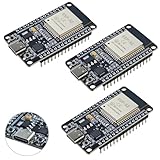
- High-performance dual-core processor – ESP32S is equipped with a powerful dual-core 32-bit CPU with a main frequency of up to 240MHz, providing smooth and efficient computing power for IoT and embedded applications.
- Wi-Fi & Bluetooth dual-mode support – Integrated 2.4GHz Wi-Fi and low-power Bluetooth, supporting wireless data transmission, remote control and smart device connection.
- Rich interfaces and functions – Provides GPIO, UART, SPI, I2C and other interfaces, supports touch sensing, infrared remote control, DAC and other functions, suitable for a variety of electronic projects.
- Low-power design – With multiple power saving modes, supports deep sleep and ultra-low power operation, suitable for battery-powered Internet of Things (IoT) devices and remote monitoring systems.
- Compatible with multiple development environments – Supports for Arduino IDE, for ESP-IDF, for MicroPython and for PlatformIO, easy to develop, suitable for beginners and advanced developers to quickly build smart applications.
Product prices and availability are accurate as of the date/time indicated and are subject to change. Any price and availability information displayed on Amazon at the time of purchase will apply.

