
There is no single ideal Vcore for every Core i7-3930K. The right 24/7 setting is the lowest load voltage that keeps your chosen frequency stable on your particular processor, motherboard, cooling system and workload. Increase voltage only in small steps, measure voltage while the CPU is loaded, and stop when temperatures or long-term reliability risk are no longer acceptable.
What the i7-3930K is starting with
Intel identifies the i7-3930K as a six-core, 12-thread, 32 nm Sandy Bridge-E desktop processor with a 3.20 GHz base frequency, turbo up to 3.80 GHz and a 130 W TDP. Intel lists the product as discontinued. The boxed processor does not include a fan or heat sink, so an overclock requires separate cooling.
Those stock specifications do not establish an overclocking voltage. Two nominally identical 3930Ks can need different Vcore for the same frequency, and motherboard load-line calibration can make a BIOS voltage differ substantially from the voltage observed under load.
How to interpret voltage numbers
BIOS-set Vcore versus load Vcore
Always state which voltage you mean. A BIOS value is the requested setting; CPU-Z, HWiNFO or a board sensor reports an observed value that may fall (vDroop) or rise under load. For comparing settings, record the sustained load Vcore rather than quoting only the BIOS number.
The Tool Desk
Outbyte Driver Updater FREEScan for outdated or missing drivers - takes under a minuteDriver Scan →Outbyte PC Repair FREERepair Windows errors before they cause bigger problemsFix Now →#1 Best Overall

- Model: Intel Core i7 Processor i7-3770
- Clock Speed: 3.4 GHz
- Max Turbo Frequency: 3.9 GHz
- DMI: 5 GT/s
- Intel Smart Cache: 8 MB
Intel’s general ceiling is not a 3930K certification
Intel’s general article for unlocked Core processors says to find the lowest stable voltage, increase it incrementally and check temperatures after each change. It also gives broad guidance that conventional air or liquid cooling should not exceed 1.4 V. That is general overclocking advice, not a Sandy Bridge-E-specific promise that 1.4 V is safe for continuous use. Processor temperature, workload, cooling quality and silicon aging still determine the practical limit.
What published 3930K examples actually show
| Source or setting | Voltage mentioned | What it means |
|---|---|---|
| Jagat Review guide (2012) | Approximately 1.35 V Vcore | The guide considered this among its daily-use settings on its tested system, with separate CPU I/O, system-agent and DRAM values. It is not Intel’s specification or a universal recommendation. |
| Tom’s Hardware discussion | 1.4 V discussed but not used for long-term operation | The reviewer said the expected gain did not justify moving to 1.4 V because long-term safety was not guaranteed. This is a personal test judgment, not a measured maximum-safe threshold. |
Neither example tells you what voltage your chip needs. A meaningful comparison also requires sustained frequency, measured load voltage, peak temperature, cooling method, stability-test workload and intended use.
Rank #2
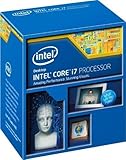
- Compatible with Z87 and Z97 motherboards. Z87 motherboard users may need to apply a BIOS update for compatibility. Not compatible with Intel Motherboards.
- LGA 1150
- Intel Rapid Storage Technology
- Quick Sync Video enabling faster video conversion
- Intel Device Protection with Boot Guard Intel IPT with PKI Intel Turbo boost technology
A practical method for finding your voltage
- Choose the target frequency. Decide whether the machine is for continuous daily use or a short benchmark. Record multiplier, base-clock settings and memory settings before changing Vcore.
- Use conservative automatic settings first. Disable features that can unexpectedly add voltage, or configure them deliberately according to your board’s manual. Keep CPU I/O, system-agent and DRAM voltages separate from Vcore; changing one does not prove the others are safe.
- Set a modest manual Vcore. Start near the lowest value that boots at the target frequency, not at a historical number copied from another system. Apply small increments rather than a large jump.
- Measure under a repeatable load. Log observed Vcore, sustained clock, package temperature and cooling-fan or pump behavior while running the workload you actually care about. A short benchmark and a long, all-core workload can produce very different temperatures.
- Check stability. Run a repeatable CPU and memory stress workload for the duration appropriate to your use, then test normal applications, sleep/wake and idle transitions. Watch for calculation errors, crashes, freezes, reboots and corrected hardware errors.
- Reduce voltage after stability is established. Lower Vcore one small step at a time and repeat the same tests. The last setting that passes is more useful than a higher setting that merely boots.
- Set a temperature policy. If the system reaches temperatures you cannot accept, improve cooling, lower frequency or lower voltage. Do not treat a cooler as making a particular Vcore automatically safe.
How to judge a 24/7 setting
- Frequency: the clock must remain sustained under the workload, not just appear briefly during turbo behavior.
- Observed load Vcore: identify the monitoring tool and whether the value is steady, droops or overshoots.
- Peak temperature: report the hottest core or package reading and the cooler and case airflow used.
- Stability evidence: name the workload, duration and any errors, rather than calling a system stable because it reached the desktop.
- Use case: a benchmark run can tolerate different compromises from a workstation that operates for years.
For a daily system, a lower-frequency overclock at substantially lower voltage is often the better engineering choice than chasing the last multiplier. Silicon degradation is gradual and difficult to predict from one session, so no published 3930K voltage can guarantee a service life.
Cooling and hardware requirements
The 3930K uses the LGA2011 platform. Verify that any replacement cooler explicitly supports LGA2011 and fits your case, motherboard heatsinks and memory. Intel’s boxed part has no included heatsink, and extra Vcore increases heat output. Better cooling can reduce temperatures and noise, but it does not certify a specific voltage or frequency.
Rank #3

- Game Without Compromise. Play harder and work smarter with Intel Core 14th Gen processors
- 20 cores (8 P-cores plus 12 E-cores) and 28 threads. Integrated Intel UHD Graphics 770 included
- Up to 5.6 GHz with Turbo Boost Max Technology 3.0 gives you smooth game play, high frame rates, and rapid responsiveness
- Compatible with Intel 600-series (with potential BIOS update) or 700-series chipset-based motherboards
- DDR4 and DDR5 platform support cuts your load times and gives you the space to run the most demanding games
Common mistakes
Copying a forum number
An owner’s 1.30 V or 1.35 V may be a BIOS setting, an idle reading or a load reading on a different board. Without frequency, measured load voltage, temperatures and workload, the number is not a useful target.
Treating 1.4 V as a guaranteed limit
Intel’s 1.4 V statement is broad guidance for conventional cooling in an unlocked-processor article. It is not a guarantee for a discontinued 32 nm Sandy Bridge-E processor running every workload indefinitely.
Rank #4

- All Core i7 processors have Intel Turbo Boost Technology
- 8 MB Intel Smart Cache is dynamically shared to each processor core, based on workload
- Quad-core processor with Intel Hyper-Threading Technology (Intel HT) delivers eight-way multicore processing
- Specs: Quad-core 3.4GHz, 8M Cache, Intel HD Graphics 2000, 95 watt TDP, Dual-channel DDR3 memory support, socket LGA1155
- Enhanced Intel SpeedStep Technology is an advanced means of enabling very high performance while also delivery power-conservation.
Ignoring voltage overshoot and droop
Load-line calibration can alter transient behavior. Check the voltage during both light and heavy load, and avoid aggressive settings whose overshoot is not visible in your monitoring data.
Calling a boot successful
Booting Windows proves only that the machine started. Errors often appear later during sustained all-core work, memory-heavy tasks or idle-to-load transitions.
Recommended Free Tools
Best Value

- 4 Cores / 8 Threads
- 3.60 GHz up to 4.20 GHz Max Turbo Frequency / 8 MB Cache. Sockets Supported: FCLGA1151, Max Memory Size: 64 GB, Memory Types: DDR4-2133/2400, DDR3L-1333/1600 at 1.35V
- Compatible only with Motherboards based on Intel 100 or 200 Series Chipsets
- Intel Optane Memory Supported
- Intel UHD Graphics 630
What to record before declaring the overclock complete
- Multiplier and sustained all-core frequency
- BIOS-set Vcore and observed minimum, typical and peak load Vcore
- Motherboard model and load-line calibration setting
- Cooler, case airflow and ambient temperature
- Peak CPU temperature
- Stress workload, duration and result
- Whether the setting is intended for daily use or a short benchmark
Frequently Asked Questions
Is 1.35 V safe for every i7-3930K?
No. Jagat Review used approximately 1.35 V in its own daily-use testing, but that result depends on its processor, board, cooling and workload and is not a blanket recommendation.
Can I run my 3930K at 1.4 V?
Intel’s general unlocked-processor guidance discusses 1.4 V with conventional air or liquid cooling, but it is not a 3930K-specific long-term safety guarantee. Use the lowest stable voltage and treat temperature and degradation risk as system-specific.
Quick Recap
Product prices and availability are accurate as of the date/time indicated and are subject to change. Any price and availability information displayed on Amazon at the time of purchase will apply.

