
Outdated Drivers Are Slowing You Down
One free scan finds every outdated or missing driver and matches the right update for your exact hardware.Free scan · exact hardware matchWindows Errors? Fix Them Before They Spread
Repair common Windows errors and clear accumulated junk for a smoother, more stable PC - no reinstall needed.Free scan · no reinstalliTechGuides is reader-supported. When you buy through links on our site, we may earn an affiliate commission. As an Amazon Associate I earn from qualifying purchases. Learn more
Building a meeting summarizer means connecting two separate AI tasks: transcribing the recording into text, then asking a chat model to turn that transcript into useful notes. Spring AI supplies a shared transcription API and model integrations for Spring applications, but it does not make a meeting-minutes format or a particular transcription provider automatic.
This walkthrough explains the architecture and the decisions to make before wiring it into a Spring Boot app. The exact dependency coordinates and supported transcription models depend on the Spring AI release you choose, so pin a version and use its matching documentation rather than mixing examples from different release lines.
What the application does
A summarizer for a completed meeting recording follows a straightforward pipeline:
What’s actually slowing this PC down?
Pick the symptom - the matching free tool is one click away.
- Accept an audio file as a Spring
Resource. - Send it to a speech-to-text model and receive a transcript.
- Pass the transcript to a chat model with instructions for the notes you want.
- Return or store the generated meeting notes.
These are distinct operations. The transcription model turns audio into text; the chat model interprets that text. Spring AI describes itself as “an application framework for AI engineering” on its project page, and its model APIs provide integration points for both stages. The application still needs to handle file validation, errors, privacy, and the output contract.
#1 Best Overall

- Stay present in every scenario: Every conversation is covered, in person, on calls, and online. 4 MEMS + 1 VPU microphones with AI beamforming capture every voice across the room. Smart Dual-Mode Recording switches automatically between phone calls and in-person. The free Plaud Desktop captures online meetings without a bot
- Walk out of every meeting with notes ready to act on: Plaud Intelligence transcribes in 112 languages with speaker labels and turns each recording into action items, decisions, and follow-ups, structured and ready to use. Choose from 10,000+ customizable templates tailored to your role and industry
- AI summary ready before you reach your desk: Auto Transfer moves each recording to the Plaud app automatically, and AutoFlow transcribes and summarizes so your notes are ready before you are back at your desk. Upgrade anytime to Pro (1,200 min/mo) or Unlimited
- Access your AI workspace anywhere: One connected workspace across Plaud Desktop, Plaud Web, and the Plaud mobile app, so your conversations and finished work follow you everywhere
- Your conversations stay private and yours: Compliant with ISO 27001, ISO 27701, SOC 2, HIPAA, GDPR, and EN 18031, with zero data used to train AI models. Trusted by 2.5M+ professionals, including legal, medical, and business professionals handling sensitive information
Choose the Spring AI version before adding dependencies
Spring AI’s current general reference displays stable version 2.0.1 and lists audio transcription among its model APIs. Its transcription reference describes a shared TranscriptionModel interface that takes an AudioTranscriptionPrompt and returns an AudioTranscriptionResponse; it also offers a convenience method for transcribing a Spring Resource. Provider selection is configured through Spring Boot. See the Spring AI API reference and the Transcription API.
Provider-neutral does not mean every provider option or upstream model is interchangeable. The detailed Spring AI OpenAI transcription page available here belongs to the 1.0 reference line. It documents a particular starter and properties and says that line uses whisper-1. Do not assume those details apply to 2.0.1 or another release. Check the reference for the exact release pinned in your project before copying dependency coordinates or model settings.
OpenAI configuration in the Spring AI 1.0 reference
For orientation only, the Spring AI 1.0 OpenAI transcription page lists the spring-ai-starter-model-openai starter and the spring.ai.openai.api-key configuration property. It also documents transcription settings for model, response format, prompt, language, temperature, and timestamp granularities. These are details of that version’s documentation, not a verified configuration recipe for every current Spring AI release. Consult the Spring AI 1.0 OpenAI Transcriptions page alongside the documentation for your chosen version.
Rank #2

- 【PCM Recording and Automatic Noise Reduction】:This digital voice recorder is equipped with advanced dual noise reduction microphones and supports 1536 kbps PCM HD audio recording, ensuring crystal-clear sound capture in any environment. Recorder device with automatic noise reduction and voice-activated recording, the recorder only picks up the sound when there’s speech, reducing background noise,Excellent sound quality can meet the needs of students, journalists, music lovers and more people
- 【136GB Memory and Long Battery Life】Voice Recorder with Playback with 8GB built-in storage and includes a complimentary 128GB TF card, this digital voice recorder can hold up to 9775 hours of recordings in MP3 format or WAV format;Recorder for lectures with a built-in 1100mAh rechargeable lithium battery, this voice recorder can continuously record for up to 68 hours on a single charge, making it perfect for back-to-back meetings, interviews, or extended classroom sessions
- 【One Click Record and Save】: Our voice recorder supports one click recording and saving functions. Even when the product is in a powered-off state, simply push up the side recording button to immediately enter recording mode, and push down the recording button to save the recording. This allows for capturing as much information as possible.Easily transfer your recordings to your computer using the USB-C connection, allowing for fast and secure file management
- 【Easy-to-Use】This portable voice recorder is designed with a simple, user-friendly interface featuring a large, easy-to-read LCD screen. The voice-activated recording (VOR) feature makes hands-free operation a breeze. With one-touch recording, users can start or stop recording instantly, even during busy moments. A-B repeat function and password protection ensure that important segments are easily accessible and secure
- 【Portable and Durable Design】Designed with portability in mind, this lightweight screen recorder fits comfortably in your pocket or bag, weighing only 97 grams. Its sleek and durable metal casing ensures longevity and protection from everyday wear and tear. Whether you’re traveling, in the office, or attending a lecture, this compact recorder is always ready to capture clear, high-quality audio
Transcribe a completed meeting recording
For batch processing, treat the recording as a completed file and pass it through the transcription model. Spring AI’s transcription API accepts an AudioTranscriptionPrompt; its convenience method can take a Spring Resource. A typical service therefore needs to load or receive the resource, invoke the configured transcription model, and extract the returned transcript before calling the summarization stage. The API reference explains the shared interface and provider configuration, but exact construction and provider options should follow your pinned release.
OpenAI’s file transcription guide describes a 25 MB limit for the documented file flow. It lists supported formats including MP3, MP4, M4A, WAV, and WebM. Validate size and type before submitting the file; if a recording exceeds the documented limit, your application needs a deliberate handling strategy rather than assuming the request will succeed. Consult the current OpenAI speech-to-text guide for file-flow details.
That guide distinguishes completed-file transcription from realtime transcription for audio that is still arriving, such as a live microphone or call. A meeting summarizer that works on an uploaded recording can use the batch path; a live captioning or running-notes feature needs a realtime transcription design instead.
Rank #3

- AI-POWERED TRANSCRIPTION & SUMMARIES: Plaud Note Pro is your professional voice transcriber, delivering high-accuracy transcription in 112 languages with auto speaker labels. Powered by top AI models and thousands of templates, Note Pro instantly creates structured summaries, mind maps, To-Do lists, and proposals tailored to your role and industry
- ENHANCED CONTEXT WITH MULTIMODAL INPUT: Capture audio, type notes, add images, and press to highlight key moments for richer context. During recording, instantly mark key moments with a single button press. Simultaneously enrich your audio by snapping photos of important documents or typing in ideas
- CHAT WITH YOUR RECORDINGS USING "ASK Plaud": Unlock deeper insights with this interactive AI. Ask questions, extract key points, draft emails, and get next-step suggestions—all grounded in your original audio for reliable, ready-to-use answers
- INTELLIGENT RECORDING WITH AI DIRECTIONAL AUDIO: Enjoy seamless, intelligent recording with Plaud Note Pro. Its AI automatically switches between call and meeting modes while recording, while directional audio and real-time spatial awareness minimize noise to capture voices with crystal clarity
- Everything Included: Includes Plaud Note Pro, magnetic case, magnetic ring, charging cable, and a free Starter Plan with 300 transcription minutes per month. Upgrade anytime in the Plaud app to Pro Plan (1,200 min/mo) or Unlimited Plan(Up to 24 hours of transcription per user per day)
Choose transcript output for the review workflow
Plain transcript text is usually the simplest handoff to a summarization prompt. Other formats can help when people need to review timing or identify speakers, but supported formats depend on the transcription model and integration:
- Plain text: a simple input for a chat model to summarize.
- JSON variants: useful when the application needs machine-readable transcription data; available combinations vary by model.
- SRT or VTT: subtitle formats that retain timing information where supported.
- Diarized output: speaker-labeled segments from a model/API combination that supports diarization.
OpenAI’s Create transcription API reference documents multiple model IDs and output formats, with diarization available through a specialized model. That upstream list does not establish that every model or option is exposed by your Spring AI release. Check both the provider API and the Spring AI version-specific documentation before designing around a feature.
Independent reader supportYour contribution helps us test, update, and keep practical guides available for everyone.Summarize the transcript with an explicit contract
Once transcription returns text, send it to a chat model with a prompt that defines what useful notes mean for your audience. Spring AI provides the model integration; the prompt and schema below are application choices, not built-in meeting-summary features:
Rank #4
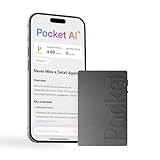
- YOUR AI PERSONAL ASSISTANT FOR EVERYDAY PRODUCTIVITY: More than a voice recorder, Pocket works as your AI personal assistant to capture, transcribe, and summarize meetings, calls, and ideas instantly. Core features are included out of the box, with optional advanced tools available for power users.
- ONE-TAP RECORDING FOR REAL-LIFE MOMENTS: Capture meetings, phone calls, and in-person conversations instantly with a simple tap, no typing, no interruptions, just effortless note-taking anywhere you go.
- SMART AI INSIGHTS & ORGANIZATION: Pocket automatically turns recordings into clear summaries, key action items and structured conversation maps so you can quickly review what matters without digging through audio.
- TURN CONVERSATIONS INTO ACTION WITH “ASK POCKET”: Don’t just record, understand. Instantly ask questions across your meetings, extract key insights and generate next steps in seconds. All grounded in your recordings, so answers stay accurate and reliable.
- MAGSAFE COMPATIBLE FOR SEAMLESS USE: Easily attach Pocket to your iPhone or other MagSafe compatible devices for convenient, hands-free recording on the go. Perfect for capturing meetings, calls, and ideas without needing to hold your device.
Summarize the meeting transcript below using only information stated in it.

Return:
- Summary: the main purpose and outcome
- Decisions: each decision explicitly made
- Action items: task, owner (or "unassigned"), and due date (or "not stated")
- Open questions: unresolved questions raised in the meeting

Do not infer owners, dates, or decisions. If a detail is absent, mark it as not stated.

Transcript:
{transcript}
In a production application, format the prompt using the chosen Spring AI release’s APIs rather than concatenating arbitrary user text into a fixed string. If downstream systems need predictable fields, define a structured response contract and validate the model output before saving or displaying it. A prompt can ask the model not to invent details, but the application should still make the transcript available for verification.
Design around the main implementation choices
| Choice | Use it when | Trade-off |
|---|---|---|
| Completed file or realtime audio | File processing fits uploaded recordings; realtime processing fits audio that is still arriving. | The file guide documents a 25 MB limit for its described flow; realtime needs a streaming-oriented design. See OpenAI’s speech-to-text guide. |
| Shared API or provider-specific options | Use Spring AI’s TranscriptionModel interface for a common integration point; use provider-specific settings when you need provider features. |
The shared API helps decouple application code, but does not erase differences in model capabilities or options. See the Transcription API. |
| Plain text or richer transcript | Use plain text for a basic summary; retain timestamps, subtitles, or diarized segments when review or attribution matters. | Format and feature availability depend on the model and the Spring AI integration. See the OpenAI transcription API reference. |
Handle failures and protect meeting content
A useful implementation needs more than a successful model call. Treat meeting audio and transcripts as potentially sensitive data, and decide how long each is retained, who can access it, and whether it may be sent to the configured provider. The cited model references describe APIs, not your organization’s consent, retention, or compliance requirements.
- Reject unsupported file types and files outside the applicable size limit before calling the provider.
- Handle transcription and chat-model errors separately so a failed summary does not obscure whether a transcript was produced.
- Keep the transcript or a suitable diagnostic identifier available for troubleshooting, subject to your retention policy.
- Make it clear that generated notes are derived from the transcript and can omit context; let users check them against the source when accuracy matters.
- Return a controlled error or retry only where appropriate; avoid automatically resubmitting large recordings without considering cost and duplicate work.
What Spring AI contributes—and what remains yours
Spring AI supplies a Spring-oriented interface for transcription, configuration-driven provider selection, and integrations with AI models. The application design remains responsible for choosing a compatible release and provider, deciding between batch and realtime audio, defining the meeting-notes format, validating generated output, and setting data-handling rules. Separating transcription from summarization makes those responsibilities visible and gives you room to change one stage without treating it as the other.
Quick Recap
Product prices and availability are accurate as of the date/time indicated and are subject to change. Any price and availability information displayed on Amazon at the time of purchase will apply.

