
Recommended Free Tools
iTechGuides is reader-supported. When you buy through links on our site, we may earn an affiliate commission. As an Amazon Associate I earn from qualifying purchases. Learn more
Track each business trip as it happens, save supporting records, and keep income and vehicle costs separate. For 2026, the IRS standard mileage rate changes on July 1: apply 72.5 cents per qualifying business mile from January 1 through June 30, and 76 cents per qualifying business mile from July 1 through December 31. Your choice between that method and actual vehicle expenses affects what else you can deduct, so accurate records matter either way.
This guide covers U.S. federal tax recordkeeping for rideshare drivers, especially self-employed or independent-contractor drivers. State and local rules may differ, and whether a particular app-on, repositioning, or between-passenger trip qualifies can depend on the facts.

What to record for every rideshare business trip
Keep a timely, trip-level log rather than relying on a year-end estimate. Record the date, destination or general area, business purpose, and either miles driven or odometer readings at the start and end. Also track total annual vehicle mileage, including personal miles, so you can establish business use.
- Date: when the trip occurred.
- Destination or area: enough detail to identify where the business driving took place.
- Business purpose: for example, a passenger pickup or drop-off. Describe the actual purpose rather than labeling every mile as business use.
- Mileage: trip miles or beginning and ending odometer readings.
- Annual totals: total vehicle miles and business miles for the year.
The IRS says records entered weekly can be considered timely. A logbook is one convenient option, but a spreadsheet or digital log can also work if it captures adequate details. The IRS provides a sample daily mileage and expense log with fields such as date, destination, business purpose, odometer readings, miles, expense type, and amount. The IRS does not require drivers to use that form or a particular product. See IRS Publication 463.
Do not fill gaps by guessing. Publication 463 states, “You can’t deduct amounts that you approximate or estimate.” If you missed entries, preserve available contemporaneous records, such as platform trip histories, and consult a tax professional about how to handle incomplete substantiation.
A practical recordkeeping routine
- At the start of a business-use period, note the date and odometer reading. If you use the car personally during the same period, record enough information to separate those miles.
- For each business trip, enter the destination or area, the business purpose, and trip miles or start-and-stop odometer readings.
- Log parking and tolls separately. Save receipts or transaction records, and note the business context.
- Save receipts for vehicle costs if you use actual expenses or are evaluating which method fits your circumstances. Organize items such as fuel, repairs, insurance, and registration.
- Keep platform statements and payment records. They help reconcile receipts and other income, but they do not replace a mileage log.
- Review the log weekly to catch missing dates, odometer entries, and receipts while details are still available.
- At year end, total business and overall vehicle miles and retain the log and supporting documents with your tax records.
Choose a vehicle deduction method
For a vehicle used for both personal and rideshare driving, the two broad federal methods are standard mileage and actual expenses. Their calculations and supporting records differ:
Rank #2
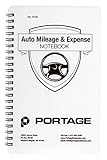
- TRACK MILEAGE AND MORE: Tracking mileage and expenses for work doesn’t have to be a time-consuming chore. With the Portage mileage notebook, keeping track of business expenses is easy.
- EXTRA PAGES: Meant to last the whole year, the Portage mileage log includes 60 pages, 33% more pages than other top brands. This mileage notebook measures 5” x 8”, making it large enough to comfortably fill out while being small enough to fit in a glove compartment, center console or work bag.
- SIMPLE FORMAT: Each page is designed with spaces for the date, business purpose, odometer reading, and total mileage. Plus, our form boxes give you plenty of space to write comfortably.
- DURABLE DESIGN: Built to last, our spiral mileage logbook is constructed with extra-thick paper and a stiff backing meant to stand up to daily use.
- RECORD ON YOUR TERMS: Whether you need to track actual expenses or just mileage for a flat deduction rate, this journal has you covered.
| Consideration | Standard mileage | Actual expenses |
|---|---|---|
| Basic calculation | Qualifying business miles multiplied by the IRS rate applicable on the date driven | Eligible vehicle costs multiplied by the business-use share |
| Costs accounted for | The rate represents vehicle operating costs; do not also deduct actual operating costs covered by it | May include depreciation or lease payments, registration, licenses, insurance, repairs, fuel, garage rent, and tires, subject to applicable rules |
| Parking and tolls | Qualifying business parking and tolls may generally be added separately | Track business-related parking and tolls distinctly as costs |
| Mixed personal and business use | Keep both business-mile and total-mile records | Allocate mixed-use costs between business and personal use, commonly by mileage |
| Method restrictions | For an owned vehicle, choosing the standard mileage rate in the first year it is available for business use preserves the option to switch later, subject to applicable rules. For a leased vehicle, using the rate requires continuing it for the entire lease, including renewals. | Availability depends on vehicle history and depreciation rules. |
These are general federal rules, not a calculation of your individual deduction. Review Publication 463, Publication 583, and the IRS guidance on business use of a car before choosing. The relevant facts include how the vehicle was used in earlier years and, for a leased vehicle, the lease period.
Apply the 2026 mileage rate by date
The IRS set the 2026 standard mileage rate at 72.5 cents per business mile for January 1–June 30, 2026, then revised it to 76 cents per business mile for July 1–December 31, 2026, citing increased fuel prices. Split the calculation at June 30; do not apply a single rate to every 2026 mile. Check the IRS standard mileage rates page for later years or revisions.
Rank #3

- KEEP DETAILED RECORDS OF THE CAR'S MILEAGE - This mileage log book for car, whether you are a professional driver who needs accurate mileage reimbursement records, or you just want to track your personal vehicle usage, our mileage log book is the perfect choice for you
- UNIQUE DESIGN - The vehicle mileage log book with spiral binding for truck drivers has 1732 entries to meet your needs. Each entry has space to log date, depart time, odometer readings, business & personal miles, purpose, vehicle info, start location & destination and expenses.
- MORE FUNCTIONS - Auto mileage log book help you keep track of mileage, expenses, gas consumption, lubrication, repairs & accessories, annual summary, contacts, important dates and notes.
- HIGH QUALITY - This mileage log book for business or personal, mileage logbook size of 5.8" x 8.5", just the perfectly size to fit in your backpack, purse or laptop case. Is used to high quality 100gsm pure white paper, elastic band and a back pocket for extra space.
- THE PERFECT GIFT - This driving log book can effectively organize and track your work or life, give it to your children, friends, family as a gift for Birthday| Easter|Children's Day|Halloween|Thanksgiving|Christmas|Back to school and New Year's Day.
Keep operating costs from being counted twice
If you use standard mileage, do not add actual operating costs already represented by the rate, such as fuel or repairs. Qualifying business parking and tolls may be treated separately. Parking at a regular workplace is generally a commuting expense, not a deductible business parking cost. Under the actual-expense method, record eligible costs and allocate mixed personal and business use rather than claiming the full cost of a partly personal vehicle.
Which rideshare miles count as business use?
The general IRS rule treats driving between home and a main or regular workplace as personal commuting. Rideshare driving does not make every mile automatically deductible: passenger trips, movement between trips, repositioning, and driving while waiting may require a fact-specific analysis. Do not assume every mile with the app open qualifies. Keep an accurate log of what you did, and use the IRS rules or a qualified tax professional to assess uncertain trips.
Rank #4

- Little LogBook is an automated electronic GPS trip logbook solution that takes away the responsibility and inaccuracy of manually recording trip logs.
- Highly sensitive and accurate SIRF GPS chip provides world-class trip logging.
- Plug and Go - No vehicle Installation Required
- Secure - Device is password secure so your movements cannot be studied should your device be lost or stolen.
- Free software updates - We'll keep your software up to date and cutting edge, for free. Will work on Microsoft windows 10 or newer (not Mac compliant yet)
Likewise, a cost is not deductible merely because it occurred while you were driving. The expense must qualify as business-related and be adequately documented. Parking and tolls should be recorded with enough context to distinguish business use from commuting or personal use.
The Tool Desk
Outbyte Driver Updater FREEScan for outdated or missing drivers - takes under a minuteDriver Scan →Outbyte PC Repair FREEClear out junk files and repair common Windows errorsFree Scan →Track rideshare income as well as expenses
Keep platform statements and payment records and report all gig income, including amounts not shown on an information return. The IRS says, “You must report all income on your tax return, even if you don’t receive Forms 1099 from the businesses that pay you.” See the IRS page Manage taxes for your gig work.
Best Value

- KEEP DETAILED RECORDS OF THE CAR'S MILEAGE - This mileage log book for car, whether you are a professional driver who needs accurate mileage reimbursement records, or you just want to track your personal vehicle usage, our mileage log book is the perfect choice for you
- UNIQUE DESIGN - The vehicle mileage log book with spiral binding for truck drivers has 1732 entries to meet your needs. Each entry has space to log date, depart time, odometer readings, business & personal miles, purpose, vehicle info, start location & destination and expenses.
- MORE FUNCTIONS - Auto mileage log book help you keep track of mileage, expenses, gas consumption, lubrication, repairs & accessories, annual summary, contacts, important dates and notes.
- HIGH QUALITY - This mileage log book for business or personal, mileage logbook size of 5.8" x 8.5", just the perfectly size to fit in your backpack, purse or laptop case. Is used to high quality 100gsm pure white paper, elastic band and a back pocket for extra space.
- THE PERFECT GIFT - This driving log book can effectively organize and track your work or life, give it to your children, friends, family as a gift for Birthday| Easter|Children's Day|Halloween|Thanksgiving|Christmas|Back to school and New Year's Day.
The IRS generally requires a person to file if net self-employment earnings are at least $400. Independent contractors may also need to make estimated tax payments during the year. See IRS gig-work tax guidance for federal filing and payment information.
How long to keep your records
Publication 463 gives three years from filing as the general period for keeping records that support a deduction or income item. Vehicle business-use documentation can be needed for each year in the vehicle’s recovery period, so do not discard relevant mileage and vehicle records merely because three years have passed. Keep receipts, logs, platform statements, and tax filings together for the applicable period; see Publication 463 for the record-retention rules.
Quick Recap
Product prices and availability are accurate as of the date/time indicated and are subject to change. Any price and availability information displayed on Amazon at the time of purchase will apply.
Quick wins for a faster PC:
Scan for outdated or missing drivers - takes under a minuteDriver Scan →Repair Windows errors before they cause bigger problemsFix Now →
