
iTechGuides is reader-supported. When you buy through links on our site, we may earn an affiliate commission. As an Amazon Associate I earn from qualifying purchases. Learn more
To reduce delay on an Owncast-to-YouTube stream, tune the two services separately: lower Owncast’s latency buffer for the next stream, then choose the YouTube latency mode that fits your audience. Use RTMP or RTMPS where your relay supports it, follow YouTube’s CBR and keyframe guidance, and monitor buffering and stream health as well as delay. There is no published, guaranteed end-to-end latency figure for this combined setup.
Where the delay comes from
The stream passes through separate stages. An encoder sends video to Owncast over RTMP; Owncast processes it and serves segmented HLS video to its viewers. A relay or restreamer then sends the stream to YouTube, which ingests and processes it before buffering playback for viewers. Each stage can add delay, so reducing one buffer does not guarantee a matching reduction in the total source-to-viewer delay.
Owncast’s published latency estimates describe its own buffer levels. YouTube’s latency figures describe its playback modes. They are not measurements of the same synchronized path and should not be added together as a prediction for your channel.
Do these 3 things before closing this tab:
1Repair Windows errors before they cause bigger problems2Fix the driver behind crashes, sound loss and screen glitches3Clear out junk files and repair common Windows errorsFor a 24/7 channel, the goal is not the lowest possible number at any cost. Less buffering can make playback closer to live, but it also leaves less video available to ride out network interruptions. Owncast puts the tradeoff plainly: “It’s up to you to decide you want lower delays over less reliability or a more reliable stream with additional delay.” (Owncast: Reducing Latency)
#1 Best Overall

- 【Hardware H.265/H.264 Encoding at 1080P60】Dedicated hardware encoder delivers broadcast-quality 1080P60 streams with H.265/H.264 compression. Reduces bandwidth usage by up to 50% compared to legacy H.264-only solutions, while maintaining crisp, crystal-clear video output.
- 【Broad Protocol Support for IP Distribution】 Supports SRT, RTMP(S), RTSP, UDP, HTTP, HLS, WebRTC, TRTC, Icecast and SHOUTcast — integrate seamlessly with CDNs, surveillance NVRs, IPTV systems and browser-based monitoring dashboards. One device replaces multiple single-purpose streaming boxes.
- 【Browser-Based Setup in Minutes】 Set up in minutes through any browser — no software, drivers or OS compatibility issues. DHCP is enabled by default to prevent IP address conflicts on your network. Note: basic networking knowledge (IP address, RTSP/RTMP configuration) is recommended for advanced streaming setups.
- 【Compact Design with Flexible Deployment】Palm-sized form factor (approx. 90×54×29mm) fits easily behind monitors, on shelves, or in equipment racks. Low power consumption ensures reliable 24/7 operation for live events, remote monitoring, and digital signage.
- 【Professional Audio & OSD Overlay + 1-Year Warranty】 Supports HDMI embedded audio plus external 3.5mm input. Built-in OSD generator adds scrolling text, logos, or timestamps directly to the video stream — ideal for branding, event info, or security labeling. Backed by a 1-year warranty and 24/7 online technical support.
Establish a baseline before changing settings
Measure the parts of the path separately where possible. Use a visible clock or a repeatable live event to compare the source, Owncast playback, and YouTube playback before and after each change. This is a practical measurement method, not a built-in product feature.
- In Owncast, inspect Stream Performance for viewer latency, segment download time, player network speed, errors, and quality changes. See Owncast Stream Performance.
- In YouTube Live Control Room, watch stream health and its messages, then review live metrics. See YouTube live stream metrics.
- Record both delay and reliability: buffering frequency, recovery after network blips, Owncast CPU load, output quality, and whether encoding keeps up during continuous operation.
Choose an Owncast latency buffer
Owncast’s documented latency buffer levels trade delay for resilience. These are approximate Owncast platform estimates, not end-to-end results for a YouTube relay. Level 2 is the default in Owncast’s documentation; changing the level affects the next stream, not one already running.
Rank #2

- 【Ultra-Compact & Low-Power Design】 Experience maximum portability with this pocket-sized (2.95 x 1.26 x 0.87 in) HDMI video encoder, weighing only 1.13oz. Engineered for extreme efficiency, it consumes just 2.4W and can be powered directly via USB or the HDMI source. This eliminates the need for bulky external adapters—perfect for professional live broadcasting, mobile setups, and installations with limited space.
- 【Pro-Grade 1080P HD Encoding】 Deliver crystal-clear video transmission with support for up to 1080P60 HD input and stable 1080P30 encoding output. This versatile hardware encoder is fully compatible with a wide range of HDMI sources, including NVRs, PCs, drones, DSLR cameras, and professional camcorders. Whether for security monitoring or live broadcasting, it ensures a high-quality, low-latency video feed for a truly reliable user experience.
- 【2K SRT & Multi-Protocol Compatibility】 Experience broadcast-level stability with 2K SRT support, delivering secure, reliable, and ultra-low latency video over any network. This hardware encoder ensures peak efficiency with H.265/HEVC and H.264/AVC compression. Fully compatible with a wide range of protocols—including RTMP, RTMPS, HLS, RTSP, and UDP—it is tailor-made for social media live production, house of worship, secure IP surveillance, and corporate training.
- 【Centralized Cloud Management】 Beyond standard Web-UI, this encoder supports DDMALL LinkCloud for remote monitoring and control via the Internet. For large-scale deployments, we provide specialized support to assist you in building a self-hosted private cloud, ensuring absolute data security and efficient video distribution. This professional-grade centralized control simplifies complex workflows for multi-site corporate, educational, or broadcast environments.
- 【More Excellent Features & Reliable Support】This encoder elevates your broadcasting with dual-stream output, enabling simultaneous streaming to platforms like YouTube and Facebook. It also features real-time OSD overlays and direct Web-UI signal preview for precise control. Beyond the device, our professional technical team provides customized solutions, continuous firmware updates, and expert guidance to ensure your live production stays seamless.
| Owncast buffer level | Segment length | Approximate Owncast latency | When to consider it |
|---|---|---|---|
| 0 | 1 second | About 5 seconds | Try when closeness to live matters most and monitoring shows enough stability. |
| 1 | 2 seconds | About 8–9 seconds | A lower-delay option with more buffer than level 0. |
| 2 (default) | 3 seconds | About 10 seconds | The documented default balance. |
| 3 | 4 seconds | About 15 seconds | Consider more buffer if the lower settings produce instability. |
| 4 | 5 seconds | About 18 seconds | Prioritize a larger playback buffer over minimal delay. |
If your current broadcast is too far behind, try a lower level on the next stream, then watch for buffering and errors under representative network conditions. Move back up if viewers stall or monitoring shows instability. Lower levels also create more, smaller segments and more requests, which can affect storage or CDN costs in a setup that uses them; that is not a promise that changing storage or CDN providers will reduce latency. Details and the current setting guidance are in Owncast’s latency documentation.
What’s actually slowing this PC down?
Pick the symptom - the matching free tool is one click away.
Keep Owncast’s viewer control separate from the YouTube output
Owncast’s viewer-side “Minimize latency” option changes playback behavior for a person watching the Owncast player. It can speed playback when conditions allow, back off when conditions worsen, and turn itself off after repeated buffering. It does not change the upstream stream sent to YouTube. Owncast documents this option for v0.3.0 and later; confirm availability in the version you run. (Owncast: Reducing Latency)
Rank #3

- ⭐【Innovative Product with Leading Technology】- Equipped with an advanced H.265 /H.264 dual encoding chip, supports 4K UHD (3840x2160) video input and output, with a maximum frame rate of 30fps at 4K resolution and up to 120fps at 2K and lower resolutions, delivering a smooth and detailed visual experience. It also supports HDCP 1.4 decryption, easily decoding various HDMI ultra HD video sources, delivering a cinematic visual experience for both professional live streaming and 4K ultra HD content transmission.
- ⭐【Multi-protocol and Multi-platform Compatibility】- Fully compatible with streaming protocols such as HTTP, RTSP, RTMP(S), SRT, HLS(M3U8), MP4, Multicast(UDP, RTP, PTL), ONVIF, FLV, WebRTC, TRTC, ICECAST, it can simultaneously output 4 video streams with different protocols and push them to live streaming platforms such as YouTube, Facebook, Twitch, and Vimeo with one click. Simultaneous live streaming across multiple platforms can be achieved without additional equipment.
- ⭐【Highly Customizable Settings to Meet Individual Needs】- It supports adding static text, scrolling captions, brand logos, and timestamps. Users can freely adjust core parameters such as video resolution, frame rate, and bitrate, and also perform personalized editing functions such as video cropping, rotation, flipping, and mirroring. It supports dual input of HDMI embedded audio and line-in audio, with adjustable sound quality, making your live stream content more distinctive and allowing you to create a unique brand live stream style.
- ⭐【Stable and Efficient Transmission, Easy Operation】- Employing HDMI to Ethernet core connection technology, it ensures stable and reliable network transmission with low latency and no lag, adapting to various network environments. Equipped with an intuitive user interface and detailed instruction manual, no professional technical background is required; setup can be completed quickly after connecting the device. It is also compatible with multiple terminals such as computers and mobile phones for management, and the video stream status can be viewed in real time via a URL.
- ⭐【Lifetime Free Warranty and Technical Supports】- All URayCoder video codecs come with a lifetime free warranty and technical supports, supporting secondary development and feature customization to meet enterprise-level personalized needs. Meanwhile, we providing many kinds of customization services such as shell pattern printing, logo addition, hardware and function development, ensuring reliable quality and worry-free after-sales service.
Avoid passthrough as a latency shortcut
Do not turn on video passthrough solely to reduce delay. Owncast warns that passthrough can increase latency because it cannot re-encode and optimize the source for segmentation. It can save CPU, but then the source encoder is responsible for compatibility and suitable keyframe spacing; long keyframe intervals can add latency.
Instead, match the incoming broadcast settings to the quality Owncast can deliver and the server can encode. Owncast recommends starting with one average output, checking how the hardware handles it, and adding variants only if capacity permits. Extra conversions and output variants use additional processing resources. See Owncast’s video quality settings and video quality and performance guidance.
Rank #4
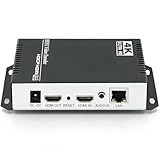
- 【Innovative Product with Leading Technology】- Equipped with an advanced H.265 /H.264 dual encoding chip, supports 4K UHD (3840x2160) video input and output, with a maximum frame rate of 30fps at 4K resolution and up to 120fps at 2K and lower resolutions, delivering a smooth and detailed visual experience. It also supports HDCP 1.4 decryption, easily decoding various HDMI ultra HD video sources, delivering a cinematic visual experience for both professional live streaming and 4K ultra HD content transmission.
- 【Multi-protocol and Multi-platform Compatibility】- Fully compatible with streaming protocols such as HTTP, RTSP, RTMP(S), SRT, HLS(M3U8), MP4, Multicast(UDP, RTP, PTL), ONVIF, FLV, WebRTC, TRTC, ICECAST, it can simultaneously output 4 video streams with different protocols and push them to live streaming platforms such as YouTube, Facebook, Twitch, and Vimeo with one click. Simultaneous live streaming across multiple platforms can be achieved without additional equipment.
- 【Highly Customizable Settings to Meet Individual Needs】- It supports adding static text, scrolling captions, brand logos, and timestamps. Users can freely adjust core parameters such as video resolution, frame rate, and bitrate, and also perform personalized editing functions such as video cropping, rotation, flipping, and mirroring. It supports dual input of HDMI embedded audio and line-in audio, with adjustable sound quality, making your live stream content more distinctive and allowing you to create a unique brand live stream style.
- 【Stable and Efficient Transmission, Easy Operation】- Employing HDMI to Ethernet core connection technology, it ensures stable and reliable network transmission with low latency and no lag, adapting to various network environments. Equipped with an intuitive user interface and detailed instruction manual, no professional technical background is required; setup can be completed quickly after connecting the device. It is also compatible with multiple terminals such as computers and mobile phones for management, and the video stream status can be viewed in real time via a URL.
- 【Lifetime Free Warranty and Technical Supports】- All URayCoder video codecs come with a lifetime free warranty and technical supports, supporting secondary development and feature customization to meet enterprise-level personalized needs. Meanwhile, we providing many kinds of customization services such as shell pattern printing, logo addition, hardware and function development, ensuring reliable quality and worry-free after-sales service.
Choose YouTube’s latency mode for the kind of channel you run
YouTube’s latency mode controls the playback side of the path. The right choice depends on how much interaction matters and how much buffering your viewers can tolerate. YouTube’s estimates below apply to its modes, not to the total delay from your source through Owncast and a relay.
Recommended Free Tools
| YouTube mode | Best fit | Published audience guidance | Tradeoff |
|---|---|---|---|
| Normal | Non-interactive streams, such as ambient or music channels | No single latency estimate stated in the cited mode guidance | Lowest buffering risk among the modes. |
| Low | Limited interaction | Most viewers should see less than 10 seconds of latency | More buffering risk than normal; 4K is not supported. |
| Ultra-low | Real-time interaction | Most viewers should see less than 5 seconds of latency | Greater buffering risk; 4K is not supported. |
For a mostly unattended 24/7 channel, normal latency may be the more reliable fit. Choose low or ultra-low only when the interaction benefit justifies the added buffering risk. YouTube’s guidance summarizes the tradeoff: “Lower latency may mean more playback buffering.” Read YouTube’s explanation of live streaming latency.
Best Value

- 4K HDMI VIDEO ENCODER — BROADCAST-QUALITY HARDWARE ENCODING — hardware encoder for live streaming, capturing HDMI input at up to 4K@30fps with H.265/H.264 dual codec. Unlike software solutions, this dedicated hardware video encoder processes video in real time with zero host CPU load. Supports adjustable bitrate 2–61,440 kbps with CBR/VBR/AVBR/FIXQP — ideal for church broadcasts, online education, and live event production
- VIDEO ENCODER FOR LIVE STREAMING TO ANY PLATFORM — Stream simultaneously via RTMP, RTSP, SRT, HLS, FLV, TS, RTC, and UDP Multicast from a single video encoder for live streaming. Push directly to YouTube, Twitch, Zoom, OBS, or any RTMP-compatible CDN. Each channel outputs 2 concurrent streams at independently configurable resolutions — from 4K@30 down to 720P@30 — for seamless multi-bitrate adaptive delivery
- VIDEO ENCODER DECODER FOR IPTV & MULTI-VIEW DISPLAY — This all-in-one video encoder decoder not only encodes HDMI sources but also decodes network streams (RTMP/RTSP/SRT/FLV/HLS/TS) back to HDMI output at 4K@30. Purpose-built as a video encoder for IPTV deployments — supports HLS, TS, and UDP Multicast for hotel TV systems, campus networks, and digital signage. Create 9-split, 4-split, PiP, and fully custom multi-view layouts with drag-and-drop ease
- PROFESSIONAL OSD OVERLAY, LOCAL RECORDING & 24/7 RELIABILITY — Add text, scrolling tickers, logos, real-time clocks, and mosaic overlays via intuitive web interface — no extra software needed. Record streams directly to USB drives or network storage (NFS/CIFS) for instant playback without a PC. Compact 125×105×30mm all-metal chassis (~400g), DC 12V/2A powered, rated 0–45°C for 24/7 continuous operation in churches, classrooms, control rooms, and broadcast studios
- 【FREE WARRANTY AND TECHNICAL SUPPORT】— All video encoders/decoders come with a free warranty and professional technical support. We support secondary development and feature customization to meet enterprise-level personalized needs. Additionally, we offer various customization services, such as custom case printing, logo addition, and hardware and feature development, ensuring reliable quality and worry-free after-sales service.
Check ingest protocol and encoder settings
YouTube’s RTMP and RTMPS recommendations include constant bitrate (CBR) and a two-second keyframe interval; do not exceed four seconds. Use RTMPS when supported to encrypt the ingest connection. Confirm that the relay or intermediary you actually use can preserve or configure the relevant settings; YouTube’s guidance does not establish compatibility for a particular Owncast relay implementation.
HLS ingest can be appropriate for requirements such as HDR or codecs outside RTMP support, but YouTube says HLS ingest adds latency because it sends video segments and disables ultra-low-latency mode. Where low delay is the priority and your full relay path supports it, use YouTube’s RTMP/RTMPS route instead. See YouTube’s live encoder settings.
Change one factor at a time and retest
- Capture the current result. Note the Owncast buffer level, YouTube latency mode, ingest protocol, encoder keyframe interval, viewer delay, errors, and buffering.
- Change the Owncast buffer for a new stream. Start with one step lower if delay is the priority; keep the setting only if buffering remains acceptable.
- Set YouTube’s mode for the audience. Use normal for a non-interactive channel, low for limited interaction, or ultra-low only when immediate interaction matters more than the additional buffering risk.
- Verify the relay and encoder path. Check that the settings are supported end to end; target CBR and a two-second keyframe interval, staying within YouTube’s four-second maximum.
- Test representative content and conditions. YouTube recommends testing with audio and video motion resembling the real event. Monitor Owncast performance and YouTube stream health through the conditions your channel normally encounters.
- Keep or revert based on the whole result. Retain a change only when measured delay improves without unacceptable buffering, errors, quality changes, or encoding strain.
Troubleshooting: delay, buffering, and unstable playback
| Symptom | Likely factor to check | What to try |
|---|---|---|
| YouTube remains noticeably behind Owncast | YouTube playback mode, ingest protocol, or buffering at another relay stage | Check YouTube’s latency mode and whether the relay uses RTMP/RTMPS or HLS ingest. Measure each stage separately rather than assuming Owncast’s buffer estimate is the total. |
| Viewers buffer after lowering Owncast’s level | The smaller buffer has less room to absorb network interruptions | Raise the Owncast buffer one level on the next stream and compare buffering and delay. |
| Passthrough increases delay or produces poor segmentation | The source may not have suitable segmentation or keyframe intervals | Disable passthrough for latency tuning and let Owncast re-encode where the server has capacity. Check source keyframe spacing. |
| Encoding falls behind or quality changes | Server capacity may be insufficient for the conversion workload or number of output variants | Start with one average output, inspect Owncast’s performance metrics, and add variants only when the hardware can keep up. |
| Ultra-low mode is unavailable or the path still feels delayed | HLS ingest disables YouTube ultra-low latency; low and ultra-low modes also exclude 4K | Check protocol and resolution requirements against the selected mode before changing additional settings. |
Keep rights and channel eligibility separate from latency tuning
Changing buffers, protocols, or latency modes does not establish that you have the rights to rebroadcast material or that a channel meets YouTube’s monetization or reused-content policies. Review the rules that apply to your content and channel separately before leaving a loop online. For a practical preflight list, use the copyright safety checklist.
Or let it run in the cloud
If your 24/7 YouTube channel is built from uploaded recordings or a playlist rather than a live Owncast feed, StreamNeo is a separate cloud option: upload a video or build a playlist, add your YouTube stream key once, and go live. It loops uploaded video; it does not relay an Owncast live stream or go live from a camera.
Quick Recap
- Nothing has to stay on at home: the stream runs from the cloud, not a computer, OBS session, or home connection.
- Any uploaded quality up to 4K 60fps streams as made, at one flat price per slot, with no re-encode or quality tiers.
- StreamNeo automatically recovers if YouTube drops the stream.
- The first day is free with no card, one free day per account. Monthly: $9.99 per month.
Start your free StreamNeo day.
Product prices and availability are accurate as of the date/time indicated and are subject to change. Any price and availability information displayed on Amazon at the time of purchase will apply.

