
iTechGuides is reader-supported. When you buy through links on our site, we may earn an affiliate commission. As an Amazon Associate I earn from qualifying purchases. Learn more
To reduce a devotional song video’s file size, lower its export bitrate; if the picture still looks good, also try a lower resolution or frame rate. For a live YouTube stream, adjust the encoder’s outgoing bitrate and quality to fit the internet connection. Those are separate jobs: changing the live bitrate does not shrink a prerecorded file or local recording.
First decide what needs to be smaller
A smaller prerecorded video file is useful when you need to store or upload a recording. A lower live bitrate reduces the data your encoder sends to YouTube and may help when the venue’s upload connection is constrained. You may need to do both, but changing one does not automatically change the other.


- Smaller file: change the export settings in your video editor or transcoder, then export a new file.
- Lower live data rate: change the livestream encoder’s output settings before going live.
- Both: make and check a smaller export, then configure the live encoder separately if that video will be streamed.
YouTube’s upload recommendations and its livestream ingestion recommendations are different. For uploads, YouTube recommends MP4, H.264 video, and variable bitrate; for live encoding, it recommends constant bitrate (CBR) and provides separate bitrate guidance. See YouTube’s upload encoding recommendations and its live encoder settings and bitrate recommendations.
What’s actually slowing this PC down?
Pick the symptom - the matching free tool is one click away.
How to make a prerecorded devotional video smaller
1. Lower the export bitrate
In your editor’s export or render settings, reduce the video bitrate and export a test. Bitrate is the main control for encoded video data at a given duration. Lowering it can reduce file size, but lowering it too far can make text, fine details, or moving imagery look soft or blocky. Compare the test on the screen and at the size viewers are likely to watch.
#1 Best Overall
![Prism Video Converter Software - Convert Between AVI MP4 MOV and Other Formats [Download]](https://m.media-amazon.com/images/I/51snGe-czuL._SL160_.jpg)
- Convert or compress video files within minutes
- Universal video converter supporting all popular formats
- Batch video conversion to convert thousands of videos
- Set compression/encoder rates, resolution and frame rate of output files
- Add video files directly from DVDs
For YouTube uploads, YouTube recommends H.264 in an MP4 container and variable bitrate (VBR). The exact bitrate that preserves acceptable quality depends on the video and its encoding settings, so do not treat a livestream bitrate recommendation as an upload export target.
2. Consider resolution and frame rate
If a lower bitrate alone does not give you a useful size reduction, try lowering resolution or frame rate and review the result. A devotional video with a mostly still image may not need the same frame rate as footage with frequent movement, but check the actual material: animated backgrounds, camera movement, or changing lyrics can make motion and detail more noticeable. Keep text and any visual details legible.
Rank #2
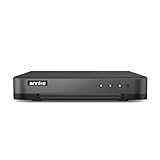
- 【Important Note on Storage】This unit is sold without a hard drive and supports real-time viewing only. For video playback, please install a compatible HDD (Max. 10TB supported).
- 【5-in-1 Hybrid DVR】The expandable hybrid digital video recorder, combing the features of DVR/NVR/HVR, supports up to 16 pcs TVI, AHD, CVI, CVBS & extra 2 IP cameras. So, you have full-range security camera choices for your property.It is highly recommended that this DVR works with ANNKE wired cameras to to achieve optimal performance.
- 【Innovative Human & Vehicle Detection】By setting up the human & vehicle detection, you will get motion detection alerts only when people and vehicles are in the frame. Minimizing unwanted alerts triggered by bugs, animals, leaves and so on.
- 【Advanced H.265+ Video Format】H.265+ coding offers longer recording time before having to overwrite the older recordings, saving up to 50% of storage space than H.265 systems. You'll enjoy fast & smooth streaming without latency when accessing the DVR.
- 【Remote Access with All Devices & Browsers】Link the DVR to a router and download ANNKE Vision App to control the DVR remotely. Access the DVR via 3G/4G/5G or with your smartphones, tablets, computers and browsers (Google Chrome, Firefox, Microsoft Edge, Internet Explorer, etc.).
3. Use duration to estimate the result
A useful rough estimate for encoded video payload is:
Megabytes ≈ bitrate in megabits per second × duration in seconds ÷ 8
Rank #3
For example, the estimate scales with both bitrate and runtime: at the same bitrate, a longer recording contains more encoded data. This is not an exact final-file-size promise. Audio and container overhead add data, and the export’s actual size depends on encoding.
Choose live settings for the connection in India
For a livestream, choose settings your upload connection can sustain reliably, rather than simply selecting the highest available quality. YouTube recommends testing upload bitrate and using a quality that is reliable for the connection. Its figures are platform recommendations, not measurements of Indian broadband or guarantees for a particular venue or ISP.
| Live output (H.264) | YouTube-listed minimum video bitrate | YouTube-recommended video bitrate |
| 720p at 30 fps | 3 Mbps | 8 Mbps |
| 1080p at 30 fps | 5 Mbps | 14 Mbps |
These are YouTube Help recommendations accessed in 2026. They are starting points, not guaranteed connection requirements for every event. Measure the actual upload connection at or near the venue and time you expect to stream. If it cannot reliably sustain your chosen settings, test a lower bitrate or output quality and check the picture and stream health during a rehearsal.
The Tool Desk
Outbyte PC Repair FREERepair Windows errors before they cause bigger problemsFix Now →Outbyte Driver Updater FREEFix the driver behind crashes, sound loss and screen glitchesFind Drivers →Keep song audio intelligible
Reducing video data should not make the devotional song difficult to hear. YouTube lists 128 kbps as its recommended stereo audio bitrate for live encoder settings. Check that the voice and instruments remain balanced and clear in a test stream, especially if the source audio is already compressed.
Best Value
![VideoPad Video Editor - Create Professional Videos with Transitions and Effects [Download]](https://m.media-amazon.com/images/I/91zAUcPqOhL.png._SL160_.png)
- Apply effects and transitions, adjust video speed and more
- One of the fastest video stream processors on the market
- Drag and drop video clips for easy video editing
- Capture video from a DV camcorder, VHS, webcam, or import most video file formats
- Create videos for DVD, HD, YouTube and more
Use the live encoder settings YouTube specifies
YouTube’s live encoder guidance lists RTMP or RTMPS and supports H.264, H.265, and AV1. It recommends CBR and a two-second keyframe interval; the interval should not exceed four seconds. Follow the current requirements for your selected encoder and protocol, and confirm that its output resolution, frame rate, bitrate, and audio settings match the stream you intend to send.
Independent reader supportYour contribution helps us test, update, and keep practical guides available for everyone.Rehearse and check the recording
- Test the connection. Run an upload-speed test near the time and place of the event. YouTube specifically recommends testing upload bitrate.
- Send a rehearsal stream. Use representative song audio and any motion or lyric changes that will appear in the real programme. Check both the image and sound.
- Watch YouTube stream health. If the stream reports problems, lower the outgoing bitrate or quality and test again rather than assuming the connection can sustain the original setting.
- Check the local archive. If your encoder is also recording locally, confirm that the file is being created and growing. Its file size is governed by its recording/export settings, not automatically by changes to a separately stored source video.
Does HLS make the file smaller?
No. HLS is a livestream delivery protocol, not a way to compress a prerecorded file. YouTube notes that HLS has higher latency than RTMP because it sends video in segments, and it has specific segment and transport requirements. Choose a protocol your encoder supports and that fits your delivery needs; do not change protocols expecting a stored video to shrink. See YouTube’s live encoder guidance and its HLS ingestion requirements.
Common problems and fixes
- The exported video is still too large: lower the export bitrate and review the picture; if acceptable, test a lower resolution or frame rate. Also account for runtime, since longer videos contain more data at the same bitrate.
- The live stream buffers or has poor stream health: test the venue’s upload connection, then reduce the outgoing bitrate or quality until the connection can sustain it reliably.
- The picture looks poor after lowering bitrate: raise the bitrate or reduce resolution/frame rate less aggressively, then rehearse again. A size target is not useful if lyrics or important image detail become hard to see.
- The live stream is stable, but the local recording is too large: change the local recording or export settings. A change to the livestream’s outgoing bitrate does not resize an independently stored file.
- The audio is unclear after reducing the video bitrate: check the encoder’s audio settings and the source mix separately. YouTube’s live guidance recommends 128 kbps for stereo audio.
Or let it run in the cloud
If your goal is to keep uploaded devotional videos playing on a YouTube channel continuously, StreamNeo is a cloud option: upload a recording or build a playlist, add your YouTube stream key, and go live. It loops uploaded videos, not a live camera feed. Nothing has to stay running at home; each slot streams your upload as made, up to 4K 60 fps, at one flat price per slot, and StreamNeo automatically recovers if YouTube drops the stream. The first day is free with no card required. Monthly pricing is $9.99 per month. StreamNeo is a service by Yorker Media; see StreamNeo for details. For Indian creators, UPI is supported. Start with the free first day on StreamNeo.
Do these 3 things before closing this tab:
1Fix the driver behind crashes, sound loss and screen glitches2Repair Windows errors before they cause bigger problems3Scan for outdated or missing drivers - takes under a minuteCopyright before you go live
Reducing file size or changing bitrate does not grant permission to use a song recording. Make sure you have the rights or permissions needed for the music and any accompanying visuals before streaming. Review the copyright safety checklist before choosing material.
Quick Recap
Product prices and availability are accurate as of the date/time indicated and are subject to change. Any price and availability information displayed on Amazon at the time of purchase will apply.

