
Quick wins for a faster PC:
Repair Windows errors before they cause bigger problemsFix Now →Fix the driver behind crashes, sound loss and screen glitchesFind Drivers →iTechGuides is reader-supported. When you buy through links on our site, we may earn an affiliate commission. As an Amazon Associate I earn from qualifying purchases. Learn more
Monitor an autonomous AI agent across its entire workflow—not just its final answer. Record what it was asked to do, which tools it used, what evidence and results it received, and what actions followed. Then check task outcomes and behavior over time, and connect important findings to a defined review, approval, block, or escalation path.
Why a final-answer check is not enough
An agent’s apparent answer is only the visible end of a sequence. It may have interpreted a request, selected tools, gathered evidence, acted on external systems, and retried or changed course before producing its final response. A plausible-sounding answer can therefore conceal an incomplete task, a mistaken tool call, or an unintended action.


NIST’s Building Evaluation Probes into Agentic AI describes the hidden complexity behind agents’ interfaces and emphasizes visibility into multi-step workflows, tool use, gathered evidence, and machine-readable audit trails. Partnership on AI also discusses sequence-level anomalies, including goal drift: a run may diverge from its objective across several steps even when no single action looks obviously wrong in isolation.
Do these 3 things before closing this tab:
1Clear out junk files and repair common Windows errors2Fix the driver behind crashes, sound loss and screen glitches3Repair Windows errors before they cause bigger problemsAnthropic defines an agent as “an AI model that directs its own processes and tool use when accomplishing a task.” That autonomy makes the amount of oversight, the permissions granted, and the consequences of an action relevant to monitoring design.
#1 Best Overall
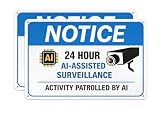
- 🧠 SIGNALS ADVANCED AI MONITORING Ai-focused messaging creates the impression of a higher level of security, increasing perceived risk and helping deter unwanted activity
- 👁️ 24-HOUR MONITORING MESSAGE “AI-Assisted Surveillance” and “Activity Patrolled by AI” reinforce constant oversight and elevate the sense of protection
- 🛡️ WEATHERPROOF ALUMINUM BUILD Durable, rust-resistant metal designed for long-term outdoor use without fading
- 🔧 EASY INSTALLATION ANYWHERE Pre-drilled holes for fast mounting on fences, walls, gates, or entry points (hardware not included)
What to monitor
Use distinct signal groups so that a healthy service is not mistaken for a successful agent. Operational errors, task quality, and action behavior answer different questions.
Operational errors
Track practical signs that a run or its dependencies may be failing: malformed or failed tool calls, unavailable services, timeouts, repeated retries, incomplete runs, and unusual resource use. These signals help locate execution problems, but passing operational checks does not establish that the agent completed the user’s task correctly.
Rank #2

- -MODERN AI-DRIVEN DETERRENT Ai-focused messaging signals advanced monitoring and increases perceived risk—helping discourage trespassers before they act
- -HIGH-VISIBILITY WARNING DESIGN Bold red “WARNING” header and clear surveillance icons grab attention instantly from a distance
- -DURABLE WEATHERPROOF ALUMINUM Rust-free, fade-resistant metal built to withstand sun, rain, and harsh outdoor conditions year-round
- -EASY TO MOUNT ANYWHERE Pre-drilled holes for quick installation on fences, gates, walls, or posts (hardware not included)
- -IDEAL FOR ANY PROPERTY TYPE Perfect for homes, driveways, garages, businesses, warehouses, and restricted access areas
Task quality and degradation
Measure whether the run achieved its intended outcome using task-specific checks. Depending on the task, that may mean verifying a required state change, checking a result against a rubric, or confirming that required steps were completed. Track results across comparable tasks to spot declining performance or drift. NIST’s report on deployed AI monitoring identifies performance degradation and drift as monitoring challenges, while noting that AI systems can vary and behave unpredictably after deployment.
Action and goal deviation
Check whether the agent chose tools and took actions within the task’s intended scope. Look for unexpected tool choices, actions unrelated to the objective, or a sequence that appears to move away from the user’s goal. Reviewing the run as a whole matters here: an action’s significance may depend on the earlier instructions, evidence, and steps that led to it.
Rank #3
Build a monitoring workflow
1. Define correct completion
For each task type, write down the intended outcome, actions that are prohibited, and acceptable ways to reach the outcome. Create a representative evaluation set that includes routine work and consequential edge cases. Evaluate execution against these task-specific criteria rather than treating fluent output as proof of success. NIST’s evaluation-probe work describes integrating checks into workflows and accumulating their results as an audit trail.
2. Capture enough of each run to reconstruct it
Keep a correlatable record of the request and relevant input context, agent outputs, tool calls and arguments, tool results, relevant state changes, timing, retries, and completion or failure status. This is an implementation schema, not a standard prescribed by NIST. Preserve the context needed to investigate a run while applying the privacy, security, access-control, and retention requirements of your deployment.
3. Compare like with like
Record the behavior-affecting configuration associated with each run, such as the model, instructions, available tools, and policy settings. When task quality or action patterns change, compare runs with similar workloads and configurations where possible. A workload change can look like model drift, so keep changes in the system and changes in the incoming tasks distinguishable.
The Tool Desk
Outbyte PC Repair FREERepair Windows errors before they cause bigger problemsFix Now →Outbyte Driver Updater FREEScan for outdated or missing drivers - takes under a minuteDriver Scan →There is no universal drift formula or alert threshold established by the cited sources. Choose task-specific thresholds and review criteria, document why they fit the consequences of that task, and revisit them as the workload or agent changes.
4. Route findings to a response
Decide in advance which events warrant logging for later review, which should pause for approval, and which should be blocked or escalated immediately. Match the intervention to the likely consequence and reversibility of the action. This is an operational design recommendation, not a universal rule quoted by a source.
Monitoring is useful only if findings can change what happens next. OpenAI describes monitoring internal coding agents alongside evaluations and controls, including evaluating monitor performance and acting on monitor predictions. Its account is a deployment example, not a guarantee that a given monitor or control will work for another system. Test both whether the monitor detects relevant cases and whether the response path can prevent or limit harm.
5. Investigate and improve evaluations
When a finding needs investigation, review the full trace and identify where the run went wrong: for example, an integration failure, a misunderstood instruction, an unexpected tool result, or a broader change in behavior. If the incident exposes a recurring or consequential failure mode, add a representative case to future evaluations. This closes the loop between production monitoring, investigation, and pre-deployment or recurring checks.
How to assess a monitoring approach
Whether you are designing an internal process or assessing a monitoring system, use these questions to find gaps. They are practical comparison criteria—not a standardized vendor ranking or a substitute for task-specific evaluation.
| Axis | Question to ask |
|---|---|
| Coverage | Does it capture a whole run, including tool calls and relevant evidence, or only requests and final responses? |
| Timing | Can a finding pause or redirect an action before it has an impact, or does it only support investigation after the run? |
| Evaluation | Does it check task outcomes and changes in behavior as well as technical errors? |
| Response | Can a finding reach the person or control responsible for review, approval, blocking, or escalation? |
| Auditability | Can a reviewer reconstruct the sequence and identify the evidence that informed the agent’s action? |
| Fit | Does the monitoring and intervention policy account for the agent’s permissions, task, and the consequences of mistakes? |
What the evidence does—and does not—establish
NIST’s 2026 report on monitoring deployed AI describes work preceded by three practitioner workshops in 2025. That figure describes the report’s development, not monitoring effectiveness or adoption. The cited NIST, OpenAI, Anthropic, and Partnership on AI material supports the need for workflow visibility, evaluation, post-deployment monitoring, and controls, but does not establish a universal configuration that guarantees safety or correctness. Nor does it provide one numeric alert threshold suitable for every agent.
Quick Recap
Product prices and availability are accurate as of the date/time indicated and are subject to change. Any price and availability information displayed on Amazon at the time of purchase will apply.

