
iTechGuides is reader-supported. When you buy through links on our site, we may earn an affiliate commission. As an Amazon Associate I earn from qualifying purchases. Learn more
Start by finding your household’s biggest energy uses, then tackle heating and cooling, hot water, and appliances before spending money on upgrades. Compare tariffs using your actual consumption—including fixed charges—and treat savings estimates as specific to your home, local prices, and comfort needs.
Where does household energy go?
Heating and cooling, hot water, refrigeration, and other appliances can account for substantial household use; pools and spas are also significant for some homes. Which load matters most depends on the home, climate, equipment, and household routines. Begin with your recent bills or meter data rather than assuming that a particular appliance is the main culprit.
Use bills and meter data to find your large loads
- Review bills across several billing periods. Note both the amount of energy used and the unit rates and fixed supply charges.
- If your provider or meter offers usage by day or time, look for recurring peaks and compare them with heating, cooling, hot-water use, cooking, laundry, or other routines.
- Check whether a large load runs continuously or at scheduled times. Monitoring can help identify patterns, but a bill total alone may not reveal which appliance caused them.
National figures can provide context, but they are not household targets. The UK Department for Energy Security and Net Zero reported median domestic consumption in England and Wales in 2024 of 10,000 kWh of gas and 2,500 kWh of electricity. In its 2026 NEED report, it also found those medians were 43% and 33% lower, respectively, than in 2005. These are population-level figures, not predictions for an individual home or proof that one specific measure caused the long-term decline.
What can you change now?
Try low-cost changes that fit your home and routine before committing to equipment or renovation. Australian Government household guidance highlights the following measures; local climate, equipment instructions, and advice from your energy authority may call for different settings.
#1 Best Overall

- ENERGY STAR certified smart thermostat for home that helps you save energy and stay comfortable.Product note: You can also check your system’s compatibility before purchasing a Nest thermostat with our online Nest Compatibility Checker on the Google Nest support page.Connectivity Protocol : Wi-Fi.Connectivity Protocol : Wi-Fi
- The Nest Thermostat is designed to work without a C wire in most homes, but for some systems, including heating only, cooling only, zone controlled, and heat pump systems, you’ll need a C wire or other compatible power accessory. Lock feature: No
- Nest Thermostat turns itself down when you leave, so you don’t waste energy heating or cooling an empty home; easily program an energy efficient schedule in the Google home app on your Android or iPhone
- Remote control lets family members change the thermostat temperature from anywhere on a phone, laptop, or tablet[1]
- Savings Finder looks for more ways your thermostat can help you save, and suggests tweaks to your schedule in the app; check with your energy provider to learn more about rebates and more ways to save on a Nest thermostat
Heat or cool only the space you use
- Where your system allows it, condition rooms that are in use rather than the whole home.
- Block drafts around doors and windows with suitable seals, and use curtains or blinds to manage heat gain and loss in the relevant season.
- Choose a temperature that is comfortable and safe for the people in your home. Do not reduce heating below a safe level, especially where someone has health-related heating needs.
The Australian guide suggests seasonal thermostat ranges of 18–20°C for heating and 25–27°C for cooling, and estimates that each additional degree can increase heating or cooling energy use by 5–10%. These are figures from Australian guidance, not universal settings or a guaranteed saving for every home. Climate, system type, health needs, and local guidance matter.
Use less hot water where practical
- Shorten showers if that is comfortable and practical for your household.
- Consider a compatible low-flow showerhead, checking that it suits your plumbing and hot-water system.
- Follow local safety requirements and the manufacturer’s instructions for water-heating equipment; do not adjust safety settings just to reduce consumption.
Run appliances efficiently
- Wash clothes in cold water when suitable for the fabric and cleaning task, and run full loads rather than several small ones.
- Switch off devices that do not need to remain on. Leave refrigeration, medical equipment, and other essential devices operating as needed.
- When replacing an appliance, consider its expected running cost and suitability as well as its purchase price.
The English Housing Survey’s 2022–23 energy report found that in England, in response to rising prices in 2022, 51% of households reported reducing the hours they heated their home, 46% reported heating to a lower temperature, and 42% reported using less electricity. These were multiple-response survey findings from that period, not a recommendation to compromise safe or comfortable heating and not a measure of current prevalence.
Rank #2
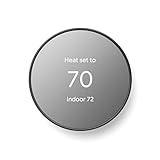
- ENERGY STAR certified smart thermostat for home that helps you save energy and stay comfortable.Connectivity : Wi-Fi - 802.11b/g/n 2.4 GHz, 802.11a/n 5 GHz Wi-Fi., Wireless interconnect : Bluetooth Low Energy Please refer to the product description section below for all applicable legal disclaimers.Product note: You can also check your system’s compatibility before purchasing a Nest thermostat with our online Nest Compatibility Checker on the Google Nest support page
- The Nest Thermostat is designed to work without a C wire in most homes, but for some systems, including heating only, cooling only, zone controlled, and heat pump systems, you’ll need a C wire or other compatible power accessory
- Nest Thermostat turns itself down when you leave, so you don’t waste energy heating or cooling an empty home. Lock feature: No
- Programmable thermostat that lets you create an energy efficient schedule in the Google Home app on your Android or iPhone
- Remote control lets family members change the thermostat temperature from anywhere on a phone, laptop, or tablet[1]
How should you compare energy tariffs?
Compare complete offers against your household’s actual usage pattern. A cheaper unit rate by itself does not prove that a tariff will cost less overall: fixed or supply charges and the times when you use energy also affect the bill.
Do these 3 things before closing this tab:
1Fix the driver behind crashes, sound loss and screen glitches2Repair Windows errors before they cause bigger problems3Scan for outdated or missing drivers - takes under a minute- Use bills or meter records to estimate how much energy you use and, if available, when you use it.
- Compare both unit rates and fixed charges. Check whether the offer’s rates or terms vary by time, and match its stated periods to your household schedule.
- Consider whether you can realistically move flexible use—such as laundry or some water heating—to a lower-priced period before choosing a time-of-use plan.
- Check local comparison tools and market rules. Availability of smart meters, tariffs, and comparison services depends on where you live.
The Australian Government’s household energy guidance points readers to its tariff comparison calculator and cautions that calculator results are guides; individual circumstances affect the outcome. Its examples and tariff context are Australian, so use the regulator or official comparison resource for your own location.
Rank #3

- An Alexa thermostat - Amazon Smart Thermostat is an easy way to switch from a traditional thermostats for homes and help reduce energy usage.
- Create comfort zones throughout your home by connecting to select Alexa devices to automatically adjust heating and cooling based on temperature readings or presence detection.
- Save money and energy - After purchase, Amazon will send you an email with details about home thermostat rebates that may be available from energy providers in your area.
- Save energy - According to EPA estimates, ENERGY STAR certified thermostats save an average of $90 on yearly energy bills.
- Programmable thermostat and automatic control - Create your own home, away and sleep schedules, or have Alexa automatically control the temperature with Alexa+ advanced features.
When are home upgrades worth considering?
Once you understand your main loads and have tried suitable low-cost changes, assess upgrades in context. Insulation, air sealing, duct sealing, heating and cooling equipment, water heaters, appliances, and lighting are possible areas to consider. The right measure depends on the building, existing equipment, climate, energy prices, and how long you expect to stay.
Assess the home before replacing equipment
- Compare expected running costs as well as purchase and installation costs.
- Choose equipment that is efficient and appropriately sized for the home and its needs; a high-efficiency model is not automatically the right fit.
- For permanent changes, renters should check with the landlord. For larger upgrades, consider a qualified local assessment rather than relying on a generic savings estimate.
Efficiency improvements can reduce the energy needed to maintain comfort, but households may respond by heating more often or choosing a higher temperature. The UK NEED analysis explicitly accounts for this comfort-taking in its discussion of measured consumption. For that reason, a single guaranteed saving or payback period is not credible without assumptions about the home, measure, local prices, and household behaviour.
Rank #4

- Save up to 23% every year on heating and cooling costs, adjusts to your set schedule to save energy when you’re gone and optimize comfort when you’re home. Compared to a hold of 72
- Compatible with 85% of systems, check your system’s compatibility with our online ecobee Compatibility Checker on the ecobee support page
- Change your temperature by easily tapping the color touchscreen or using the ecobee app. Plus, free software upgrades ensure you get the best out of your Smart Thermostat Essential, for years to come
- Automatically adjusts to your set schedule to save energy when you’re gone and optimize comfort when you’re home. Keep track of your energy consumption when you're on the go on the ecobee app
- Easy DIY install. No C Wire, no problem. Get the ecobee Power Extender Kit (PEK) for homes without a C-Wire and keep your walls looking nice with our trim kit – both sold separately
Check local incentives rather than assuming eligibility
Rebates and assistance programs vary by jurisdiction and can change. For example, the U.S. Department of Energy says its Home Energy Rebates Program is active only in select states; check the program’s current local availability, eligibility, and terms before planning around it. Its program caps are not estimates of what a household will save on energy bills. Elsewhere, use current official government or regulator information for the programs that apply to your home.
The Tool Desk
Outbyte Driver Updater FREEScan for outdated or missing drivers - takes under a minuteDriver Scan →Outbyte PC Repair FREEClear out junk files and repair common Windows errorsFree Scan →How much can these changes lower your bill?
There is no reliable percentage that applies to every household. Lower consumption can reduce the variable part of a bill, but the total bill also depends on fixed charges, tariff design, weather, household needs, and comfort choices. If a home becomes more comfortable after an upgrade, residents may use more heating or cooling, changing the measured reduction. Track consumption and bills over comparable periods, while accounting for seasonal conditions and any tariff change, to see what changed in your own home.
Quick Recap
Best Value

- PRIVACY PROTECTION*: Sensi won’t sell your personal information to third parties
- EASY DIY INSTALLATION: Use the built-in level and step-by-step app instructions for a quick installation. Works with HVAC equipment found in most homes. Common wire (c-wire) is not required in most applications
- SAVE ABOUT 23% ON HVAC ENERGY*: The ENERGY STAR-certified Sensi smart thermostat can help you save energy with features like flexible scheduling, remote access and usage reports
- SIMPLE CONFIGURATION: Looks and feels like a thermostat. Has buttons and fits the same space as a traditional thermostat so you don’t have to patch and paint your walls
- SMART MAINTENANCE: Sensi can help monitor the performance and efficiency of your HVAC system by delivering valuable usage reports, alerts about your equipment, and maintenance reminders like filter replacement
Product prices and availability are accurate as of the date/time indicated and are subject to change. Any price and availability information displayed on Amazon at the time of purchase will apply.

