
What’s actually slowing this PC down?
Pick the symptom - the matching free tool is one click away.
Generative AI can help you outline, draft, rewrite, format, and check technical documentation—but it should not be the authority on how your product works. Give it approved sources and a specific version to work from, ask it to flag uncertainty, validate examples and procedures, and have a qualified person review the result before publication. The safest approach is to treat AI as a contributor in the same versioned workflow as code, not as an automatic documentation publisher.
Where generative AI can help with technical documentation
Use AI for work that benefits from a fast first pass or a systematic comparison against source material. Google’s developer documentation guidance identifies uses such as improving existing documents, generating first drafts, converting Word documents to HTML or Markdown, and reformatting content to match a documentation style guide.
- Plan: Turn a defined audience, task, and source set into an outline.
- Draft: Create an initial walkthrough, reference explanation, or troubleshooting section from approved materials.
- Transform: Rewrite for a different reader, simplify language, or convert content to a requested format while preserving technical meaning.
- Check: Compare a draft with code, design documents, or existing procedures to identify gaps, conflicts, undefined terms, and potentially stale details.
These are assistance tasks, not proof that the output is correct. A fluent explanation can still omit a prerequisite, invent behavior, or combine details from incompatible versions.
Set boundaries before asking for a draft
Specific inputs reduce ambiguity and make review more useful. State the audience, what the reader needs to accomplish, the product and version, supported environments, relevant terminology, and the required output format. Supply the authoritative source files or repository context the model is allowed to use.
Windows Errors? Fix Them Before They Spread
Repair common Windows errors and clear accumulated junk for a smoother, more stable PC - no reinstall needed.Free scan · no reinstallOutdated Drivers Are Slowing You Down
One free scan finds every outdated or missing driver and matches the right update for your exact hardware.Free scan · exact hardware match#1 Best Overall

- 3 Pack of Wide Ruled Poly Notebook - Color varies (pink, Purple, Teal Yellow)
- 100 sheets of wide-ruled notebook paper
- Durable poly front cover and thick gray board backer
- Measures 9" x 11"; fits into most backpacks, bookbags, and totes
Define the source and uncertainty rules
Tell the model to use only the supplied or approved sources, identify where each non-obvious claim comes from, distinguish documented facts from inferences, and mark unsupported details for review rather than filling gaps with a guess. If sources disagree, ask it to show the conflict instead of silently choosing one.
Protect repository and customer information
Use only the source access the task requires. Redact secrets and sensitive material, and check the tool’s privacy and retention controls before providing proprietary code or documents. Restricting access helps limit exposure; it does not make generated output safe to publish without review.
A reliable AI-assisted documentation workflow
1. Ask for an outline before prose
Start with the reader’s task and source set, and request an outline that surfaces prerequisites, platform or version differences, and likely failure cases. Review the outline for missing topics before asking for a full draft. This is easier than discovering that an entire prerequisite or branch is absent after polishing several pages of prose.
Rank #2

- 【All-in-One Set for Writing】This notebook and pen set combines a A5 faux leather journal with a matching pen. Perfect as a journal set, journaling set, journal and pen set – all with a built-in pen holder that keeps your tool secure.
- 【Secure Pen Holder Design】This journal with pen holder keeps your pen always attached. The integrated loop turns this notebook with pen into a reliable everyday carry. It’s also a journal with pen that looks professional on any desk, from meetings to coffee shops.
- 【Premium Paper for Your Journal】Open this journal and enjoy 160 pages of smooth, 100gsm thick ruled paper. The journal pen glides without bleed-through. Use it as a notebook and pen combo for work or personal writing.
- 【Thoughtfully Designed for Daily Use】The A5 size fits most bags. An elastic closure secures pages, two ribbon bookmarks mark your place, and an expandable back pocket stores receipts or cards. Whether you need a journal with pen for reflections or a notebook with pen holder for meetings, this design delivers.
- Versatile & Gift-Ready】This notebook and pen set is also a journaling set – perfect for work notes, personal journaling, or gifting. Great for professionals, students, artists, and travelers.
2. Generate a constrained draft
Ask for scannable headings, direct instructions, examples, expected results, and error handling where the sources support them. For API or code documentation, provide the relevant interface definitions and repository context; a generic prompt such as “document this API” does not establish which behavior is current or supported.
Require source paths or citations alongside non-obvious claims. If the model cannot support a statement from the supplied material, it should label it for review rather than state it as fact.
3. Check claims and gaps
After drafting, ask for a separate claims-and-gaps review. A useful claims table includes the claim, source or code location, confidence, applicable version, and unresolved question. Also ask the model to look for contradictory instructions, undefined terms, missing prerequisites, stale paths, and examples that do not match the current interface.
Rank #3

- Product Size (W x H x D): 5.8 x 8.3 x 0.4 inches (148 x 210 x 10
- Weight: 12.2 oz (360 g)
- Texture: Yuukari Writing Paper, 95 g/m2, 96 sheets; Cover: Special paper, foil stamping, thread binding spine cloth binding
Use this as a review aid, not an independent verification: the model can misread a source or miss a conflict. A reviewer should confirm consequential claims against the referenced material.
4. Apply the house style
Provide the team’s style guide as an explicit constraint, then edit for short sentences, direct voice, consistent terminology, clear headings, accessible link text, and examples readers can follow. Microsoft Learn recommends a casual, friendly voice and simple sentences, and advises checking spelling and grammar. Style checks improve readability; they do not establish technical accuracy.
5. Validate technical instructions
Run code samples, API requests, configuration snippets, links, and version-specific procedures through the same review or CI process used for engineering changes. Check that commands work in the stated environment and that examples match the documented interface. AI can suggest likely gaps, but it cannot replace execution or approval by a subject-matter owner.
Rank #4
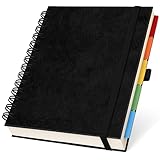
- 8x10” NOTEBOOK WITH ADJUSTABLE DIVIDERS – Stay organized with our 8x10” 300 pages college ruled notebook featuring five removable, colorful plastic dividers. Rearrange sections to fit your projects, courses, or daily tasks. Ideal for students, professionals, or anyone who loves writing and organizing. Great for back-to-school, office use, or as a thoughtful gift for colleagues, friends, or family.
- DURABLE HARDCOVER DESIGN WITH PREMIUM FEEL – Crafted with a leather-feel marbled hardcover and sturdy double-ring binding, our A4 professional notebook protects your notes while looking sleek and modern. It is durable for everyday use, from backpacks to briefcases, making it perfect for college students, teachers, and office professionals.
- 300 THICK COLLEGE-RULED PAGES – NO BLEED THROUGH – Write smoothly on 100gsm premium paper designed for gel pens, markers, and highlighters. With 300 lined pages, you’ll have plenty of space for notes, lists, and journaling.
- 180° LAY-FLAT SPIRAL DESIGN FOR EASY WRITING – Our double-ring spiral notebook opens fully flat, making every inch of the page accessible. You can write comfortably across two pages, whether planning your day, brainstorming ideas, or crafting your next creative project.
- DESIGNED WITH FUNCTIONAL FEATURES – Stay organized with built-in front and back pockets for loose notes or stickers, elastic closure band to keep pages secure on the go, and a pen loop holder to keep your favorite writing tool within reach. It also comes with free tab label stickers so you can customize each removable divider! Our notebook delivers more flexibility — combining a planner, organizer, and journal all in one!
6. Publish with provenance and maintain it
For consequential documentation, keep a useful record of the prompt or transformation, the source revision, the reviewer, and the review date. Disclose AI assistance when policy or audience expectations require it. Revisit the page when relevant code, dependencies, or support policy changes.
Keep documentation in the same versioned workflow as code so changes can be reviewed together. Google’s developer documentation guidance favors a small set of fresh, accurate documents over a sprawling collection in varying states of repair, and recommends updating documentation alongside code changes and deleting dead documentation.
Prompt pattern for a grounded technical draft
Adapt this prompt to your team’s source policy and review process. Attach or identify only material the model is permitted to use.
Do these 3 things before closing this tab:
1Scan for outdated or missing drivers - takes under a minute2Repair Windows errors before they cause bigger problems3Fix the driver behind crashes, sound loss and screen glitchesBest Value

- Comprehensive Set: The waterproof notebook set includes 3 waterproof notebooks, a black canvas bag, and 2 spray ballpoint pens. The waterproof bag can conveniently store notebooks and pens, suitable for users who need to take notes on the go
- Waterproof Notepad: No need to worry about your notes being damaged by unexpected weather. Our write in the rain notebook are made of stone paper, pocket notepad can resist rain, sweat, grease, mud, etc., keeping your notes clear and easy to read
- Lightweight and Portable: The small notepad measures 3 x 5 inches, 100 pages/50 sheets. The lightweight design makes the all weather notebook a perfect travel companion, ensuring that you can easily carry the tactical notebook wherever you go
- Diverse Uses: In addition to meeting the diary and list needs of daily life and work, the sturdy and waterproof design of this waterproof notepad and pen allows you to use write in the rain notebook as an outdoor diary, memo pad or notepad
- Widely Applicable: Whether you are an office worker, a field worker, an outdoor camping explorer, a chef, a military reporter or a military police, the waterproof notebook and pen set is an ideal choice
Act as a technical editor.
Audience: [role]
Reader task: [what the reader needs to do]
Product and version: [version]
Supported environments: [platforms or configurations]
Use only these approved sources: [files, links, or repository paths]
Output format: [format]

Preserve technical meaning. For every non-obvious claim, add the source path or citation. Distinguish facts from inferences. Mark uncertainty as NEEDS-REVIEW; do not guess. Check prerequisites, platform differences, error handling, terminology, and whether examples match the supplied interface. Follow this style guide: [rules or reference].

Return an outline first. After approval, produce the draft and a separate claims-and-gaps table with columns for claim, source, confidence, version, and unresolved question.How to assess an AI documentation tool
Evaluate a tool against the workflow and risks of your team, rather than choosing solely by how quickly it drafts. Microsoft Azure guidance describes repository-oriented opportunities such as generating API documentation and diagrams, finding undocumented dependencies, and cross-referencing code with design documentation and operational signals. Whether a particular tool can do these tasks reliably depends on its capabilities and the quality and scope of the sources it can access.
- Grounding: Can it show the source behind a claim, and does it distinguish missing evidence from established behavior?
- Repository context and access: Can you scope which files it can use and limit access to what the task requires?
- Editorial control: Can you specify structure, terminology, style rules, and output format?
- Review integration: Does it fit version control, pull requests, approvals, and the existing change process?
- Validation: Can examples be run or checked in your normal test and CI workflow?
- Governance: Can your team manage retention, monitoring, review, and disclosure requirements?
- Observability and cost: Can you understand how the system is used and assess the total cost of operating it?
A fast drafting tool that cannot respect access boundaries, expose sources, or fit the approval process may create more editorial risk than it removes.
Risks to check before publication
- Invented behavior: Compare API descriptions and product claims with the actual interface and authoritative source files.
- Missing prerequisites: Check required permissions, configuration, dependencies, and setup steps against the procedure’s stated environment.
- Version mixing: Label the product version and verify that instructions do not combine behavior from different releases.
- Exposed context: Minimize source access and redact sensitive material before using an AI service.
- Polished but unsupported prose: Trace important claims to sources and require a responsible technical owner to approve the page.
These controls align with the CLeAR framework’s principles—Comparable, Legible, Actionable, and Robust—which connect documentation with responsible development and evaluation. Microsoft’s guidance also emphasizes governance, mapping, measurement, management, documenting capabilities and limitations, disclosure, controls, monitoring, and review.
Keep AI-assisted documentation useful to readers and searchers
Readable, accurate documentation is the goal, regardless of whether AI helped create it. Google Search Central says generative AI can help with research and structure, but published content still needs to meet Search Essentials and must not become scaled content abuse. Review pages for usefulness and accuracy rather than publishing large volumes of unverified drafts. When AI-generated advice concerns search, check it against official guidance rather than treating the tool’s answer as authoritative.
Google’s developer documentation style advice is direct: “Say what you mean, simply and directly.” Apply that standard to the final page, then keep it current as the documented product changes.
Quick Recap
Product prices and availability are accurate as of the date/time indicated and are subject to change. Any price and availability information displayed on Amazon at the time of purchase will apply.

