
The Tool Desk
Outbyte PC Repair FREEClear out junk files and repair common Windows errorsFree Scan →Outbyte Driver Updater FREEFix the driver behind crashes, sound loss and screen glitchesFind Drivers →iTechGuides is reader-supported. When you buy through links on our site, we may earn an affiliate commission. As an Amazon Associate I earn from qualifying purchases. Learn more
If a prerecorded church stream on YouTube has no sound, first find out whether the silence affects one viewer or viewers on separate internet connections. Then trace audio from the video or mixer through any capture device and encoder, check the encoder’s outgoing audio track, and compare its output with YouTube’s preview and a local recording. YouTube’s Live Control Room health indicator can help identify whether the stream arriving at YouTube has no audio or a format problem.
First determine who is hearing silence
Ask whether the problem affects everyone, several viewers on different networks, or just one person. Have an affected viewer try another device or internet connection, and check the stream yourself. YouTube says a problem reported by one viewer is likely on that viewer’s computer or connection; reports from viewers on separate connections can point to the encoder. If multiple viewers share the same network, that network may be a factor too. YouTube’s live-stream troubleshooting guide recommends using the scope of the reports to narrow the cause.
- One viewer: Ask them to test another device or connection before changing the church’s stream setup.
- Several viewers on one shared connection: Check for a shared network or playback issue.
- Viewers on separate connections: Inspect the encoder output and the stream’s audio routing.
Check YouTube’s stream health and error time
Open the stream in YouTube Studio’s Live Control Room and check the Health Indicator. Note any error and its timestamp; the dashboard checks the stream sent to YouTube, and unresolved errors can continue to appear. A no-audio error means the incoming stream contains no audio stream. YouTube also flags multiple audio streams, unsupported audio codecs, and more than two audio channels. Some encoders have a control that must be enabled to send audio. See YouTube’s live-stream error messages and resolutions.
Use the error and timestamp to focus the next check. If YouTube reports no audio, verify that the encoder is sending an audio stream at all. If the message names a codec or channel-count issue, check that format rather than changing unrelated settings.
#1 Best Overall

- Pro performance with great pre-amps - Achieve a brighter recording thanks to the high performing mic pre-amps of the Scarlett 3rd Gen. A switchable Air mode will add extra clarity to your acoustic instruments when recording with your Solo 3rd Gen
- Get the perfect guitar and vocal take with - With two high-headroom instrument inputs to plug in your guitar or bass so that they shine through. Capture your voice and instruments without any unwanted clipping or distortion thanks to our Gain Halos
- Studio quality recording for your music & podcasts - Achieve pro sounding recordings with Scarlett 3rd Gen’s high-performance converters enabling you to record and mix at up to 24-bit/192kHz. Your recordings will retain all of their sonic qualities
- Low-noise for crystal clear listening - 2 low-noise balanced outputs provide clean audio playback with 3rd Gen. Hear all the nuances of your tracks or music from Spotify, Apple & Amazon Music. Plug-in headphones for private listening in high-fidelity
- Everything in the box: Includes Pro Tools Intro+, Ableton Live Lite, Cubase LE, and Hitmaker Expansion: a suite of essential effects, powerful software instruments, and easy-to-use mastering tools
Trace the sound from the recording to the encoder
1. Confirm the prerecorded file or mixer has sound
Play the exact file used by the stream locally, not just a similar recording. Confirm that its audio track is audible. If the service sound comes from a mixer layered over prerecorded video, check the relevant channel’s gain and mute state and the mixer’s master output.
Follow the physical and software path in order: media player or mixer, any camera or capture device, operating-system input, and encoder source. At each step, verify the selected input and relevant cable or connection. The exact controls depend on the source, encoder, operating system, and hardware in use.
Rank #2

- The new generation of the songwriter's interface: Plug in your mic and guitar and let Scarlett Solo 4th Gen bring big studio sound to wherever you make music
- Studio-quality sound: With a huge 120dB dynamic range, the newest generation of Scarlett uses the same converters as Focusrite’s flagship interfaces, found in the world's biggest studios
- Find your signature sound: Scarlett 4th Gen's improved Air mode lifts vocals and guitars to the front of the mix, adding musical presence and rich harmonic drive to your recordings
- All you need to record, mix and master your music: Includes industry-leading recording software and a full collection of record-making plugins
- Everything in the box: Includes Pro Tools Intro+, Ableton Live Lite, Cubase LE, and Hitmaker Expansion: a suite of essential effects, powerful software instruments, and easy-to-use mastering tools
2. Check whether the encoder receives the source
If you use OBS, play the media or service audio and watch the meter for the intended source in the Audio Mixer. If the meter does not move, OBS is not receiving usable sound from that point in the chain. Check that the correct source or capture-device input is selected, the source and physical controls are not muted, and system or application volume and permissions allow audio through.
OBS recommends checking sound first at its originating device and again when it reaches OBS. Its Audio Mixer guide explains the mixer controls and monitoring. A meter moving only confirms that a signal reaches that point; it does not prove that the outgoing stream includes the intended track.
Rank #3
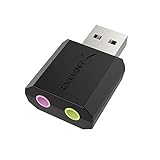
- PLUG IN AND HEAR SOUND IN SECONDS - USB Type-A connector with a 3.5mm stereo headphone output and a separate 3.5mm mono microphone input. No drivers, no software, no external power - the adapter is USB bus-powered and is recognized as a standard USB audio device.
- WORKS ON WINDOWS, MAC AND LINUX - Driverless on Windows 98SE/ME/2000/XP/Server 2003/Vista/7/8, Linux and Mac OSX, and compliant with the USB Audio Device Class 1.0 specification, so any system that supports class-compliant USB audio will see it. Select it as the sound output and input device after plugging it in.
- TWO JACKS, TWO JOBS - The green jack is stereo OUT for headphones or powered speakers; the pink jack is mono microphone IN for a 3.5mm mic. It does NOT support 4-pole headsets on a single combo plug, it does NOT power passive speakers, and it does NOT add surround sound - it is a stereo 2-channel adapter.
- FOR LAPTOPS AND DESKTOPS THAT NEED AN AUDIO PORT BACK - Adds a headphone and mic port to a laptop, desktop, or mini PC whose onboard jack has failed or was never there. Managed and work-issued computers can block new USB audio devices by policy - check with your IT department before ordering for a company machine.
- SABRENT SUPPORT AND WARRANTY - What is in the box: one USB audio sound adapter. Backed by a 1-year limited warranty, extended to 2 years when you register within 90 days on the manufacturer's website.
If audio comes through a capture device, verify that the encoder’s video or capture source is also configured to receive audio from that device, or that the audio is added as a separate source. A church-stream forum post documents this as one possible routing failure, not a universal diagnosis: OBS forum example.
3. Confirm the stream mix and selected track
Check that the intended audio source is unmuted and assigned to the encoder’s stream output. In OBS, inspect Advanced Audio Properties and confirm that the source is assigned to the audio track selected for streaming. Do not change to a presumed default track without checking the current output selection: track assignments and defaults can vary by setup.
Rank #4

- Podcast, Record, Live Stream, This Portable Audio Interface Covers it All - USB sound card for Mac or PC delivers 48kHz audio resolution for pristine recording every time
- Be ready for anything with this versatile M-AUDIO interface - Record guitar, vocals or line input signals with two combo XLR / Line / Instrument Inputs with phantom power
- Everything you Demand from an Audio Interface for Fuss-Free Monitoring - 1/4" headphone output and stereo 1/4" outputs for total monitoring flexibility; USB/Direct switch for zero latency monitoring
- Get the best out of your Microphones - M-Track Duo’s transparent Crystal Preamps guarantee optimal sound from all your microphones including condenser mics
- The MPC Production Experience - Includes MPC Beats Software complete with the essential production tools from Akai Professional
Compare the encoder, a local recording, and YouTube
Listen to the encoder preview, make a short local recording with the same sources and settings, and check YouTube’s stream preview and health information. The first point where the audio disappears narrows the fault: if the local recording is silent, investigate the source, routing, or encoder; if the encoder and local recording sound right but viewers receive silence, investigate the outgoing connection and YouTube delivery.
Free tools Windows power users keep installed
One-click scans. No signup required.
YouTube recommends checking the encoder’s output and local archive, reviewing error messages and CPU load, and testing the outbound connection if encoder audio sounds good but the stream does not. If the connection shows problems, contact your internet provider. OBS likewise recommends making and listening to a normal test recording before going live. See YouTube’s troubleshooting steps and the OBS Audio Mixer guide.
Best Value

- The new generation of the artist's interface: Connect your mic to Scarlett's 4th Gen mic pres. Plug in your guitar. Fire up the included software. Start making your first big hit
- Studio-quality sound: With a huge 120dB dynamic range, the newest generation of Scarlett uses the same converters as Focusrite’s flagship interfaces, found in the world's biggest studios
- Never lose a great take: Scarlett 4th Gen's Auto Gain sets the perfect level for your mic or guitar, and Clip Safe prevents clipping, so you can focus on the music
- Find your signature sound: Air mode lifts vocals and guitars to the front of the mix, adding musical presence and rich harmonic drive to your recordings
- With Scarlett 4th Gen, you have all you need to record, mix and master your music: Includes industry-leading recording software and a full collection of record-making plugins
Change audio format only when a warning points to it
If YouTube reports a format issue, use the current error message and your encoder’s settings to make a targeted correction. YouTube’s error guidance specifies H.264 video and AAC audio in the expected format, while its error details list AAC or MP3 as supported audio codecs. It requires one audio stream and supports mono or stereo—not more than two channels. The same guidance recommends 128 Kbps audio and 44.1 kHz sampling. YouTube Live Streaming API encoding guidance lists 44.1 kHz and 48 kHz as recommended sample rates.
These figures are not a reason to change a working stream at random. Match the fix to the reported error, then verify the result in the encoder and YouTube. If the channel count, codec, or presence of an audio stream is wrong, correct that specific setting and test again.
Escalate only after locating the likely failure point
- If the source itself is silent, check the file’s audio track or the mixer and its output.
- If sound disappears before the encoder meter, inspect source selection, cabling, capture-device routing, levels, mute controls, and permissions.
- If the encoder receives sound but the local recording or outgoing stream does not, check track assignment, encoder errors, and system load.
- If the encoder and local recording sound right but YouTube does not, investigate the outbound connection and YouTube’s health messages.
Update an outdated encoder if relevant checks still fail. If the source and local archive do not explain bad output, YouTube recommends trying another encoder; if the issue remains unresolved, report it to YouTube. Avoid replacing a capture card, interface, or other hardware unless the checks point to a hardware fault.
Or let it run in the cloud
If the issue is part of a broader need to keep prerecorded material streaming around the clock, StreamNeo is a YouTube-only cloud service from Yorker Media. Upload a recording or build a playlist, add your YouTube stream key, and go live. It loops the uploaded videos from the cloud, so no computer, OBS, or home connection has to stay on. This is an alternative way to run the broadcast, not a repair for muted, misrouted, unassigned, or unsupported audio.
- There is one flat price per slot for any uploaded quality up to 4K 60fps; there are no quality tiers or re-encoding.
- Each slot includes 10 GB storage, pooled across active slots, 24/7 looping and playlists, automatic recovery if YouTube drops the stream, and StreamNeo team support.
- The first day is free with no card. Billing options are a day, a week, a month, 6 months, or a year; cancel any time. UPI and cards are accepted in India, and card checkout is available worldwide.
Monthly: $9.99 per month. See StreamNeo for details, or start your free first day.
Quick Recap
Product prices and availability are accurate as of the date/time indicated and are subject to change. Any price and availability information displayed on Amazon at the time of purchase will apply.

