
iTechGuides is reader-supported. When you buy through links on our site, we may earn an affiliate commission. As an Amazon Associate I earn from qualifying purchases. Learn more
Commercial off-the-shelf (COTS) capacitors can be candidates for spacecraft electronics, but being commercially available, automotive grade, or marketed as “space” parts does not establish that a capacitor is suitable for a mission. Start with the mission’s requirements and risk posture, then evaluate the exact part, its manufacturer and lot evidence, the verification needed, and radiation assurance as a separate question.
What does COTS capacitor sourcing mean for a spacecraft?
COTS sourcing is a way to consider commercially available parts instead of requiring every component to be custom-developed or fully space-qualified. The tradeoff is that project teams must establish whether the chosen part and its supporting evidence are adequate for the actual hardware and mission. The European Space Agency described the motivation in 2020: “We simply can’t afford to custom-develop every component for every space mission.” That rationale is not evidence that any particular commercial capacitor is fit for flight; ESA also noted that bespoke, fully space-qualified component development can take two to five years. ESA’s 2020 account of its COTS approach provides historical context, not a current procurement authorization.
NASA’s NESC frames COTS assurance around Mission, Environment, Application, and Lifetime (MEAL), together with project risk and available evidence. That makes a generic “space capacitor” label or marketplace listing a starting point for investigation at most—not a qualification decision. NASA NESC Phase II COTS recommendations discuss tailoring selection and assurance to the specific project.
What’s actually slowing this PC down?
Pick the symptom - the matching free tool is one click away.
How do I source COTS capacitors for a new-space application?
-
Define MEAL, circuit stresses, and project risk
Before requesting quotes or choosing a part, document mission life, operating environment, circuit function, expected electrical and thermal stresses, fault tolerance, size and mass constraints, performance needs, and procurement constraints. Identify the mission’s risk posture and how critical the capacitor is to the circuit and spacecraft. NASA’s MEAL framework includes considerations such as radiation, thermal conditions, fault tolerance, SWaP, and performance; the required evidence and testing depend on the project’s needs and risk. NASA NESC’s recommendations are guidance for tailoring, not a universal rule for every agency or mission.
#1 Best Overall
 Globe Capacitor, Oval Run Start, 45MFD CBB65 Single Element, 370V/440V
- PERFORMANCE SPECS: GLOBE/ControlGear 45uf 370V/440VAC OVAL Start Capacitors have a SINGLE FIXED capacitance value. The GCS-OS450J5 model functions as a reliable motor start capacitor for motor compressor systems where OEM approved components are essential.
- LONG LIFE: GLOBE/ControlGear capacitors are designed and manufactured to OEM standards or 3X the life of typical replacement aftermarket capacitors
- SAFETY FEATURES: Features self-healing Metalized Polypropylene Film with 10,000 AFC UL-approved Pressure Sensitive Interrupter. These capacitors excel in HVAC applications where safety and reliability are paramount.
- ELECTRICAL QUALITY: GLOBE/ControlGear capacitors offer high capacitance stability with minimal internal power losses. These industrial-grade capacitors maintain performance across temperature variations, meeting strict OEM approved standards for critical applications.
- REGISTERED U.S. TRADEMARK: Control Gear is a federally registered trademark, our products come directly from the official, protected brand. Real, quality-tested product.
NASA’s Phase II recommendations vary by risk class: MIL-SPEC-based design for Classes A and B and human-rated missions; a System of COTS approach for Classes D and Sub-D; and a project choice among approaches for Class C. Treat these as NASA recommendations, not as a substitute for the applicable project requirements or another agency’s policy.
-
Choose the capacitor family and specification route
Choose based on the circuit’s electrical, environmental, mechanical, and reliability needs—not on the broad technology label alone. NASA’s Parts Selection List (NPSL) is an index of capacitor categories and associated specifications. For ceramic capacitors, it lists the following references:
Rank #2
 Globe Capacitor, Round Run Start, 50+5MFD CBB65 Dual Element, 370V/440V
- PERFORMANCE SPECS: GLOBE/ControlGear 50+5uf 370V/440VAC ROUND Start Capacitors have a DUAL FIXED capacitance value. The GCS-RD500050J5 model functions as a reliable motor start capacitor for motor compressor systems where OEM approved components are essential.
- LONG LIFE: GLOBE/ControlGear capacitors are designed and manufactured to OEM standards or 3X the life of typical replacement aftermarket capacitors
- SAFETY FEATURES: Features self-healing Metalized Polypropylene Film with 10,000 AFC UL-approved Pressure Sensitive Interrupter. These capacitors excel in HVAC applications where safety and reliability are paramount.
- ELECTRICAL QUALITY: GLOBE/ControlGear capacitors offer high capacitance stability with minimal internal power losses. These industrial-grade capacitors maintain performance across temperature variations, meeting strict OEM approved standards for critical applications.
- Direct Replacement for: 97F9850 , 97F9970 , 97F9970BZ3 , TRCFD505 , RC0120 , 12790 , RC0121, 1094993 , 38514D018 , P2915053R , HC98CA050 , P291-5053RS , 024-25338-000 , 43-25133-25 , P291-5053R , HC98JA051 , 43-23204-15 , 432320415 , 05706036 , D6789043 , B94577400 , B945774-00 , CARG32458 , TT-CAP-50/5/440R , 27L601
NASA NPSL ceramic reference Designation shown by NPSL MIL-PRF-20 CCR MIL-PRF-123 CKS MIL-PRF-39014 CKR MIL-PRF-55681 CDR MIL-PRF-49467 HV MIL-PRF-49470 PS DSCC-DWG-87106 Designation not stated on the NPSL category page The NPSL also lists tantalum, glass, and plastic-film categories and their associated specifications. A listing is an index, not a recommendation that a particular family—or any particular part—is suitable for an unspecified circuit. Review the NASA NPSL capacitor categories alongside the project’s actual requirements.
Special offer. See more information about Outbyte and uninstall instructions. Please review EULA and Privacy policy. -
Evaluate the exact part and its documentation
Use the manufacturer’s datasheet and supporting quality and reliability records for the precise part under consideration. Check that its stated limits address the real operating conditions and the circuit’s relevant behavior, including capacitance and tolerance, rated voltage, temperature behavior, package and termination, bias, ripple, transient conditions, and aging where applicable. Confirm that documentation is relevant to the part family, manufacturing site, and lot being procured. NASA advises understanding datasheet limitations and verifying manufacturer specifications and reliability for the space-hardware application.
Rank #3
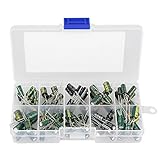 Hilitand 100pcs DIY High Grade Audio Capacitor Assorted Electrolytic Capacitors Kit 10 Values 10V-63V 10uf-470uf
- MEET YOUR NEEDS: This set includes 10 types of popular capacitors10v-63v 10uf-470uf which could meet your basic needs.
- ADVANTAGE: Convenient and practical use, very popular in electronic enthusiasts and amateurs.Safely packed and assorted in a plastic box for convenient use and storage. easy to distinguish; all capacitors are packed in re-use box, easy to manage, you could also add your other resistors transistors diodes capacitors in this box.
- These are electrolytic audio capacitors for making audio circuit.
- MULTIPURPOSE ELECTROLYTIC CAPACITORS ASSORTMENT: Suitable for audio applications, quite good accessory for audio DIY or repair.
- HIGH PRECISION ALUMINUM ELECTROLYTIC CAPACITORS : With clearly marked values and voltage ratings on each capacitor for you to easy select and use.
There is no defensible part-number recommendation without circuit values, operating requirements, and mission context. The same capacitor technology or datasheet rating can be adequate in one application and inadequate in another.
-
Plan verification at part, board, and system levels
Decide which evidence and tests are needed for the specific part and hardware. NASA NESC discusses verification at part, board, and system levels; it allows certain screening or non-radiation lot-acceptance testing to be reduced or eliminated only when sufficient evidence supports that decision for the mission and risk posture. That is not an automatic exemption for COTS components. Record the rationale for the verification plan and any accepted residual risk.
Rank #4
 Chazcool 100pcs DIY High Grade Audio Capacito, Audio Capacitor Assorted Kit, 10 Values 10V-63V 10uf-470uf Electrolytic Capacitors Radial Capacitor
- APPLICABLE: These electrochemical capacitor kits are high-quality electrolytic audio capacitors used for making audio circuits.
- QUANTITY: This set includes 10 popular capacitors that can meet your basic needs and is a great accessory for audio DIY or repair.
- USAGE AND STORAGE: Safely packaged and classified in plastic boxes for easy use and storage. Different types of capacitors are classified and placed for easy selection and use.
- LARGE QUANTITY AND VARIETY: This set includes 10 popular capacitors, with labeled codes and capacitor values on each electrolytic capacitor to avoid confusion.
- A POPULAR CAPACITOR: Easy to use and practical, highly favored by electronics enthusiasts and hobbyists.
NASA NEPP’s commercial MLCC guideline is narrower: it addresses simple parallel-plate, surface-mount chip multilayer ceramic capacitors (MLCCs) rated at 100 V or less. It proposes possible selection, screening, and qualification practices, but its preface says it is neither an official endorsement of commercial capacitors for space nor an established testing requirement. Designs such as LICA or LGA may need additional testing and tailoring. The guideline dates to 2012, so consult the NASA NEPP commercial MLCC guideline in light of current project standards rather than treating it as a blanket approval.
Recommended Free Tools
Special offer. See more information about Outbyte and uninstall instructions. Please review EULA and Privacy policy. -
Assess radiation tolerance separately
Do not infer radiation suitability from COTS status or from an “Established COTS” designation. NASA’s ILPM assessment explicitly does not evaluate ionizing-radiation tolerance. Check the NASA ILPM and Established COTS list for relevant manufacturer and product entries, then request the radiation evidence required by the project’s environment and risk posture.
Best Value
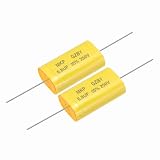 MECCANIXITY 2Pcs 6.8uF Frequency Divider Capacitor, 250V Audio Speaker Crossover Non-Polarity Polypropylene MKP Film Capacitor
- This MKP polypropylene film capacitor is a precision audio grade component designed for high frequency signal filtering and crossover networks. Frequency divider capacitor features two end leads and a durable yellow case to minimize signal loss and distortion in audio amplifiers, dividers, fan lights, home appliances, car speakers, power supplies, industrial equipment and is also great for DIY soldering electronics projects.
- This MKP capacitor features a yellow shell color with a capacity of 6.8uf and ±5% capacity deviation. Auto non-polarity capacitor has a rated voltage of 250V, measuring 12.5mmx36mmx20.5mm/0.49inchx1.42inchx0.81inch(W*L*H). Each package contains 2pcs of electrolytic capacitors. Good for audio equipment applications.
- Cylindrical capacitor with two end leads use copper pins, high voltage resistance, 5% error, low damage, exquisite appearance, wide range of applications, high voltage resistance, 250V rated voltage can meet the requirements of stringent car audio and power amplifier circuits. Accurate capacitance, light weight, simple to use and install, can be easily installed vertically or horizontally in a small space. Wide operating range, reliable operation in high/low temperature environments.
- Solder non-polarity two-end leads directly to crossover boards or PCB pads.
- Please use capacitors within the rated range of the capacitor to avoid damaging the capacitor.
Derating and qualification guidance can be technology-specific. For example, NASA’s 2023 guideline says polymer tantalum capacitors from MIL-PRF-32700, AEC-Q200, or COTS+ categories should be screened, qualified, and derated according to that publication. Do not apply polymer-tantalum instructions wholesale to MLCCs or other capacitor technologies; consult the NASA polymer tantalum capacitor guideline for that component class.
-
Procure through a channel that supports traceability
Commercial distribution can make COTS parts easier to obtain, but a generic online listing does not establish authorization, provenance, screening history, lot identity, or flight suitability. Seek a manufacturer-direct or authorized distribution channel when project requirements call for traceable product and manufacturer documentation. NASA’s COTS materials discuss commercial distribution and the value of vendor testing and manufacturing evidence; the NASA ILPM guidance recommends obtaining documentation sufficient for the project’s MEAL. NASA’s COTS phasing presentation and the ILPM guidance provide related context.
Keep a procurement record that identifies the manufacturer, full orderable part number, datasheet revision, source, date and lot codes, qualification evidence, and any screening or acceptance results. This gives the project a record of what was evaluated and what was actually received.
Recommended: Crashes or Glitches? A Free Driver Scan Usually Finds the Culprit →Recommended: PC Feels Slow? A Free Scan Shows What's Dragging Windows Down →Special offer. See more information about Outbyte and uninstall instructions. Please review EULA and Privacy policy.
What should a COTS capacitor evaluation compare?
When there are specific candidate parts, compare them against the same circuit and mission requirements rather than ranking manufacturers or technologies in the abstract. Useful comparison criteria include:
- Capacitor technology and dielectric, capacitance, tolerance, and rated voltage.
- Temperature behavior, package, termination, and relevant bias, ripple, transient, and aging behavior.
- Manufacturer data, quality controls, lot traceability, and supply continuity.
- Screening and qualification evidence, derating, and separate radiation evidence.
- Mission criticality, risk posture, and the total effort required for procurement and verification.
The available project information here does not specify candidate part numbers or circuit requirements, so it cannot support a part ranking or selection. NASA’s NPSL can identify specification routes, but the final comparison depends on the actual parts, their evidence, and the mission.
Quick Recap
What a COTS label does—and does not—establish
- Commercial availability establishes that a product is offered through a commercial route; it does not establish provenance, lot history, or flight suitability.
- Automotive grade or a general “space” marketing claim does not, by itself, show that the part meets a spacecraft project’s requirements.
- An NPSL category or specification listing points to a selection route; it does not approve a specific part for a particular mission.
- Established COTS status on NASA’s ILPM list is not radiation qualification.
- A screening or qualification test provides useful evidence only when its scope, results, and relevance to the actual part and lot are understood.
Product prices and availability are accurate as of the date/time indicated and are subject to change. Any price and availability information displayed on Amazon at the time of purchase will apply.

