
Windows Errors? Fix Them Before They Spread
Repair common Windows errors and clear accumulated junk for a smoother, more stable PC - no reinstall needed.Free scan · no reinstallOutdated Drivers Are Slowing You Down
One free scan finds every outdated or missing driver and matches the right update for your exact hardware.Free scan · exact hardware matchiTechGuides is reader-supported. When you buy through links on our site, we may earn an affiliate commission. As an Amazon Associate I earn from qualifying purchases. Learn more
To estimate carbon stored in a woodland’s living trees, define the area, divide it into comparable stands, inventory the trees, estimate stem volume, convert that volume to whole-tree biomass, then convert biomass to carbon. Record the date, included tree parts, methods, assumptions, and uncertainty. This produces a standing-stock estimate—not a forecast of future growth or a carbon-credit calculation.
First decide what “carbon storage” includes
A tree-only estimate covers carbon in living tree biomass. A total woodland estimate can also include litter, deadwood, other vegetation, and soil. The Woodland Carbon Code baseline guidance identifies these as separate carbon pools. Be explicit about which pools you count: a tree-only result should not be labelled total woodland carbon.
Also distinguish the amount stored now from carbon sequestered over a period. A standing-stock estimate describes a point in time. Project accounting, by contrast, tracks changes in carbon stocks and may include establishment and management emissions. The Woodland Carbon Code’s carbon calculator is intended for project carbon accounting, not as a substitute for a simple inventory of current tree stock.
Recommended Free Tools
Estimate living tree carbon in five steps
The Forestry Commission’s Carbon Assessment Protocol sets out a sequence of defining the area, stratifying it, estimating stem volume, allocating biomass among tree parts, and converting biomass to carbon.
#1 Best Overall

- OUTSIDE DIAMETER TAPE MEASURE - Pocket-sized, flexible, and retractable steel tape measure with both diameter (OD measurement) and standard integer measurements.
- MEASURE AROUND ANYTHING - Standard, consecutive inches on top-side to 1/16 inches; diameter measurements on underside to 1/100th inches. Perfect for measuring trees, branches, or pipe fitting.
- EASY READ TAPE MEASURE - Includes inches and metric measurements down to millimeters on both sides; High contrast, easy to read numbers.
- MAGNETIC, REFLECTIVE AND RETRACTABLE TAPE MEASURE Reflective, aluminum rotating wheel brake allows for high visibility and effortless retract control. Strong magnet on case for affixing to metal objects.
- Define the boundary and purpose. Map the woodland area and state whether you are estimating living tree biomass, broader woodland carbon, or project change over a stated period. Note the assessment date and any areas excluded.
- Divide the woodland into stands. Separate areas that differ meaningfully in species mix, age or structure, or management. A single average across unlike stands can hide important variation.
- Survey the trees and estimate stem volume. Gather the inventory and measurements required by your chosen method, then estimate stem volume by species or species group, and where appropriate by size class. A diameter tape can help collect stem measurements, but it does not itself calculate biomass or carbon.
- Convert stem volume to whole-tree biomass. Apply the selected method’s equations or factors to account for relevant tree components, including stem, branches, foliage, stump, and roots. Do not treat stem biomass alone as the whole tree.
- Convert biomass to carbon and report the units. Use the carbon conversion specified by the method. Keep carbon mass distinct from carbon dioxide equivalent (CO₂e): converting carbon to CO₂e is a separate reporting transformation, so say clearly which unit your result uses.
For a result others can interpret or reproduce, document the boundary, stand divisions, species groups, measurement approach, equations or calculator version, included pools, and limitations. The available sources do not establish a universal uncertainty percentage; report uncertainty from your chosen method rather than inserting an unsupported figure.
Why two woodlands can produce different estimates
Species, age and structure, stocking, management history, and growing conditions all affect the estimate or any projection based on it. Forest Research says UK forest growth models require information including species, age, initial spacing, management, and yield class. These factors are why a generic “carbon per tree” shortcut is not a dependable estimate for a mixed woodland.
Rank #2

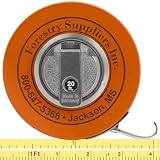
- WHITE LINE — Model 347D has a white enameled steel line with black graduations for reading in the field.
- 76 IN DIAMETER — One side reads tree diameter in inches and 10ths up to 76 in.
- 20 FT LINEAR — Reverse side reads 20 ft of linear measure in feet, 10ths, and 100ths.
- CLAW HOOK — 3/8 in wide steel line ends in a claw hook.
- HANDCRANK REWIND — Handcrank rewinds the line into a compact 3-1/2 x 1 in case.
The Forestry Commission’s public explainer offers broad context: conifers generally grow faster early in life than native broadleaf woodland, while broadleaf woodland can store larger amounts over the long run; mature trees can remain carbon stores for hundreds of years. These general observations do not replace a site inventory or provide a quantified forecast for a particular woodland.
The Tool Desk
Outbyte Driver Updater FREEFix the driver behind crashes, sound loss and screen glitchesFind Drivers →Outbyte PC Repair FREEClear out junk files and repair common Windows errorsFree Scan →When you need total woodland carbon or project accounting
For total woodland stock, include the pools required by the accounting framework you are using. The Woodland Carbon Code baseline identifies above- and below-ground tree biomass, litter and deadwood, above- and below-ground non-tree biomass, and soil. Forest Research’s national statistics show that soil is a substantial component of UK forest carbon, so omitting it can materially change a total-stock estimate.
Rank #3
- FABRIC DIAMETER TAPE — Woven synthetic fabric diameter tape with English scales.
- 76 IN DIAMETER — Diameter side reads inches and 10ths up to 76 in.
- 20 FT LINEAR — Linear side reads 20 ft in feet, 10ths, and 100ths.
- 5/8 IN FABRIC LINE — 5/8 in wide woven synthetic line; graduations begin 10 cm from the claw hook with a reinforced start.
- PVC-COATED CASE — PVC-coated steel case measures 3-7/8 in x 1-1/8 in.
If the work is for a UK Woodland Carbon Code project, use the current Code standard, calculator, and survey protocol. Official guidance identifies Carbon Calculation Spreadsheet version 2.4.1 from April 2024; verify the current version before operational use. Project accounting incorporates stock changes over time and emissions, so it answers a different question from how much carbon is standing in trees today. The Code is a standard for woodland creation projects; the Forestry Commission says it does not cover existing woodlands or carbon stored in forest products. Do not describe an existing-woodland stock estimate as a Code credit or unit calculation without checking eligibility and current requirements.
Use national statistics only as context
Forest Research estimated the total carbon stock in UK forests at 4.1 billion tonnes of CO₂e in 2025. Of that national total, 2.8 billion tonnes of CO₂e were in soils and 0.9 billion tonnes of CO₂e in living woody biomass. The estimated UK forest total rose from around 3.2 billion tonnes of CO₂e in 1990 to 4.1 billion tonnes in 2025. These are national aggregates, not typical per-hectare figures or estimates for an individual site. See Forest Research’s 2025 forestry statistics.
Rank #4

- Spencer ProTapes are the original 50′ and 100′ auto-rewind tape measures
- The tapes feature an open reel design with gear drive and come in a variety of lengths and blade styles including English (with Stud and Truss), English/Metric, and all Metric
- The blade is double side printed and nylon coated for added durability
How to compare two estimates
Before comparing results, check that they answer the same question. At minimum, compare the boundary and included pools, the field data collected, treatment of species and stand differences, equations and assumptions, uncertainty, and whether each figure is a current stock or a change over time. A difference may reflect a different scope or method rather than a change in the woodland.
What’s actually slowing this PC down?
Pick the symptom - the matching free tool is one click away.
Quick Recap
Best Value

- Designed for measuring diameters of pipe, cable, tires, and other circular items
- Double-sided blade print - simply turn the blade over for a conversion from diameter to circumference
- Durable metal case made from polished chrome
- Easy-to-read, bold graduations
- Compact size for easy storage and transport
Product prices and availability are accurate as of the date/time indicated and are subject to change. Any price and availability information displayed on Amazon at the time of purchase will apply.

