
Recommended Free Tools
iTechGuides is reader-supported. When you buy through links on our site, we may earn an affiliate commission. As an Amazon Associate I earn from qualifying purchases. Learn more
A fair division means sharing not only the visible chores and care, but also the planning, remembering, arranging, and follow-through behind them. Start by listing the whole workload, agree what “done” means, and give each person ownership of complete areas. The split need not be an identical number of tasks; it should fit the household’s capacity and feel fair to the people doing the work.
What counts as household and caregiving work?
A task is more than its visible final step. For example, “get the child to an appointment” can include noticing the need, finding a provider, scheduling, arranging transport, remembering paperwork, and handling follow-up. If one person performs the appointment-day drive while the other does all the thinking and coordination, the work is not fully divided.
The Nuffield Foundation’s 2022 report distinguishes physical daily childcare, socio-emotional care, and higher-order responsibility such as planning activities, scheduling social events, packing a child’s bag, and arranging childcare. Its UK family context is specific, but the categories are a useful way to build a household inventory. Read the Nuffield Foundation report.
Quick wins for a faster PC:
Scan for outdated or missing drivers - takes under a minuteDriver Scan →Clear out junk files and repair common Windows errorsFree Scan →- Physical household work: cooking, dishes, laundry, cleaning, shopping, and maintenance.
- Physical care: meals, bathing, transport, medication routines, and hands-on support.
- Social and emotional care: listening, helping a child or relative stay connected, and noticing when someone needs support.
- Planning and monitoring: tracking supplies, researching options, booking appointments, remembering deadlines, and checking what needs to happen next.
- Contingency work: responding to illness, schedule changes, breakdowns, or unexpected care needs.
How do we divide the work without one person managing it?
1. Make one shared inventory
Write down recurring daily and weekly work as well as less frequent tasks and the planning behind them. Include care for children, older relatives, or others in the household where relevant. Make the invisible steps explicit: who notices a need, decides what to do, arranges it, and follows up? A shared list is a no-cost starting point; a card-based method is optional, not required.
#1 Best Overall

- Versatile Design: This magnetic dry erase chore board features a weekly chore chart on one side and a blank whiteboard on the other for optimal planning and note-taking. Perfect for writing family chore lists and weekly plans, never missing important events
- Convenient Mounting Options: The double-sided chore chart white board is flexible to install on the wall with included hooks, screws, and rope. Horizontally for showing plans and chore lists; vertically for a limited space to display pictures or doing list (Sweet Note: For flexible using the double side board, it is recommended to hanging it with detachable hooks in the package)
- Excellent Writing & Erasing: Made with metal panels with multiple coating layers, our chore chart offers a smooth and scratch-free surface for ink shrinkage and ink break-resistant writing, and no traces or ghosting erasing
- Easy Organization: This ultra-thin 16 x 12.6 x 0.27 IN chore chart is designated for multiple kids, each is with 7 rows for weekly plan, a note column and magnetic white board for notes and ideas to help stay organized throughout the week. Convenient for both kids and adults to arrange lessons, schedules, and housework
- Durable Construction: Features a sturdy silver aluminum frame designed for long-lasting use, the wall chore chart and whiteboard are resistant to impact and scratch. The overall design of the chore board makes it not only practical, but also a valuable addition to home, and office, with an appealing view
2. Agree on the standard and timing
For each area, decide what “done” means and how often it needs to happen. “Kitchen reset” might mean dishes loaded, counters cleared, and food put away by bedtime. Choose a standard the household can maintain. Without an agreed standard, one person can end up monitoring the result, reminding the other, and deciding whether the task counts as complete.
3. Assign ownership, not helper status
Give each person complete areas of responsibility, including noticing, planning, execution, and follow-through. For instance, owning school lunches could include checking supplies, making a shopping list, preparing lunches, and responding when plans change—not waiting to be asked to make one part of them.
Rank #2

- EVERYTHING YOU NEED - 2 refrigerator Pocket Charts, whiteboard planners & bonus, 6 dry-erase markers with eraser caps.
- ACCOUNTABLE & MOTIVATED KIDS: Responsibility Pocket Charts that will teach your kids, in a fun way, how to get organized and meet their goals.
- CHORES BECOME FUN: The reward board keeps the kids on their toes for chores & excited for their check marks.
- QUALITY MATTERS: Stain-resistant surface, wipes easily, strong magnetic backing & flat packaging.
- GET THE WHOLE FAMILY ON THE SAME PAGE with this chore chart and meal planner set to keep you all synchronized.
Ownership does not require splitting every task in half. Consider work hours, availability, health, preferences, skills, and care needs. A person can own several predictable tasks while the other handles a different set; compare the full effort and responsibility rather than counting task names.
4. Decide in advance how disruptions are covered
Agree how you will handle a sick child, a canceled appointment, or an unexpected care need. Consider whose work is more flexible, who is less busy that day, and whether either person can reasonably take leave. In Pew Research Center’s 2026 survey, 70% of married or cohabiting different-sex couples with two full-time working parents said which parent had more workplace flexibility was a major factor in deciding who would take time off for a sick child or unexpected childcare issue. That figure describes this U.S. subgroup, not all households. See Pew’s report and methodology.
Rank #3

- Strong Magnetic Hold & Durable Design: Includes 1 piece magnetic whiteboard calendar for fridge and 1 magnetic chore chart, both are 17" x 12" having thick backing that stays firmly in place without slipping, curling, or bubbling. Tear-resistant material supports daily and monthly planning for years
- Smooth Writing & Easy Erasing: Write clearly and wipe clean without smudges or ghosting. This reusable dry erase calendar for fridge and a chore chart is all you need to keep your daily, and monthly plans neat, organized, and easy to update
- Fine-Tip Magnetic Markers & Eraser: This magnetic fridge calendar and fridge chore chart comes with 6 colorful fine-tip markers for smooth, precise writing and easy schedule organization, plus 1 large magnetic eraser. All accessories stay securely attached to your refrigerator and within easy reach
- Spacious Writing Area: Our Combo set gives you plenty of room to write. Easily organize meal plans, shopping lists, schedules, reminders, and notes, making them perfect for homes, offices, classrooms, and busy families.
- Stay Organized Every Month: Keep your schedule clear and easy to manage with the magnetic monthly planner and daily chore chart. Track appointments, important dates, events, meetings, reminders, to-do lists, birthdays, and more, so you never miss what matters most.
5. Ask both people whether the arrangement feels fair
Do not assume that one person’s sense of the split represents the other’s. In the same Pew subgroup, 63% of mothers said they did more day-to-day parenting and household chores, while fathers were more likely to describe those responsibilities as shared equally. Perceptions can differ even when people are describing the same household.
A peer-reviewed study of low-income new parents found that mothers’ perception that housework was fair to both partners was related to lower relationship conflict one year postpartum. The finding concerns a particular population and period; it does not show that a specific chore allocation causes less conflict. Read the study on household labor and relationship conflict.
Rank #4

- UPGRADE DESIGN: The upgraded design of the extra large size whiteboard combine the chore chart, meal planner and notes/TO Do/Grocery all in one, so you don't need to buy them separately and keep your fridge more neat and organized!
- 100% DRY ERASABLE: We use NANO premium erase film to do the lamination which prevents any stains or ghosts. it is super easy to wipe off writings even after leaving the writings on the boards for months long. Just start using markers to do your plan as you want on this chore because erasing is no longer a headache! Also the NANO film is waterproof so you may use a wet cloth to clean it easily.
- BONUS ITEMS INCLUDED: We make sure all of your planning needs are covered. The whiteboard comes with 6 colored high quality dry erase markers and eraser with strong magnets, so you may use your own color to plan or use them for different tasks.
- STRONG MAGNET BACK: Our durable flexible whiteboard planner will stick to any flat or curved magnetic surface without sliding or falling. Please make sure your fridge can support magnetic items before placing the order!
- International products have separate terms, are sold from abroad and may differ from local products, including fit, age ratings, and language of product, labeling or instructions.
6. Set a review point and rebalance
Agree to revisit the arrangement after a job or schedule change, illness, new care need, or repeated missed tasks. A short coordination conversation can surface work that has become invisible or unmanageable. A diary study of Dutch heterosexual parents associated conversations about household tasks, childcare, and paid work with more equal task division and relationship quality; it does not establish a universally effective meeting schedule. Read the study abstract.
Free tools Windows power users keep installed
One-click scans. No signup required.
Which division method should we use?
No single method is established as best for every household. Choose a setup that makes planning visible, gives predictable coverage, can adapt to changing capacity, and feels fair to both people.
Best Value
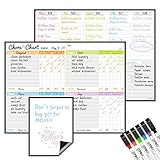
- EFFECTIVE COMBO SET: JJPRO Chore chart set includes one 14.5”x11”magnetic dry erase chore chart, one magnetic weekly calendar and one 7.25”x 5.5”magnetic white notepad. The combo set fits most refrigerators, no matter its mini or full size, single door or side-by-side. Flexible sizes provide more options to choose and convenience to use.
- PLEASURABLE WRITE AND CLEAN: We use the nano premium erase film on our products. Compare to the old PET film, the nano material will make your writing super easy to be wiped off even after leaving the writing on the notes for long time. Let’s say bye to stains and ghosting! We promised it’s 100% erasable!!
- ENJOYABLE AND CLARITY: REUSABLE design makes you much easier to check the plan at a glance. The upgraded design of chore chart board and weekly calendar ensures that the data box is big enough to write down the plan. In addition, the white board is sufficient for drawing or writing the important things down and can be use for to-do list or groceries list as well.
- DRY ERASE: With nano premium erase film, it will be a breeze to wipe off the writings even after several months; it’s not going to leave any stains; it’s waterproof, so you can clean it with a wet cloth if you want.
- MARKERS INCLUDED: We make sure all of your planning needs are covered. The combo set includes 6 bonus magnetic dry erase markers with extra fine tips, so you’ll have more colorful choice to create your own idea.
| Method | How it works | Useful when | Watch for |
|---|---|---|---|
| Fixed ownership | Each person owns defined areas, including planning and completion. | Responsibilities are reasonably predictable and each person can take full ownership of some areas. | One person may still carry the harder-to-see work unless planning and follow-through are explicitly included. |
| Shared rotation | People alternate tasks or periods of responsibility. | Tasks are similar enough to rotate and both people can learn the routine. | Rotating execution alone may leave one person responsible for reminders, supplies, or knowing what comes next. |
| Preference-based allocation | People choose or trade tasks based on preference, capacity, or skill. | Preferences differ and a balanced set of responsibilities can be negotiated. | Popular or easy tasks can be claimed first; compare the full workload, including planning and unpleasant work. |
| Outside support | Paid or community support takes on some work where available. | The household needs capacity beyond what its members can reasonably provide. | Someone may still need to identify, arrange, and coordinate that support; cost and availability vary. |
USC’s project page describes a completed 2024 project that tested Fair Play’s card-based system with couples to examine physical chores and their associated mental load. It is one optional organizing aid, not evidence that a particular system guarantees a fair result. Read the USC project description.
What the available findings can—and cannot—tell you
Pew’s 2026 figures show how work was reported within a defined U.S. group, not a universal division across all caregivers. Among married or cohabiting different-sex couples with two full-time working parents, 43% said the mother did more household chores, 17% said the father did more, and 40% said chores were shared about equally. For day-to-day parenting tasks, 52% said mothers did more, 10% said fathers did more, and 39% said tasks were shared about equally. The reported percentages are subgroup results and should not be generalized to every couple or household type.
The Nuffield report supplies useful categories and examples in a UK family context. The new-parent study and the Dutch diary study examine particular populations and report relationships or associations, not a universal causal formula. The evidence cited here does not establish one best split for same-sex couples, single parents, multigenerational households, or disability-related care. The practical framework—make all work visible, assign complete ownership, account for capacity, and ask whether the result feels fair—can be adapted without assuming those households work alike.
What’s actually slowing this PC down?
Pick the symptom - the matching free tool is one click away.
Quick Recap
Product prices and availability are accurate as of the date/time indicated and are subject to change. Any price and availability information displayed on Amazon at the time of purchase will apply.

