
iTechGuides is reader-supported. When you buy through links on our site, we may earn an affiliate commission. As an Amazon Associate I earn from qualifying purchases. Learn more
There is no single disclaimer that makes every AI-assisted political ad compliant. First identify the sponsor and medium disclaimers required where the ad will run; then check whether that jurisdiction separately regulates AI-generated or manipulated content. The answer can turn on what the content depicts, what AI changed, the ad’s purpose, its timing, and how it is presented.
How do I disclose AI-generated content in a political ad?
Use this sequence before publication. Treat sponsor attribution and AI-content disclosure as separate compliance questions: satisfying one does not necessarily satisfy the other.
- Map the ad’s jurisdictions. Check the rules where the ad will be distributed, not just where the campaign is based. For a U.S. ad, identify relevant federal and state requirements; for an ad reaching people in the European Union, consider applicable EU rules as well.
- Identify the sponsor and authorization status. Establish who paid for the communication and whether a candidate or committee authorized it. In the United States, the Federal Election Commission (FEC) describes different attribution requirements for authorized communications and independent communications, with additional rules depending on medium.
- Describe the AI use precisely. Record whether AI generated or altered audio, images, video, or text; whether the content appears to depict a real person or event; and whether it represents something that did not happen. These facts can determine whether a law’s trigger applies.
- Check each relevant AI-content rule. Read the current statute and regulator guidance for the specific jurisdiction. Look for the covered content, intent standard, election-period window, exceptions, required wording, placement, legibility, and enforcement provisions.
- Apply the medium-specific presentation rules. Determine whether the notice must be spoken, visible, persistent, machine-readable, or viewable without a user taking an extra action. A disclaimer that is technically present but fails the required format may not meet the rule.
- Review the final version in context. Check the rendered ad on the platforms and formats where it will appear, including video, print, and public internet communications. Retain the final creative and the records used to determine which rules apply.
These steps are a practical way to organize a compliance review, not a substitute for the applicable law or legal advice. Campaigns should verify current official rules and consult counsel familiar with the relevant jurisdiction before publishing.
The Tool Desk
Outbyte PC Repair FREERepair Windows errors before they cause bigger problemsFix Now →Outbyte Driver Updater FREEScan for outdated or missing drivers - takes under a minuteDriver Scan →Do I have to label an AI-generated campaign ad in the United States?
Not under one universal federal AI-label rule established by the sources discussed here. Federal campaign-finance disclaimers and AI-specific restrictions are distinct, and state laws may add separate requirements.
#1 Best Overall

- ★Double Sided Print-The same text and pattern are printed on both sides. It is visible from any angle. This sign is made of white plastic board.
- ★Easy To Install-Stand is included. Just insert the stand into earth, then insert the other end of the stand to the yard sign. The yard sign body has many inner gap. It is handy to install it. No tool is needed.
- ★Extremely Long Lifespan-This sign uses industry-leading UV printing ink It has a good luster appearance.The graphics and paint can withstand various factors outside,ensuring that it will not fade.
- ★Suitable Size-This sign Uses 12x18 inch,would be great for your front or back yard where the beautiful blue background and white text shows clearly your opposition to Trump.
- ★Inspiring Message: Encourage unity and positivity with this powerful statement.
Federal sponsor disclaimers depend on the ad
The FEC’s campaign-ad guidance distinguishes authorized communications from independent communications and sets requirements by medium. For example, covered authorized communications generally identify the authorized committee, while covered independent communications identify the payor and state that the ad was not authorized by a candidate or committee. Broadcast communications have additional “stand by your ad” requirements; internet ads have their own presentation rules. The required wording and format depend on the communication, so those examples are not a complete disclaimer template.
The FEC’s AI position concerns fraudulent misrepresentation, not every use of AI
On September 19, 2024, the FEC voted not to open an AI-specific rulemaking and instead adopted an interpretive rule addressing its existing fraudulent-misrepresentation prohibition. The Commission said the statute and its implementing regulation are technology neutral: the prohibition may apply to AI-assisted media when the specified fraud is involved, with individual cases assessed on their facts. This does not establish a general duty to label every AI-assisted campaign ad. The FEC said it had received more than 2,000 comments on the petition that prompted the rulemaking question.
The FCC document cited here is a proposal
FCC 24-74 is a Notice of Proposed Rulemaking concerning disclosure and transparency of AI-generated content in political advertisements. It should be described as a proposal, not as a final, generally applicable AI-label regulation. Check the FCC docket for later action before relying on its status.
What’s actually slowing this PC down?
Pick the symptom - the matching free tool is one click away.
Why state rules can change the answer
State political-ad disclaimer rules differ in scope and format. The National Conference of State Legislatures (NCSL), in a resource updated September 11, 2026, says nearly every state regulates political-ad disclaimers. Requirements may vary with the sponsor, whether the ad is an independent expenditure, the communication type, the medium, and exceptions. NCSL also cautions that its general disclaimer resource does not capture most AI disclosure requirements; its separate AI-in-elections resource is a distinct starting point.
Rank #2

- Save america flags for room man cave - polyester nylon banner with brass grommets. Cool dorm room flags or banners made for wall bedroom, wall flag indoor outdoor. Flags to hang in your room.
- 3x5 american flag outdoor heavy duty funny USA national flags 2024 take America back and cool 2024 banner for room man or meme flags funny dorm decor. Decorative america flag for boat.
- American 2024 sign outdoor heavy duty stars with house small and also voting Desantis - cool sign is great decoration for festival, backyard, garden, home. United states american sign.
- Donald 2024 yard flags with grommets. 2024 for president flag for republicans neylon 3x5 feet for garden backyard decor, outdoor decorations, housewarming gifts.
- Nice gift for students, friends, classmates, family, organization, adults, young people, etc. And it's a nice addition in college, classroom, home, garden, games, outdoor, indoor, dorm, office, etc.
In a June 23, 2026 summary, NCSL reported that 31 states had enacted laws regulating political deepfakes. That figure describes laws using varied approaches, including disclosure requirements, prohibitions, or both. It does not mean that 31 states require a label on every ad that uses AI. Laws can differ in the content covered, intent standards, election windows, exceptions, enforcement, and remedies.
Florida illustrates why the exact trigger and format matter
Under 2026 Florida Statutes §106.145, the relevant rule applies to specified political advertisements using generative AI to create digital content that appears to depict a real person performing an action that did not occur, when the content was created with intent to injure a candidate or deceive about a ballot issue. For covered ads, the statute requires this statement: “Created in whole or in part with the use of generative artificial intelligence (AI).” The AI notice is additional to other disclaimers required under the chapter.
- Print: The statement must be bold and at least 12 points.
- Television or video: It must remain clearly readable throughout the communication and occupy at least 4% of the picture height.
- Covered internet public communications: It must be viewable without user action and clearly readable.
Florida’s wording and presentation rules are a state-specific example, not a nationwide template. Check the current law for the state or states involved, including applicable timing, exceptions, and other sponsor or medium disclaimers.
Do these 3 things before closing this tab:
1Fix the driver behind crashes, sound loss and screen glitches2Clear out junk files and repair common Windows errors3Scan for outdated or missing drivers - takes under a minuteWhat does the EU AI Act require for political content?
EU transparency obligations under Article 50 of the AI Act began to apply on 2 August 2026, according to European Commission guidance. The rules create distinct responsibilities for providers and deployers; whether a particular campaign communication is covered depends on the applicable definitions, scope, and exceptions.
Rank #3
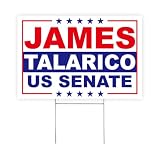
- JAMES TALARICO YARD SIGN: Show support for James Talarico in the US Senate Texas race with this bold red, white, and blue campaign yard sign
- DURABLE OUTDOOR DESIGN: Made of corrugated plastic, this political yard sign is weather-resistant and built to last through the election season
- DOUBLE-SIDED PRINT: High-visibility design printed on both sides so your campaign message can be seen from any direction
- EASY SETUP WITH H-STAKE: Includes a sturdy metal stake for quick installation in lawns, gardens, or community spaces
- CAMPAIGN SIGNS THAT STAND OUT: Perfect for political rallies, outdoor displays, or showing your support right from your front yard
- Providers: The guidance describes a duty to mark AI-generated or manipulated content in a machine-readable way.
- Deployers: The guidance describes duties to inform people exposed to covered deepfakes and certain AI-generated text publications on matters of public interest when there has been no human review or editorial control.
The Commission’s guidelines discuss the scope, definitions, exceptions, and practical examples. Its code of practice is voluntary guidance intended to help demonstrate compliance; that does not make applicable Article 50 duties voluntary. Organizations using another approach must be able to demonstrate adequate compliance. The Commission reported that about 190 organizations had signed the code by the end of July 2026.
Independent reader supportYour contribution helps us test, update, and keep practical guides available for everyone.How should campaigns compare rules across jurisdictions?
When an ad may be covered by more than one regime, compare the actual legal requirements rather than copying a label from another campaign. These are the questions that usually determine whether a rule fits:
- Authority and location: Which federal, state, or EU rule applies to the sponsor, distribution, and audience?
- Content trigger: Does the rule cover any AI-generated material, only a materially deceptive deepfake, or a narrower type of depiction?
- Intent and timing: Does it require an intent to deceive or injure, and does it apply only during a defined period before an election?
- Medium and placement: What must the notice say, where must it appear, and how long or clearly must it remain visible or audible?
- Other notices and exceptions: Is an AI disclosure added to sponsor disclaimers, and do exceptions or human-review provisions apply?
- Enforcement: Which authority enforces the rule, and what remedies or penalties does it provide?
These comparison points help direct a review; they do not replace checking the operative statute and current regulator guidance.
What do current figures say about AI labels in campaign ads?
The available figures describe bounded observations, not a complete census or a legal-compliance rate. The Associated Press reported on September 25, 2026, that the Wesleyan Media Project had identified at least 164 AI-generated or AI-enhanced political ads in the 2026 cycle, and that 69% did not disclose AI use. The count may be incomplete because AI use can be difficult to establish; an ad without a label in that dataset also cannot be assumed to violate a particular state law, whose trigger may be narrower than AI use generally.
The AP report also quoted Scott Babwah Brennen, director of NYU’s Center on Technology Policy and policy research affiliate at its Center for Social Media, AI, and Politics, saying: “I’m generally not opposed to the sort of labels that exist, on narrowly targeted and materially deceptive content.” That is an attributed expert view, not a statement of law or a consensus position.
Quick Recap
Product prices and availability are accurate as of the date/time indicated and are subject to change. Any price and availability information displayed on Amazon at the time of purchase will apply.

