
Free tools Windows power users keep installed
One-click scans. No signup required.
iTechGuides is reader-supported. When you buy through links on our site, we may earn an affiliate commission. As an Amazon Associate I earn from qualifying purchases. Learn more
Turn off and unplug the PC before inspecting a loose or wobbling case fan. First check whether the fan’s frame is loose or something is touching the blades. If a blade or hub is cracked, loose, or still wobbles after you clear obstructions and secure the frame, replace the fan assembly; don’t glue, bend, or add weight to a damaged blade.
Is the fan frame loose, or is the blade damaged?
A fan that rattles or appears to wobble does not necessarily have a damaged blade. With the PC shut down and disconnected from power, inspect the fan without forcing it to spin.
- Loose frame: Check whether the fan shifts at its mounting points. If the blades and hub look intact, secure the mounting hardware with the appropriate driver. Avoid overtightening, and follow your case’s instructions because fasteners vary.
- Obstruction: Look for dust, debris, or a cable touching the blades. Fan noise can come from debris, loose screws, or wiring near the fan, according to CyberPowerPC’s troubleshooting guidance. ASUS also advises securing or relocating cables that could interfere with a fan.
- Damaged blade or hub: Look for cracks, looseness where the blades meet the hub, or contact with the frame. Do not try to straighten or glue a damaged blade.
If the fan still rotates abnormally or makes unusual noise after you check its mounting and clear obstructions, replace it or contact the fan maker for service. The available PC fan guidance supports inspection, cleaning, and replacement; it does not establish a safe repair for an individual loose or cracked blade.
How to inspect and clean the fan safely
- Shut down and disconnect the computer. Do not handle a fan while the PC is powered. If you discover that a processor fan has stopped, avoid continued operation because the processor can overheat quickly.
- Check the mounting and wiring. Inspect the fan screws and nearby cables for looseness or contact with the blades. Move interfering cables out of the fan’s path and secure them so they cannot fall back into it.
- Clean according to the fan maker’s instructions. If using compressed air, hold the blades still. Noctua’s fan-cleaning guidance warns that the fan should not spin at high speed during cleaning, which can damage its bearing. Noctua also advises removing a fan from its heatsink before cleaning it; follow the instructions for your particular fan and installation.
- Inspect the blade, hub, and frame again. If a part is cracked or loose, or the fan remains abnormal after cleaning and securing the frame, replace the fan rather than attempting an improvised blade repair.
When should you replace the case fan?
Replace the fan if a blade or hub is damaged, or if abnormal rotation or noise continues after you have checked for obstructions and secured the mounting. A damaged fan should be replaced as an assembly or assessed by its manufacturer—not balanced with added weights or repaired by bending or gluing a blade.
#1 Best Overall
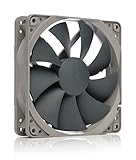
- High performance cooling fan, 120x120x25 mm, 12V, 4-pin PWM, max. 1700 RPM, max. 25.1 dB(A), >150,000 h MTTF
- Renowned NF-P12 high-end 120x25mm 12V fan, more than 100 awards and recommendations from international computer hardware websites and magazines, hundreds of thousands of satisfied users
- Pressure-optimised blade design with outstanding quietness of operation: high static pressure and strong CFM for air-based CPU coolers, water cooling radiators or low-noise chassis ventilation
- 1700rpm 4-pin PWM version with excellent balance of performance and quietness, supports automatic motherboard speed control (powerful airflow when required, virtually silent at idle)
- Streamlined redux edition: proven Noctua quality at an attractive price point, wide range of optional accessories (anti-vibration mounts, S-ATA adaptors, y-splitters, extension cables, etc.)
Before buying a replacement, check your case or fan documentation for the supported fan size and mounting position, connector, and any other compatibility requirements. There is no single replacement size that applies to every case.
For one model-specific example, ASUS’s AP201 rear-fan replacement instructions use a Phillips screwdriver to remove four screws, then replace the fan. That procedure applies to the AP201; follow your own case manual for other chassis.
Rank #2

- HIGH STATIC PRESSURE: Efficient even with resistance – the generated airflow easily penetrates dense radiators, narrow perforated panels and mesh structures and ensures reliable cooling
- PWM CONTROL WITH WIDE SPEED RANGE: The speed can be progressively adjusted up to 3000 rpm via the 4-pin PWM connection – the fan stops completely at less than 5% PWM
- PRECISE MANUFACTURING FOR MAXIMUM SMOOTH RUNNING: Minimal gaps, automatic balancing and high-precision measurement noticeably reduce vibrations – for quiet, efficient and long-lasting performance
- SMOOTH-RUNNING FLUID DYNAMIC BEARING (FDB): The self-lubricating bearing minimizes noise during operation – ideal for quiet, efficient cooling and a long, reliable service life
- NEW FAN BLADE DESIGN FOR MORE PERFORMANCE: The redesigned rotor blades offer an optimal balance of performance and low noise – especially efficient at low speeds
Important safety limits
This guidance is for a PC case fan, not a fan inside a power supply. Do not open a power supply or try to replace its internal fan: HP warns of fire and electrical-shock risks. If the problem is with a processor fan rather than a case fan, stop using the computer until its cooling issue is resolved.
Quick wins for a faster PC:
Clear out junk files and repair common Windows errorsFree Scan →Scan for outdated or missing drivers - takes under a minuteDriver Scan →Repair Windows errors before they cause bigger problemsFix Now →Quick Recap
Best Value

- 【High Performance Cooling Fan】 Automatic speed control of the motherboard through the 4PIN PWM fan cable interface, which can determine the speed according to the temperature of the motherboard, with a maximum speed of 1550RPM. Configured with up to 55cm of cable for PWM series control of fans, ideal for cases and CPU coolers.
- 【Quality Bearings】The carefully developed quality S-FDB bearings solve the problem of pc cooling fan blade shaking in lifting mode, keeping fan noise to a minimum while providing maximum cooling performance when needed and extending the life of the fan.
- 【Silent Fan Size】 Model: TL-C12C X5, Size: 120*120*25mm, Speed: 1550RPM±10%, Noise ≤ 25.6dBA Connector: 4pin pwm, Current: 0.20A, Air Pressure: 1.53mm H2O, Air Flow: 66.17CFM, Higher air flow for improved cooling performance.
- 【Intelligent Temperature Control Function】The fan has PWM temperature control function, after connecting the 4-pin power supply interface to the motherboard, there is no need to manually adjust the speed, the fan will automatically set the unfixed speed according to the temperature, if you want a fixed speed, you can adjust the fan to DC mode.
- 【Perfect Match】The PC fan can be used not only as a case fan, but is also suitable for use with a cpu cooler to create a cooling effect together, which can take away the dry heat from the case and the high temperature generated by the CPU in operation, allowing for maximum cooling; Ideal for cases, radiators and CPU coolers.
Rank #4
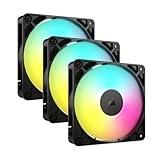
- Streamlined Fan Connections: Daisy-chain multiple fans together and control them all through just one 4-pin PWM connector and one +5V ARGB connector.
- Lighting Made Easy: Eight LEDs per fan shine bright with customisable lighting through your motherboard’s built-in ARGB control (requires compatible motherboard).
- Precise PWM Speeds: Set your fan speeds up to 2,100 RPM while providing up to 72.8 CFM airflow to your system.
- CORSAIR AirGuide Technology: Anti-vortex vanes direct airflow at your hottest components for concentrated cooling, pushing air in the direction you need when mounted to a radiator or heatsink.
- High Static Pressure: RS fans work well as radiator fans with a static pressure of 2.8mm-H2O to push through obstructions.
Rank #3

- Streamlined Fan Connections: Daisy-chain multiple fans together and control them all through just a single 4-pin PWM connector.
- Precise PWM Speeds: Set your fan speeds up to 2,100 RPM while providing up to 72.8 CFM airflow to your system.
- CORSAIR AirGuide Technology: Anti-vortex vanes direct airflow at your hottest components for concentrated cooling, pushing air in the direction you need when mounted to a radiator or heatsink.
- High Static Pressure: RS fans work well as radiator fans with a static pressure of 4.15mm-H2O to push through obstructions.
- Quiet Operation with Magnetic Dome Bearing: CORSAIR’s Magnetic Dome bearing minimises noise and reduces friction for greater longevity.
Product prices and availability are accurate as of the date/time indicated and are subject to change. Any price and availability information displayed on Amazon at the time of purchase will apply.

