
iTechGuides is reader-supported. When you buy through links on our site, we may earn an affiliate commission. As an Amazon Associate I earn from qualifying purchases. Learn more
A no-code price quote calculator is a web form or spreadsheet-powered tool in which each customer selection feeds a pricing rule, and the result appears on the page as an estimate, a quote for review, or a fixed price. You can build one in a form builder by writing your pricing rules first, mapping every customer choice to a field, adding the calculation, and deciding what happens after the number appears. If your prices already live in an Excel model, a spreadsheet-powered quoting app can reuse that model instead of rebuilding it in a form.
The question behind much of this is practical: a user on Reddit’s r/nocode community asked for the best way to automate website quote requests using an existing Excel pricing model. The approaches below answer that case as well as the simpler one of a form with a few options and a formula.
Write the pricing rules before you touch the builder
Most broken calculators fail for a reason that has nothing to do with software: the owner never wrote down how the price is actually built. Before opening any tool, put the pricing model on paper, or in a spreadsheet if you already have one. Cover these points:
Recommended Free Tools
- Inputs that change the quote. These might include quantity, scope of work, material, job duration, service location, or add-on options. The examples are illustrative; your list depends on what you sell.
- Which inputs are required and which are optional. A calculator cannot price a job whose size is unknown, so decide early what the form must collect before it will show a number.
- The cost of each option. Write a price, a per-unit rate, or a percentage for every choice a customer can make.
- Fees, discounts, and minimums. Note any setup fee, volume discount, travel charge, or minimum order, along with the condition that triggers it.
- Rounding. Decide whether totals round to the nearest dollar, to cents, or are shown as ranges. Rounding that is applied inconsistently is a common source of disputed quotes.
Cognito Forms’ support guide on building a no-code quote calculator places this planning step before any fields or calculation logic are created, and it is the right order to follow. Cognito Forms’ guide to building a custom quote calculator walks through the calculation and totals setup once that plan exists.
#1 Best Overall
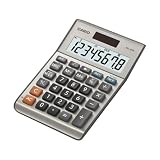
- LARGE EIGHT-DIGIT DISPLAY – Clear and easy-to-read 8-digit display, perfect for everyday calculations and ensuring accurate results in home or office settings.
- TAX & CURRENCY EXCHANGE FUNCTIONS – Effortlessly handle tax calculations and convert home currency to other currencies for easy financial management.
- GENERAL PURPOSE CALCULATOR – Ideal for a wide range of applications, from basic math to business and personal use, with memory keys for quick storage and recall.
- USER-FRIENDLY KEYBOARD – Easy-to-use layout, featuring square root, percent calculation, and simple functions that make it perfect for everyday tasks.
- COMPACT & PORTABLE DESIGN – Space-saving design that fits easily on any desk or in a briefcase, making it ideal for both home and office use.
Pick the calculator structure
There are two broad routes. A form-based calculator works when your pricing can be expressed as fields and formulas. A spreadsheet-powered interface works when the pricing logic is already complicated and maintained in Excel, and you want to keep that model as the source of truth. The table below compares the approaches the reviewed vendor pages describe. These are descriptions of advertised features, not independent tests of how well each product performs.
| Your situation | Approach to consider | What the vendor describes | Check before choosing |
|---|---|---|---|
| Straightforward choices and formulas, embedded in your website | Form-based calculator | Paperform’s calculations page describes embedding a form with live calculations and price calculators. | Whether the formula you need can be written with the functions the builder offers. |
| Tiers, conditional prices, or price lookups | Builder with conditional and lookup calculations | involve.me’s price quote calculator page describes tiered, conditional, and lookup-based pricing with live price updates. | The exact functions and limits on your plan. The page does not state them in detail. |
| Pricing already maintained in Excel | Spreadsheet-powered quoting interface | Airrange’s price quotes page describes using an existing Excel pricing model to build a guided quoting interface around chosen inputs and outputs. | How your specific workbook structure maps to the interface, and whether the model needs cleanup first. |
| A formal-looking document generated from form answers | Quote form with PDF generation | Cognito Forms’ guide includes automatic quote PDF generation. | The document layout, branding options, and delivery behaviour in the current product. Not stated in the guide. |
Build the inputs and the formula
Once the structure is chosen, map each customer choice to a field. Every input you wrote down in the planning step needs a home in the form, with the right field type: a dropdown for a fixed list of materials, a number field for quantity, a checkbox for optional add-ons. Mark required fields clearly so the calculation never runs on a blank value.
Map every choice to a field
Then write the calculation that combines those values. A simple example: a cleaning quote might be a base price, plus a rate per square metre multiplied by the area entered, plus a fixed charge for each selected add-on, with a minimum total applied at the end. Build that calculation in the order you would do it by hand, and label each intermediate value so you can see it when testing.
Quick wins for a faster PC:
Fix the driver behind crashes, sound loss and screen glitchesFind Drivers →Clear out junk files and repair common Windows errorsFree Scan →Scan for outdated or missing drivers - takes under a minuteDriver Scan →Rank #2

- Check your calculations thanks to the calculator's inbuilt serial impact roller printer that enables you to monitor your inputs and retains ongoing records. This two-color printer with a four-key memory prints red and black ink at up to 2.3 lines per second onto the included roll of paper.
- Printing calculator offers 12-digit LCD display for convenient viewing. 4-key memory keeps often-used figures accessible for faster calculations. Clock and calendar functions help maintain schedules.
- Easy-to-use solution for all of your basic math needs. Streamline financial calculations with currency conversion, tax calculation, and item counter functions. 1-year manufacturer limited warranty.
- Dimensions: 2.2"H x 6.4"W x 9.1"D. Package content: AC adapter, paper roll, user manual.
- Powered by any standard AC outlet, eliminating the need for expensive batteries. Decimal switch, rounding switch, percent, sign change, backspace, double zero, and grand total functions help you solve a variety of mathematical problems.
Handle tiers, conditions, and lookups
Where the price changes by tier or condition, use the builder’s conditional or lookup rules rather than nesting many separate calculations. involve.me describes tiered, conditional, and lookup-based pricing on its quote calculator page, and Paperform describes conditional pricing in its calculations feature. Keep each rule readable. A long chain of nested conditions is hard to audit and is where errors usually hide.
Decide what the customer sees
The result can take several forms, and the choice shapes both the customer’s expectations and your risk. Show the output in a way that says which assumptions and selected options produced it.
Estimate, quote for review, or fixed price
- Estimate. A range or indicative figure that the customer should expect to be confirmed after you review the job. Label it as an estimate on the page itself.
- Quote for review. A figure you will check and send back, often with a validity period you state in the calculator’s text.
- Fixed price. A figure the customer can accept and pay for directly. This works only when your pricing rules cover every case the form allows, so the calculation must be tested thoroughly before this status is used.
The reviewed vendor pages describe these kinds of workflows but do not establish when a displayed price is legally binding. Treat the wording on the calculator as your statement of intent, and get professional advice if enforceability is a concern.
Rank #3
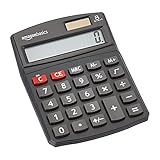
- 8-digit LCD provides sharp, brightly lit output for effortless viewing
- 6 functions including addition, subtraction, multiplication, division, percentage, square root, and more
- User-friendly buttons that are comfortable, durable, and well marked for easy use by all ages, including kids
- Designed to sit flat on a desk, countertop, or table for convenient access
Breakdown and quote documents
A price breakdown lists each line, such as base price, add-ons, fees, and discounts, so the customer can see how the total was reached. Paperform describes quote PDFs as a possible follow-up, and Cognito Forms describes automatic quote PDF generation. A breakdown is usually more useful than a single number, because it prevents the most common question: why is this higher than I expected?
Connect the result to your next step
The calculator should lead somewhere. Depending on how you sell, the next step after the price appears might be:
- Capturing the customer’s contact details before the price is revealed, or after it.
- Sending the quote to an email address or routing the lead into a CRM. Paperform describes CRM connections as a possible follow-up.
- Opening a call-booking calendar, which involve.me describes as a booking integration.
- Taking payment for a fixed-price offer, which involve.me describes as a payment option.
Choose one primary next step. Calculators that ask a visitor to do three things at once, such as book a call, pay, and request a quote, tend to confuse the visitor.
Rank #4

- 【12 Digit Display】Features easy-to-read 12 digits LCD display, the big screen clearly shows the numbers, suitable for all kinds of calculations and office scenes.
- 【Double Power Supply】Support both solar energy and batteries. Our calculator comes with an AAA battery; In a well-lit environment, you can also use solar energy to charge.
- 【Embedded Big Button】Big buttons make your input flow and comfortable; Raised button design makes your input accurate and fast; Sturdy plastic keys for long-lasting use.
- 【Automatic Shut-down】Intelligent power saving design-Our calculator can stand by for 8 minutes without operation, then it will automatically shut down.
- 【Function introduction】Contains basic functions of add, subtract, multiply, divide,CE, %; Upgrade function of M+/M-/MRC; Covers the needs of daily computing.
Test the math before going live
No vendor page substitutes for checking your own numbers. Before publishing, run a set of test submissions and compare each result against your written pricing rules, not against the calculator’s output. Include these cases:
- Ordinary cases. Typical combinations of inputs that you expect most customers to choose.
- Minimum and maximum values. The lowest and highest allowed quantities, durations, or options.
- Boundary values. Inputs sitting exactly on a tier threshold, where the rule should switch from one price to the next.
- Optional selections. A submission with no add-ons, one add-on, and all add-ons selected.
- Discounts and fees. Cases that should trigger a discount, a minimum charge, or a fee, and cases that should not.
- Rounding. Totals that produce fractions of a cent or dollar, checked against the rounding rule you chose.
Record the expected figure for each test before you run it. If the calculator disagrees with your hand calculation, find out which is wrong before any customer sees the tool.
If your pricing already lives in Excel
Rebuilding a working spreadsheet in form fields is often the slowest part of this project, and it is where mistakes creep in when the two versions drift apart. A spreadsheet-powered approach keeps the model you already trust. Airrange describes this route: using an existing Excel pricing model to create an embeddable or shareable quoting interface, with delivery by PDF or email.
- List the inputs the customer should choose and the input cells in your workbook that receive them.
- List the output cells you want the customer to see, such as the total, a breakdown line, or a range.
- Confirm that the workbook calculates correctly with those inputs entered manually, including edge cases, before connecting it to a website.
- Decide how the output is delivered: displayed on the page, emailed, or produced as a PDF.
- Test the interface with the same case list used for a form-based calculator, and compare results against the workbook.
Keep one copy of the pricing model. If you change a rate, change it in the model, and confirm that the interface picks up the change before you rely on it.
Limits and what to verify before you choose a tool
The vendor pages reviewed here describe their own capabilities and do not compare usability, quality, or value. Before committing to a product, check the following on its current plan and documentation:
Quick Recap
- Which calculation functions and lookup methods are available, and whether any limits apply to them.
- Whether the calculator can be embedded on your own website, and what the embedding requires.
- How PDFs and emails are generated and delivered, and whether you can edit the document layout.
- Which CRM and booking integrations are available on your plan.
- Current prices. Software pricing and feature sets change, and no prices are listed in this guide.
these
Product prices and availability are accurate as of the date/time indicated and are subject to change. Any price and availability information displayed on Amazon at the time of purchase will apply.
Free tools Windows power users keep installed
One-click scans. No signup required.

