
Free tools Windows power users keep installed
One-click scans. No signup required.
Choose one 30TB drive when capacity per bay is your priority and your NAS supports that exact drive and pool configuration. Choose several smaller drives when your bay count, redundancy plan, or staged upgrade path makes a multi-drive pool a better fit. In either case, the drive capacity printed on the label is not the same as usable NAS storage.
Start with your NAS and storage plan
Before comparing drive capacities, identify the NAS model, the number of free bays, the current pool layout, and the amount of usable space you expect to need. A 30TB disk is only an option if the NAS accepts that exact model and its software supports the intended pool and volume size.
- NAS model and firmware: compatibility and capacity limits can differ between models and may change with firmware.
- Pool layout: decide how much redundancy you need and how many drives the layout requires.
- Growth: estimate when you will need more space and whether you want to add drives or replace existing ones over time.
- Workload: compare the exact drive’s published workload rating and other specifications with your use.
- Budget and flexibility: compare total drive count and current local pricing, while accounting for the value of spare bays and future expansion.
Do not assume every NAS accepts every drive or supports every volume size. Check the NAS maker’s documentation and calculator for your exact model before buying.
Compare raw capacity with usable pool capacity
A 30TB drive provides 30TB of raw drive capacity, not necessarily 30TB of usable NAS storage. Mirroring and parity layouts reserve capacity for redundancy, and the pool’s usable space depends on the number and sizes of its drives, the RAID type, and the NAS’s volume-size limits.
The Tool Desk
Outbyte PC Repair FREEClear out junk files and repair common Windows errorsFree Scan →Outbyte Driver Updater FREEScan for outdated or missing drivers - takes under a minuteDriver Scan →#1 Best Overall

- Breakthrough areal density: The first hard drive to feature up to 3TB per platter, enabling massive storage capacity in the same footprint for maximized data center efficiency.
- Enormous capacity: Up to 30TB of storage in an industry-standard 3.5-inch form factor.
- Time-tested excellence. Next-gen innovation: Blends 90% of trusted, proven components from previous generations with cutting-edge Mozaic 3+ technology for enhanced performance and reliability.
- Reduces power consumption: Up to 60% compared to 10TB drives for lower operational costs and energy consumption.
- Enterprise-class reliability: Designed for the stringent demands of hyperscale cloud service providers and enterprise data centers, providing durable, always-on performance essential for critical enterprise applications.
Several smaller drives can spread raw capacity across more bays, but their combined label capacities do not tell you how much usable space the pool will provide. Use the manufacturer’s calculator with the intended RAID type and drive sizes. Synology notes that available RAID types and maximum single-volume capacity vary by NAS model, and its expansion documentation describes configuration-specific capacity rules. Those Synology rules should not be assumed to apply to other NAS systems: Synology RAID Calculator and Synology storage-pool expansion guidance.
When one 30TB drive makes sense
One large drive concentrates more capacity in a single bay. That can be attractive when bays are scarce or you want to add a large amount of raw capacity without occupying several new bays. It does not, by itself, provide redundancy: a single-disk pool has no second disk to keep the pool available if that drive fails.
Rank #2
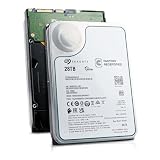
- MASSIVE 28TB CAPACITY – Store and manage enormous datasets with ease. Ideal for data centers, servers, NAS systems, cloud storage, and large-scale backup solutions.
- ENTERPRISE-CLASS PERFORMANCE – 7,200 RPM spindle speed, SATA III 6Gb/s interface, and large cache deliver fast, consistent throughput for demanding 24/7 workloads
- CMR TECHNOLOGY (CONVENTIONAL MAGNETIC RECORDING) – Designed for predictable performance, reliability, and compatibility in RAID and enterprise storage environments.
- BUILT FOR 24/7 OPERATION – Engineered for continuous use with enterprise-grade durability, making it suitable for mission-critical applications and high-density storage arrays.
- STANDARD 3.5” SATA FORM FACTOR – Seamlessly integrates into most enterprise servers, workstations, and NAS enclosures that support 3.5-inch SATA hard drives.
Seagate lists the IronWolf Pro ST30000NT011 as a 30TB SATA 6 Gb/s, 7200 RPM drive with a five-year limited warranty. Its 2025 datasheet specifies CMR recording, helium filling, rotational-vibration sensors, a 550 TB/year workload rate limit, and 512 MB cache. Seagate also lists a 2,500,000-hour MTBF, a maximum nonrecoverable read-error rate of 1 per 1015 bits read, three years of Rescue Data Recovery Services, and a five-year limited warranty for this model. These are manufacturer specifications, not a prediction of how long a drive will last or what will happen to a particular user’s data. Check current local terms and the current datasheet before purchase: Seagate IronWolf Pro product support and model listing and Seagate IronWolf Pro 30TB datasheet.
Seagate also lists a 30TB Exos ST30000NM004K with a five-year limited warranty. Exos is an enterprise drive family, so treat it as an option for a system suited to that drive class—not as interchangeable with every home or small-business NAS drive. The relevant support listing does not establish compatibility with your NAS: Seagate Exos product support and model listing.
Rank #3

- High Performance: All-CMR (conventional magnetic recording) portfolio enables consistent, industry-leading 24×7 performance allowing users to access data anytime, anywhere.Average Operating Power (W) - 7.7W, Operating Temperature (drive reported, max °C) : 65, Operating Temperature (ambient, min °C) : 0
- Class-Leading Dependability: Up to 550TB/year workload rating, 2.5M hours MTBF, and 5-year limited warranty for unparalleled total cost of ownership (TCO)
- Peace of Mind with Data Recovery: Complimentary 3 year Rescue Data Recovery Services for a hassle-free, zero-cost data recovery experience
- IronWolf Health Management: Helps protect data with prevention, intervention, and recovery recommendations to ensure peak system health
- Optimized for NAS: AgileArray with dual-plane balancing, time-limited error recovery (TLER), and rotational vibration (RV) sensors to deliver top RAID performance in multi-bay environments
When several smaller drives may be a better fit
Smaller drives let you distribute capacity across bays and may suit a pool design that requires multiple disks for redundancy. They can also support staged growth, but only if the NAS’s pool rules allow the planned additions or replacements and the resulting capacities work for your layout.
Drive families are not uniform across capacities. Seagate’s current family page lists IronWolf up to 16TB and 180 TB/year workload rate, and IronWolf Pro up to 32TB and 550 TB/year. Those are family-level upper bounds, not specifications that apply to every model. Compare the precise SKU rather than relying on the family name: Seagate IronWolf family specifications.
Rank #4

- (1) 1GB = 1 billion bytes and 1TB = 1 trillion bytes. Actual user capacity may be less depending on operating environment.
- Compatibility: Unlike desktop drives, WD Red hard drives are specifically designed and tested for NAS and include NASware technology which fine tunes drive parameters to match NAS system workloads for optimum performance.
- Reliability: Desktop drives aren’t typically designed for the demands of an always-on NAS environment. WD Red hard drives are designed to perform under tough conditions encountered in high-intensity 24x7 multi-user NAS environments.
- RAID Ready: WD Red hard drives are engineered with RAID error recovery control to help reduce failures within multi-bay NAS systems, unlike most desktop drives that are configured for generic use.
- Noise and Vibration Protection: Designed to operate solo, desktop drives typically offer little or no protection from the noise and vibration present in a multi-drive system. WD Red hard drives include Rotation Vibration (RV) sensors that anticipate and proactively counteract disturbances caused by increased vibration often found in multi-bay NAS systems.
Expansion and replacement rules can also affect whether smaller disks fit your plan. Synology’s guidance describes configuration-specific rules for adding drives and replacing them; it recommends replacing smaller drives first to optimize use of pool capacity and illustrates mixed-size RAID 5 behavior. Follow the instructions for your particular NAS and pool rather than applying those examples to another platform: Synology drive replacement guidance.
Independent reader supportYour contribution helps us test, update, and keep practical guides available for everyone.Check compatibility and volume limits for the exact model
For Synology, select your exact NAS model in its compatibility list and check the complete drive SKU. Synology describes the list as tested and verified, warns that hardware or firmware changes can affect compatibility and stability, and says support may be limited for issues involving unlisted drives. A result for one NAS model does not establish compatibility with another: Synology compatibility list.
Best Value

- 28TB Massive Enterprise Capacity
- 7200 RPM Performance
- SATA 6Gb/s Interface
- 512e Sector Format 3.5-Inch Enterprise Form Factor
- 2.5M-hours MTBF enterprise rating
Then verify that the model supports the intended RAID type, drive mix, pool expansion method, and maximum single-volume capacity. Use your NAS maker’s current calculator and documentation; do not infer those limits from the drive’s 30TB label.
Plan for resilience and backup separately
Redundancy and backup solve different problems. RAID or another redundant pool layout can help keep a pool available after a disk problem, but it is not an independent backup. Keep a separate backup of important data and know how to restore it.
Neither the listed manufacturer specifications nor the cited NAS guidance establish a universal rebuild duration or a measured failure-probability comparison between one 30TB drive and several smaller drives. Rebuild time depends on the NAS, pool layout, drive behavior, workload, and settings; do not buy on the assumption that a rebuild will take a particular number of hours or days. Workload and MTBF ratings are vendor specifications, not guarantees of service life.
Make the choice
- Favor one 30TB drive if bay capacity is the main constraint, the exact drive is supported, and your plan accounts for what happens if that disk becomes unavailable.
- Favor several smaller drives if your chosen pool needs multiple disks, you have bays to use, or the NAS’s documented expansion and replacement rules make staged growth suitable.
- Pause before buying if you have not confirmed model-specific compatibility, usable capacity, volume limits, or an independent backup.
Compare total cost using current prices in your region and the number of drives your actual pool design needs. Without those inputs, there is no universal cost-per-terabyte winner.
Quick Recap
Product prices and availability are accurate as of the date/time indicated and are subject to change. Any price and availability information displayed on Amazon at the time of purchase will apply.

