
iTechGuides is reader-supported. When you buy through links on our site, we may earn an affiliate commission. As an Amazon Associate I earn from qualifying purchases. Learn more
For U.S. federal tax purposes, calculate a capital gain or loss on crypto by subtracting the adjusted basis of the units you disposed of from the amount realized, with both amounts expressed in U.S. dollars: gain or loss = amount realized − adjusted basis. The calculation depends on the transaction type, the units’ basis and holding period, the transaction’s date, and what any fee paid for. The steps below cover individuals holding digital assets as capital assets—not every kind of crypto income or business activity.
Which crypto transactions can produce a gain or loss?
The IRS treats digital assets as property. Selling crypto for dollars is a disposition, but it is not the only one: exchanging it for another digital asset or other property, or spending it on goods or services, can also produce a gain or loss. The IRS summarizes the principle this way: “Digital assets are treated as property, and the general tax principles applicable to all property transactions also apply to transactions involving digital assets.” See the IRS FAQs on digital asset transactions.


First classify the event. A purchase or a transfer between accounts or wallets you own is not, by itself, the same as a sale or exchange. Receiving crypto as compensation or a reward may instead create income at receipt, followed by a separate capital gain or loss if you later dispose of it. Mining, staking, gifts, business activity, futures treated as section 1256 contracts, and complex DeFi activity can require different treatment or forms; the basic capital-asset calculation here should not be applied to them automatically.
What records do you need for each disposed lot?
Calculate at the level of the specific units disposed, rather than treating all holdings of one cryptocurrency as if they had the same purchase price. For each transaction, keep the asset and quantity, date and time, USD fair market value, basis, and fees. The IRS lists these kinds of records in its digital assets filing and records guidance.
#1 Best Overall
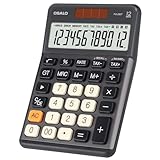
- 【Advanced Tax & Business Functions】Quickly set tax rates with dedicated TAX+/- keys and simplify budgeting via GT, MU, and memory keys (MRC/M+/M-). These tools enable seamless tax calculations and customizable rate settings for precise, tailored results—ideal for accountants, business owners, and professionals requiring accurate tax computations.
- 【Visualized Operation Symbol Display】When you would like to calculate the number, it will express the symbol (plus, subtract, multiply, or divide) on the screen. It can help you see the operation steps when you operate continuously.
- 【Efficient Dual Power System】The calculator uses high conversion rate solar panels, and solar power can be used in well-lit areas. At the same time, we provide a matching battery double safe uninterruptible power supply. The calculator will shut down automatically after 8 minutes without operation.
- 【Small Size, Large Display & Premium Build】It features a large LCD display with a 30° angled screen for clear visibility, paired with a high-grade metal panel and durable ABS buttons. The ergonomic button curvature aligns with natural finger movements, reducing errors and enhancing efficiency.
- 【Durable Construction and Portability】 Made of high-grade metal panel and durable ABS buttons, this 12-digit calculator is lightweight yet durable, capable of withstanding multiple impacts from desktop height. The large, clear LCD Display offers crisp, easy-to-read numbers, minimizing eye strain and ensuring professional-grade performance whether at home, in the office, or while traveling.
Identify the units and their basis and holding period using reliable records. The applicable unit-identification rules can depend on whether the assets were held with a broker, in a hosted wallet, or in an unhosted wallet. The IRS’s current digital-asset FAQs address identification and default identification; do not assume one cost-basis method applies across every account and wallet.
How to calculate the USD gain or loss
- Classify the event and tax year. Determine whether you sold for dollars, exchanged crypto for property, spent crypto, received it as income, or merely transferred it between accounts you own. The date matters especially for transaction-cost treatment: the current digital-asset FAQs address transactions on or after January 1, 2025; the IRS’s older virtual-currency FAQs generally address transactions before that date.
- Identify the disposed units and adjusted basis. Match the units to acquisition records and determine their basis, including applicable acquisition costs. For a cash purchase, basis starts with what you paid. If you received crypto for services, the IRS says its USD fair market value when received is ordinary income; if that amount is included in income, it generally also establishes basis for a later disposition.
- Determine the amount realized in USD. For a cash sale, start with the cash received and apply the relevant disposition-cost rules. For a crypto-to-crypto exchange or an exchange for other property, use the USD fair market value of what you received at the transaction time and account for applicable transaction services and costs under the rules for that type of exchange.
- Subtract adjusted basis. If the amount realized exceeds basis, the difference is a gain. If it is less than basis, the difference is a loss.
For arithmetic only: if adjusted basis is $1,000 and amount realized after applicable disposition costs is $1,250, the gain is $250. If amount realized is $850, the loss is $150. These examples do not determine whether or how much of a loss is deductible.
How to establish the USD value at the transaction time
Use a value tied to the transaction date and time, not a later market quote. For exchange-facilitated transactions, the IRS’s older virtual-currency FAQs point to the USD amount recorded by the exchange. For off-chain exchange transactions, they describe using the exchange price at the date and time the transaction would have been recorded on-chain.
The Tool Desk
Outbyte PC Repair FREERepair Windows errors before they cause bigger problemsFix Now →Outbyte Driver Updater FREEFix the driver behind crashes, sound loss and screen glitchesFind Drivers →For peer-to-peer transactions, the IRS describes valuing the transaction when it is recorded on the ledger, or at its on-chain equivalent. It says the IRS will accept values from an explorer that analyzes worldwide indices and calculates a value at an exact time; another valuation must be substantiated as an accurate fair-market-value representation. If received crypto has no published exchange value, the older FAQ says to use the fair market value of the property or services exchanged at the time. Preserve the exchange statement, explorer record, timestamp, and method used. See the IRS FAQs on virtual-currency transactions.
How crypto fees affect basis and amount realized
Do not treat every crypto-related fee alike. Under the IRS’s post-2025 digital-asset FAQs, transaction costs are amounts paid in cash or property—including digital assets—to another party for services that effect a purchase, sale, or disposition. Examples include transaction or gas fees, transfer taxes, and commissions. A cost to move crypto between wallets or accounts you own is not a transaction cost under that guidance.
| Transaction or fee | General treatment in the cited IRS guidance | Date qualification |
|---|---|---|
| Cash purchase; qualifying service fee to effect the purchase | Qualifying purchase costs are included in the acquired asset’s basis. | Post-2025 FAQ treatment applies to transactions completed on or after January 1, 2025. The older FAQ also explicitly says purchase fees, commissions, and other acquisition costs are included in basis. |
| Sale or other disposition; qualifying cost allocable to the disposition | For a cash sale, qualifying costs allocable to the disposition reduce amount realized. | The current FAQ treatment is for transactions completed on or after January 1, 2025. Do not assume this treatment applies retroactively to every earlier disposition. |
| Transfer between wallets or accounts you own | The cost to effect this self-transfer is not a transaction cost under the current FAQ definition. | The cited definition is in the post-2025 FAQs. Classify the transaction by its date and applicable guidance. |
| Crypto-for-crypto exchange | Follow the IRS FAQ for the particular exchange. In a materially different digital-asset exchange example, relevant costs are allocated to the transferred or disposed asset and are not added to the basis of the different digital asset received. | The detailed treatment cited is in the current FAQs for transactions on or after January 1, 2025. |
The table is not a universal “all fees increase basis” rule. For transactions before 2025, the older IRS FAQ explicitly addresses acquisition costs, but the cited guidance does not support a blanket retroactive rule for every disposition-fee pattern. Check the guidance applicable to the transaction year and type. The current digital-asset FAQs give separate answers for different purchases, sales, and exchanges.
How holding period changes the classification
For digital assets held as capital assets, the IRS classifies a disposition after a holding period of one year or less as short-term, and a disposition after more than one year as long-term. The holding period starts the day after acquisition and ends on the sale or exchange date. This classification is separate from calculating the dollar gain or loss; retain the acquisition and disposition dates for each lot. The current IRS digital-asset FAQs explain the holding-period rule.
Free tools Windows power users keep installed
One-click scans. No signup required.
Where to report a capital-asset disposition
The IRS directs sales, exchanges, and other dispositions of digital assets held as capital assets to Form 8949, with totals flowing to Schedule D. Other crypto receipts do not all belong on those forms: ordinary income from mining or staking may follow other reporting paths, and compensation, business activity, or gifts have distinct rules. Check the IRS’s digital assets filing guidance for the applicable reporting category.
Best Value

- Vibrant minimalistic accountant design featuring a rainbow outline of a calculator and spreadsheet, symbolizing creativity and precision in accounting. Colorful Calculator and Spreadsheet Accountant Design
- Perfect gift for accountants, CPAs, bookkeepers, or finance lovers who enjoy color and numbers. Great for office wear or tax season humor.
- Two-part protective case made from a premium scratch-resistant polycarbonate shell and shock absorbent TPU liner protects against drops
- Printed in the USA
- Easy installation
Report digital-asset transactions whether or not they produce a taxable gain or loss, and retain sufficient records to support the calculation. Reconcile broker paperwork with your own lot and fee records rather than assuming the form supplies a complete basis. In IRS Tax Tip 2026-07, dated January 28, 2026, the IRS says most Forms 1099-DA for 2025 transactions will not include basis, so taxpayers may need to calculate it themselves: IRS reminders for taxpayers about digital assets.
This article addresses U.S. federal guidance for individuals holding digital assets as capital assets. State and foreign tax rules, business situations, and individualized tax questions may differ.
Quick Recap
Product prices and availability are accurate as of the date/time indicated and are subject to change. Any price and availability information displayed on Amazon at the time of purchase will apply.

