
Free tools Windows power users keep installed
One-click scans. No signup required.
iTechGuides is reader-supported. When you buy through links on our site, we may earn an affiliate commission. As an Amazon Associate I earn from qualifying purchases. Learn more
To estimate the upload speed needed for a nonstop YouTube stream, take the encoder’s total bitrate and divide by 0.8. That reserves the 20% upload headroom YouTube recommends: a 10 Mbps feed calls for about 12.5 Mbps of available upload capacity. To estimate data use, multiply a steady bitrate in Mbps by 10.8 for decimal gigabytes per day. These calculations apply to the live feed sent from your encoder to YouTube, not to delivery of the stream to viewers.
What bandwidth you need to calculate
For a prerecorded-video livestream, your encoder still sends a live feed to YouTube for as long as the stream is running. The relevant rate is the encoder’s configured total output bitrate, including audio—not the size of the original video file and not the number of viewers. YouTube transcodes the incoming live feed into multiple output formats for viewers, so audience size does not multiply your outbound upload requirement. YouTube’s live encoder settings guidance describes the ingest stream and its transcoding.
Use upload speed, not download speed. YouTube notes that inbound bandwidth is often greater than outbound bandwidth, and that other people or devices sharing the connection can reduce capacity available to the encoder. Its recommendation is to leave 20% room above the total stream bitrate. YouTube’s streaming tips say the total bitrate must not exceed available upload bandwidth and recommend 20% headroom.
Use the live ingest bitrate for your video settings
Choose the row matching the stream resolution, frame rate, and codec in YouTube’s live ingest recommendations. The figures below use YouTube’s recommended H.264 rates; the upload targets are calculated estimates (recommended bitrate ÷ 0.8), not separate values published by YouTube. The YouTube page also lists recommended values for AV1 and H.265/HEVC, so use the row for the codec actually selected in your encoder. Check YouTube’s current live encoder table before configuring a stream; its recommendations can change.
#1 Best Overall

- INTERNET OFF AND ON ALERTS IN MINUTES: This internet outage detector reports to the MySpool cloud several times every minute. Two missed check-ins send an Internet OFF alert, usually delivered within 1 to 3 minutes, and an Internet ON alert follows the moment service returns.
- RECIPIENTS AND TIMING YOU CONTROL: Send alerts to up to 5 email addresses plus one SMS number. Internet ON and Internet OFF notifications can be configured separately, so you can enable both or only the alerts you need. Set active hours to help avoid unwanted notifications during the night.
- NO APP, NO HUB, NO SOFTWARE: This wired internet monitor plugs into any open LAN port on your router or switch and runs on its own. Nothing to install on a phone or PC, no gateway or bridge to buy, and no smart home ecosystem to join. A/C power cable with adapter is included. Ethernet cable is not included.
- SET YOUR OUTAGE THRESHOLD: A dashboard slider sets the outage interval anywhere from 2 to 30 minutes, so a brief dropout never fires an internet down alert. Every event is logged with a timestamp on a secure web page you can show your provider.
- RELIABLE REMOTE INTERNET MONITORING: Runs continuously with no manual input, making it practical for vacation homes, rental properties, branch offices, server closets, and camera or NVR cabinets. Designed by Bell Labs engineers, this device monitors your internet connection around the clock for outages.
| Live ingest format (H.264) | YouTube recommended bitrate | Estimated available upload target with 20% headroom |
|---|---|---|
| 720p30 | 8 Mbps | 10 Mbps |
| 720p60 | 8 Mbps | 10 Mbps |
| 1080p30 | 14 Mbps | 17.5 Mbps |
| 1080p60 | 17 Mbps | 21.25 Mbps |
| 1440p30 | 21 Mbps | 26.25 Mbps |
| 1440p60 | 34 Mbps | 42.5 Mbps |
| 2160p30 (4K) | 42 Mbps | 52.5 Mbps |
| 2160p60 (4K) | 50 Mbps | 62.5 Mbps |
These are ingest settings for a live encoder, not YouTube’s separate recommendations for uploading a video file. Do not substitute the upload-file table for the live-stream table.
Calculate the upload capacity step by step
- Set the intended output. Decide the resolution and frame rate that make sense for the source video and channel.
- Find the matching live ingest bitrate. Use the recommendation for the selected codec and format in YouTube’s live encoder table.
- Calculate headroom. Divide the total stream bitrate by 0.8. For example, 14 Mbps ÷ 0.8 = 17.5 Mbps of available upload capacity for a 1080p30 H.264 feed.
- Account for other traffic. The target is capacity available to the stream. If devices or other encoders use the same connection, allow for their traffic too. For simultaneous primary and backup feeds, add their total bitrates first, then divide by 0.8, as YouTube’s network guidance concerns the total bitrate.
- Measure the actual connection. Run an upload speed test on the same connection the encoder will use, then check again during normal household or workplace network use. A test is a snapshot; it does not prove the connection will remain stable around the clock.
Estimate monthly data use
For a constant encoded rate of R Mbps, estimate decimal data transfer with these formulas:
Rank #2

- View Live NetSpeed and Time.
- View Upload Speed and Download Speed Separately.
- View Free Memory, Uptime and Session Data Usage.
- Works on your Fire TV, Fire Tablets and other Android phones.
- Per 24 hours: R × 10.8 = approximate decimal GB.
- Per 30 days: R × 324 = approximate decimal GB.
For example, a continuous 10 Mbps feed transfers about 108 decimal GB in a day and 3,240 decimal GB (3.24 TB) in 30 days. At 50 Mbps, the estimates are about 540 GB per day. These are arithmetic estimates assuming an uninterrupted constant bitrate, before overhead and retransmissions; actual transfer and an internet provider’s billing calculation may differ.
| Steady bitrate | Approximate data per day | Approximate data per 30 days |
|---|---|---|
| 8 Mbps | 86.4 GB | 2,592 GB |
| 14 Mbps | 151.2 GB | 4,536 GB |
| 50 Mbps | 540 GB | 16,200 GB |
Encoder and connection settings that affect the estimate
Bitrate and audio
YouTube recommends constant bitrate (CBR) for the listed RTMP/RTMPS live settings. Use the recommendation for your chosen resolution, frame rate, and codec as a planning baseline. Its listed audio recommendations are 128 Kbps for stereo or 384 Kbps for 5.1 audio. Include audio in the total output rate when estimating bandwidth; do not add it twice if the encoder’s configured bitrate already represents total output.
Rank #3

- Premium Parental Controls: Easily control every device using your Internet, individually or groups via Profiles. Screen Time, Internet History, Schedule access to Apps / Websites, Explicit monitoring and more. Including mobile on Cellular and WiFi.
- Family Safe Internet: Kibosh Pro ** enjoy an Internet curiously free of any explicit content / images by default - it cannot be turned off, broken or misconfigured - your internet will ALWAYS be free of explicit content on every device 24/7. Over 10 years in production protecting homes/offices around the world.
- Malware Protection: unique dual-layer Malware: 1) stops Malware before you get infected 2) monitors your network continually for any infections and alerts you immediatly. Unlimited coverage, no software to install or complicated licensing. You will know, at a glance, if any device on your network has Malware.
- Plug-And-Play & Sustainable: The Kibosh MT6000 WiFi Router replaces your current WiFi router. That's it. Contact Support for Live setup assistance. Once in place it works without any effort on your part - a long term solution to a tough problem (in and out of home).
- Mobile Link: new with 3.0 is Mobile Link VPN-layer technology that "links" a mobile device to your Kibosh Portal thereby extending all Internet Security & Parental Controls - no matter what Internet is being used by the mobile device (Public WiFi or Cellular Data) - the Internet will ALWAYS be Family Safe + Parental Controls + GPS location (beta), Screen-time, and more.
Keyframes and ingest protocol
YouTube recommends a 2-second keyframe interval and says not to exceed 4 seconds. It recommends RTMPS, the secure extension to RTMP, for live ingestion. A stream key identifies the incoming feed and functions like a password, so keep it private. See YouTube’s encoder settings guidance and its stream key guidance for current setup details.
Network connection
Use a connection whose measured upload capacity exceeds the calculated target under ordinary network load. For a computer that can connect to the router by cable, Ethernet may avoid some wireless variability, but a cable cannot increase the upload speed supplied by the internet service. If measured upload capacity falls short, reduce the selected bitrate or investigate a plan with greater upload capacity; no particular provider or plan can be recommended from these calculations alone.
Rank #4

- control internet usage
- daily statistics on your internet bandwidth
- Real time speed update in status bar and notification.
- Daily traffic usage in notification.
- Separate stats for Mobile network and WiFi network.
Common calculation and reliability mistakes
- Checking download speed instead of upload: the encoder sends data out to YouTube, so outbound capacity is the relevant measurement.
- Using the bitrate for a file upload: a prerecorded source does not make the live ingest feed a file upload; use YouTube’s separate live encoder recommendations.
- Buying a plan that only barely matches the bitrate: leave the recommended 20% headroom and account for shared network traffic.
- Multiplying your upload requirement by viewers: the encoder sends its feed to YouTube; YouTube transcodes it for viewers.
- Treating one speed test as a 24/7 guarantee: network interruptions can still disrupt a nonstop stream. Test with the actual encoder and monitor the feed rather than relying only on a peak speed result.
Or let it run in the cloud
If you do not want a home computer and internet connection to carry the stream continuously, StreamNeo keeps an uploaded video or playlist live on your YouTube channel from the cloud. Upload the recording, add your YouTube stream key once, and go live. Nothing has to stay powered on at home; every slot streams the uploaded quality up to 4K 60fps at one flat price per slot, and the service automatically recovers if YouTube drops the stream. The first day is free with no card. The Monthly price is $9.99 per month. Start the free day with StreamNeo.
Quick Recap
Best Value
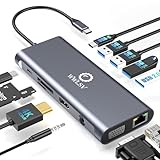
- 【12-in-1 Laptop Docking Station Massive Expansion】This 12-in-1 USB C Hub elevates your efficiency by providing 12 essential ports in one sleek device: 1x HDMI (4K@60Hz), 1x VGA (1080P), Gigabit Ethernet, 100W PD Charging, 3x USB 3.0 (5Gbps), USB 2.0, USB-C Data, SD/TF slots, and a 3.5mm Audio Jack. Laptop docking station replaces multiple messy adapters and reduces cable clutter from monitors, keyboard, and mouse, keeping your workspace organized for professional video editing and remote work
- 【4K@60Hz Ultra HD & Dual Display】This multi-port adapter delivers crisp visuals via HDMI up to 4K@60Hz for professional graphic design and smooth streaming. The WWLSV docking station supports simultaneous HDMI and VGA connections for Dual Display (VGA 1080P; HDMI adjusts due to shared bandwidth). NOTE: To achieve 4K@60Hz, your laptop must support DP 1.4. macOS Alert: This dock supports Mirror/Extend modes but DOES NOT support MST (external monitors will show the same image)
- 【1Gbps Ethernet & High-Speed Data】Our universal USB C dock transfers files instantly via 3x USB 3.0 ports (5Gbps; transfers 3.75GB in ~14s) and SD/TF readers—perfect for photographers. This high-speed hub includes additional USB 2.0 and USB-C data ports (480Mbps) for all your peripherals. The integrated Gigabit Ethernet port provides a stable, low-latency wired connection for seamless video calls, lag-free online gaming, and large downloads, ensuring a more reliable performance than Wi-Fi
- 【100W PD Charging & Pro Audio】This professional docking station supports 100W USB-C Power Delivery input with 85W safe output (15W reserved for dock stability). When using a 100W charger, this device powers your laptop from 0% to 50% in just ~35 minutes, keeping you productive during heavy workloads. The 3.5mm audio jack delivers clear, high-fidelity sound for immersive music, while the compact design makes this hub the ultimate companion for both office and travel
- 【Universal Compatibility Check】This laptop docking station is specifically designed for laptops with Thunderbolt 3/4 or Full-featured USB-C ports (supporting Display, Charging, and Data). Our hub is compatible with MacBook Pro/Air, Dell XPS 13/15/17, Latitude 5420/7420, Lenovo ThinkPad/Yoga, HP EliteBook 840, HP Envy, and Surface Pro 7/8. IMPORTANT: Please verify your laptop's USB-C port functionality; ports that only support data or charging will not support video output
Product prices and availability are accurate as of the date/time indicated and are subject to change. Any price and availability information displayed on Amazon at the time of purchase will apply.

