
iTechGuides is reader-supported. When you buy through links on our site, we may earn an affiliate commission. As an Amazon Associate I earn from qualifying purchases. Learn more
Organizations should not treat deepfake detection as a stand-alone identity check. Build identity resilience as a layered capability: verify identity evidence and attributes, protect the capture-to-check process, manage fraud signals, use human review where appropriate, and secure later account access. NIST’s Digital Identity Guidelines, SP 800-63 Revision 4, finalized in July 2025, provide current U.S. federal guidance for proofing, authentication, and federation. They can inform other organizations’ decisions, but they are not universal law or a guarantee against attacks.
What identity resilience means when attackers can manipulate identity media
Identity resilience is an organization’s ability to establish confidence in a claimed identity, detect and respond to attempts to defeat that process, and limit the consequences if a check fails. It covers more than whether a face in a selfie resembles a face on an identity document.
NIST SP 800-63A-4 describes remote identity-proofing attacks in which generative AI creates or alters images and videos of applicants or identity evidence. An injection attack can also introduce altered or forged media between a capture device and the system that performs a comparison. A submitted face image can therefore match a document image without proving that the media is genuine or that it came directly from the claimed person.
As NIST puts it: “A biometric comparison performed with a captured sample does not prevent these attacks.” The practical implication is to secure and assess the path by which evidence is captured, transmitted, and evaluated—not simply to add another face-matching step.
#1 Best Overall

- SHIELD YOUR PRIVACY WITH THE ID DEFENDER ROLLER STAMP: Tired of worrying about your personal information falling into the wrong hands? The ID Defender Roller Stamp offers a simple yet effective solution. With a unique wide camouflage pattern, it quickly and easily conceals sensitive data on a variety of surfaces.
- PRIVACY PROTECTION: useful not only as an ADDRESS BLOCKER or ID POLICE, but also keeps away preying eyes from invoices, authority documents, checks, bank statements and many more.
- SIMPLE TO USE: Just remove the cover and swipe. The wide swipe makes it easy to cover sensitive information.
- VERSATILE APPLICATION: Ideal for a variety of documents, including contracts, court documents, shipping labels, tax returns and more.
- LONG-LASTING INK: The high-quality ink works on both glossy and standard paper and provides up to 330 feet of coverage.
Which identity risks should a program cover?
Deepfakes are one part of a broader proofing threat model. NIST identifies impersonation, false or fraudulent representation, social engineering, and infrastructure attacks. Examples include presenting stolen identity evidence, fabricating a synthetic identity, persuading a person to submit evidence under false pretenses, or using fake video to impersonate someone.
Remote proofing can be exposed during unattended capture, automated biometric checks, and video-based attended proofing. The exact risks and suitable checks depend on the proofing method, evidence, technology, users, and consequences of an error.
Rank #2

- Protect Your Privacy Effectively: you can use this identity protection roller stamp to flip personal information in under 2 seconds and save time and effort, effectively hiding and protecting your personal information, such as phone numbers, social security numbers, bank statements, shipping addresses, tax documents,data, billing addresses and many more
- Ideal Replacement for Shredder: if you are still using a shredder to shred cards or papers that are printed with your personal information, this security stamper roller will be an alternative tool to block out your privacy effectively and easily
- Refillable and Long Term Use: this confidential stamp can cover a total length of up to 100 meter/ 109 yards, approximately 3,200 prints are covered, pattern width is about 0.78 inches; When ink runs out, you can refill the security stamp with ink
- Easy to Use: just continuous roll the address blocker roller stamp to conceal information, and roll on a second layer for maximum protection, works on paper, envelopes, folders, address labels, etc., please note that may not work on smooth surfaces
- How to Refill the Ink: there are 4 pieces of ID stamp refills, each is about 1.5 ml, you just need to unscrew the cap of the ink bottle (not disposable, you can close the cap for next time of use), then insert it into the hole on the side of the stamp, then turn it upside down, about 5 minutes later, the most of the ink will be replenished to the security roller stamp
How should organizations layer identity controls?
NIST’s approach is not “find one perfect detector.” It combines media analysis, protected exchanges, capture integrity, human review where applicable, and fraud handling. The following table separates what each layer contributes.
| Control layer | Purpose | What to evaluate |
|---|---|---|
| Evidence and media analysis | Assess submitted media for modification, manipulation, tampering, or forgery. | Test automated analysis on both genuine and attack media; document the tested artifacts and expected false-negative performance, and make that information available to relying parties on request. |
| Capture and transmission | Reduce opportunities to replace or alter evidence between capture and assessment. | Use authenticated, protected channels for remote-proofing exchanges; consider capture-sensor authentication or device attestation. |
| Human review | Add context and judgment to automated decisions during attended remote collection. | Train agents to recognize signs of manipulation and use randomized cues, such as asking a person to move or place an object between the camera and face. |
| Fraud management | Identify suspicious signals beyond the image itself and provide a response path. | Consider relevant checks such as SIM-swap detection and device or account tenure, and define how suspected or confirmed fraud events are communicated. |
NIST recommends passive forged-media detection and capture-sensor authentication or device attestation. These are components of a layered design, not proof that a particular capture is genuine. Human cues can also be useful, but they should complement rather than replace evidence validation, technical controls, and fraud checks.
Rank #3

- The id defender roller is the ultimate tool for guarding your personal data at home or in the office. Prevent identity theft by quickly masking sensitive information on mail, documents, or labels, giving you confidence that your details remain private and secure with Vantamo id theft protection.
- Effortlessly block out sensitive text with the label cover up identity protection, designed for quick, one-handed use. No more scraping off all shipping labels or doing a lot of swipes with a marker! Even first-time users will find the process intuitive and straightforward, making it a practical label eraser roller for anyone!
- Vantamo wide rolling privacy marker is fully refillable and arrives with 6 ink refill for self inking stamps ensuring lasting performance. Don't run out when you need it the most. The ink is specially designed for hiding information.
- Our address blackout stamp not only protects your privacy but also helps the environment. After using the roller on your documents, the paper is ready to be safely recycled, making this address eraser a smart alternative to shredding or tossing documents.
- Here at Vantamo, we are creating products that people love! We are committed to providing excellent customer service on every black out stamp. If you ever have questions or concerns, our team is here to help, ensuring your id defender delivers reliable protection and peace of mind every time.
How to evaluate deepfake detection without over-trusting it
Automated analysis has errors. A detector can miss attack media or flag genuine media, so an “AI detected” result should not be treated as a definitive identity decision. NIST calls for testing on genuine as well as forged or manipulated media, documenting tested artifacts and false-negative performance, and making that information available to relying parties on request.
When assessing a proofing process or service, ask for evidence that answers these questions:
Rank #4
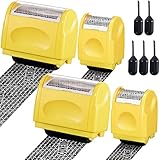
- Personal Information Protection: there are 4 pieces of address blocker roller stamps in 2 different sizes, and 5 pieces of 1.5 ml inks, a total of 9 pieces. Mainly applied to hide information such as social security numbers, bank statements, billing addresses, shipping addresses, tax documents and so on, protecting your personal information
- Re Inking Unlimitedly: the information blocker stamp can cover information of the length about 100 meters. And each security stamper roller has an oil hole, so you don't have to worry about you having to throw away the roller stamps when the ink runs out. They can be refilled with oil for repeated use, saving time and energy
- Cover Fast: our identity protection rollers come in 2 different sizes, and you can choose different sizes according to different areas of information to cover large amounts of private information in a fast and clean way, avoiding identity theft and rejecting privacy disclosure harassment
- Easy to Use: just remove the lid on the ID stamp blocker roller and open it, and then gently slide it on the place where the information needs to be covered. It is suitable for most ordinary paper with black words, and can protect your personal privacy in time
- Save Time and Energy: compared with the shredder, the personal confidential stamp has a small size, easy to carry, can be applied anytime and anywhere. Compared to the marker, it covers a larger area and can be quickly covered with a single swipe. There is no need to worry about whether you can not protect your privacy in time
- Which proofing modes are supported: remote unattended, remote attended, onsite unattended, or onsite attended?
- How are identity documents and their attributes validated against credible or authoritative sources?
- How does the process address injection, forged media, and trust in the capture sensor?
- What genuine and attack media were used for evaluation, and what false-positive and false-negative performance was observed?
- How are uncertain or suspicious cases escalated, reviewed, and recovered?
- What fraud checks are used, and how are suspected or confirmed events communicated?
- What personal information is processed, and how are privacy risks assessed?
- If AI or machine learning is used, what information is available about training, data, updates, and testing?
There is no general benchmark figure in NIST’s guidance that establishes a universal deepfake-detection success rate. Ask for results tied to the provider’s documented evaluation conditions rather than relying on a broad accuracy claim.
Keep identity proofing separate from authentication
Proofing establishes confidence in a claimed identity during enrollment or another identity-checking event. Authentication helps control later access to an account. Strengthening one layer does not automatically fix weaknesses in the other.
Best Value

- Personal Information Protection: there are 4 pieces of address blocker roller stamps in 2 different sizes, and 5 pieces of 1.5 ml inks, a total of 9 pieces. Mainly applied to hide information such as social security numbers, bank statements, billing addresses, shipping addresses, tax documents and so on, protecting your personal information
- Re Inking Unlimitedly: the information blocker stamp can cover information of the length about 100 meters. And each security stamper roller has an oil hole, so you don't have to worry about you having to throw away the roller stamps when the ink runs out. They can be refilled with oil for repeated use, saving time and energy
- Cover Fast: our identity protection rollers come in 2 different sizes, and you can choose different sizes according to different areas of information to cover large amounts of private information in a fast and clean way, avoiding identity theft and rejecting privacy disclosure harassment
- Easy to Use: just remove the lid on the ID stamp blocker roller and open it, and then gently slide it on the place where the information needs to be covered. It is suitable for most ordinary paper with black words, and can protect your personal privacy in time
- Save Time and Energy: compared with the shredder, the personal confidential stamp has a small size, easy to carry, can be applied anytime and anywhere. Compared to the marker, it covers a larger area and can be quickly covered with a single swipe. There is no need to worry about whether you can not protect your privacy in time
SP 800-63 Revision 4 updates authentication threat models, includes phishing-resistant options, and integrates syncable authenticators such as synced passkeys. Organizations can also consider a FIDO2 security key as an authentication option, after confirming that it works with the accounts and devices in use. Neither a key nor a passkey prevents synthetic identities or forged proofing media by itself.
Govern AI used in identity services
When an identity service uses AI or machine learning, NIST calls for the use to be documented and communicated to relying organizations. Organizations should provide information about model training methods, datasets, update frequency, and algorithm testing. Privacy risk assessments are required for personal information processed by these systems.
NIST recommends its AI Risk Management Framework for evaluating risks introduced by AI and machine-learning systems. Its adversarial machine-learning report also describes broader attack categories—including evasion, poisoning, privacy, and misuse attacks—but identity proofing still needs controls tailored to its own evidence and workflow.
Recommended Free Tools
A practical sequence for strengthening an identity program
- Map the identity journey. Identify where an identity is claimed, what evidence and attributes are collected, how they are checked, which systems receive the result, and how later access is authenticated.
- Threat-model each proofing mode. Assess exposure to impersonation, synthetic identities, social engineering, infrastructure attacks, forged media, and injection at the stages used by your process.
- Layer controls around evidence. Review media analysis, protected data exchanges, capture-sensor trust, and human review for attended sessions. Match fraud checks and escalation paths to the method and the consequences of failure.
- Require meaningful evaluation evidence. Ask how genuine and attack media were selected and tested, what errors were measured, and how results and limitations are documented. Do not use an unqualified detector score as the decision rule.
- Set AI and privacy governance. Document AI/ML uses, make training, data, update, and testing information available to relying organizations, and assess privacy risks for personal information processed.
- Choose controls proportionate to risk. NIST’s guidance is risk-based. Select applicable assurance levels and safeguards in light of the transaction, user base, and consequences of failure, and distinguish requirements stated as “SHALL” from recommendations stated as “SHOULD” in the relevant guideline text.
SP 800-63 Revision 4 is U.S. federal digital identity guidance, not legal advice. Organizations outside its direct scope can use its risk-based framework, but should determine which requirements and assurance levels fit their own obligations and use cases.
Quick Recap
Product prices and availability are accurate as of the date/time indicated and are subject to change. Any price and availability information displayed on Amazon at the time of purchase will apply.

