
The Tool Desk
Outbyte PC Repair FREEClear out junk files and repair common Windows errorsFree Scan →Outbyte Driver Updater FREEScan for outdated or missing drivers - takes under a minuteDriver Scan →iTechGuides is reader-supported. When you buy through links on our site, we may earn an affiliate commission. As an Amazon Associate I earn from qualifying purchases. Learn more
A self-hosted transactional email gateway should accept application messages into durable storage before attempting delivery, then manage each destination’s delivery attempts independently. Keep submission, queueing, delivery, and authentication as separate responsibilities: a message accepted by your gateway has not necessarily reached its recipient, and SMTP TLS certificate rollover is not the same operation as DKIM key rotation.
What should a self-hosted email gateway do?
Think of the gateway as a pipeline with explicit handoffs. Applications submit messages to an authenticated service; the service validates and normalizes them, records accepted work durably, and schedules delivery. Delivery attempts produce outcomes that operators and calling applications can distinguish.
- Authenticate submission. Restrict which applications, credentials, or network identities may submit, and apply authorization appropriate to the sender domains and message types they are allowed to use.
- Validate and normalize. Check envelope and message data before acceptance, and make the accepted representation consistent enough for queueing, signing, and delivery.
- Persist before acknowledging. Do not tell an application that the gateway accepted a message until the message and the state needed to resume processing have been committed to storage that meets your failure-recovery requirements.
- Schedule by destination. Dispatch queued mail through SMTP or another chosen transport while controlling concurrency and recognizing destinations that are temporarily failing.
- Record outcomes. Track whether a message is queued, being attempted, deferred, completed at the remote SMTP handoff, or failed permanently. Make these states visible to both operators and the application interface you provide.
Postfix is one documented example of this separation. Network mail can enter through SMTP or QMQP services; cleanup handles sanity-related processing, puts the message in the incoming queue, and notifies the queue manager. The queue manager then requests delivery through agents such as SMTP, LMTP, local, virtual, or pipe transports. This is a useful architectural model, not a requirement to use Postfix or a claim that every gateway needs every transport.
How should asynchronous acceptance and delivery be represented?
Return an acceptance result only for the local handoff you have actually completed. Acceptance means the gateway has taken responsibility for processing the message; it does not establish that the destination server accepted it, that the message reached an inbox, or that a person read it. Keep those outcomes separate in API responses, logs, and dashboards.
#1 Best Overall

- 【AMD Ryzen 5 3501U Mini PC For Enhanced Daily Performance】Powered by AMD Ryzen 5 3501U processor with 4 cores and 8 threads, this mini pc provides responsive performance for office applications, home entertainment, online learning, media playback, and everyday computing.
- 【16GB Memory & 512GB Storage With Expansion Options】Built with 16GB DDR4 RAM and 512GB PCIe 3.0 NVMe SSD, this mini computer provides more space for applications, files, videos, and daily content. Upgrade memory up to 32GB, expand SSD storage up to 2TB, or add a 2.5-inch HDD.
- 【Flexible Small Desktop Computer For Home Applications】This small desktop computer is designed for home office, streaming, personal server setups, digital entertainment, and light gaming. The upgraded memory helps support smoother operation when using more applications.
- 【Triple Display Setup & Flexible Connectivity】Dual HDMI ports and a full-function USB-C port support up to three displays. This micro pc offers convenient connectivity with WiFi 6, Bluetooth 5.3, Gigabit Ethernet, and multiple USB ports.
- 【Compact Mini Desktop With Space-Saving Design】Measuring only 5.0 × 4.4 × 1.6 inches, this small pc saves valuable desk space. VESA mount support allows installation behind compatible monitors, making it suitable for home offices and compact workspaces.
Give each accepted message a stable identifier and define what a repeated application request means. If the application retries after a timeout, an idempotency key or equivalent deduplication policy can prevent an ambiguous acknowledgment from producing unintended duplicate mail. Set the policy at the application-to-gateway boundary; downstream SMTP delivery cannot by itself make every end-to-end operation exactly once.
How should the queue handle delays, retries, and load?
Separate active work from deferred work
Postfix maintains an active queue as a limited working set drawn from incoming and deferred work. Its documentation describes the bounded active set as a way to avoid exhausting queue-manager memory during heavy load. Mail that cannot be delivered is kept separately in a deferred queue, so a large delayed backlog does not have to become the normal queue-access working set.
Rank #2
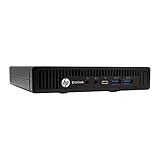
- This Certified Refurbished product is tested and certified to look and work like new. The refurbishing process includes functionality testing, basic cleaning, inspection, and repackaging. The product ships with all relevant accessories, a minimum 90-day warranty, and may arrive in a generic box. Only select sellers who maintain a high performance bar may offer Certified Refurbished products on Amazon.com
- Intel Quad-core i5-6500T up to 3.1G,16G DDR4 memory(2 slots,supports up to 32GB),240G SSD
- Includes USB Keyboard(English Keyboard & Mouse Included)
- I/O ports:Front:2 USB 3.0 ,microphone,headphone ,USB Type-C port Rear:4USB 3.0 ,VGA DP port,RJ-45
- Operating System:Win10Pro64bit
For a gateway design, queue storage should survive the process or host failures your service is expected to recover from. Decide what counts as a durable acknowledgment, how queue state is restored, and how storage exhaustion is handled. Backpressure is essential: when safe capacity is exhausted, reject or slow new submissions rather than acknowledging work that cannot be retained.
Schedule and retry with destination behavior in mind
Postfix describes scheduling in terms of concurrency—how many deliveries to a destination are made and when persistent failures lead to suspension—and preemptive scheduling—how messages and recipients are selected. Those are useful control points for any gateway. Set per-destination limits and retry policy based on workload and observed destination responses; there is no universal concurrency limit or retry interval established here.
Rank #3

- Powerful AMD Ryzen 5 5500U Processor: Beelink SER5 Mini PC is powered by AMD Ryzen 5 5500U (2.1GHz-4.0GHz, 6C/12T, 8MB L3 cache), built by the latest breakthrough 7nm architecture, processing performance is 89% increased compared to the Ryzen 5 3500U. This Mini PC delivers smooth performance for business office tasks, creative design, and daily multitasking
- High-Speed DDR4 RAM & Expandable Storage: Beelink 5500U mini pc Equipped with 16GB DDR4 RAM (dual-channel, supports up to 64GB) and a 480GB M.2 NVMe SSD. The SER5 supports storage expansion up to 4TB via the M.2 slot and includes a 2.5-inch 7mm SATA HDD slot for massive internal capacity (max 2TB, not included). Quicker load times of programs and apps for smoother using experience
- Stunning Triple 4K@60Hz Display: Beelink SER5 Pro boosts your efficiency by connecting up to three monitors simultaneously. With HDMI, DisplayPort, and a Type-C (Data & Video) port, you can enjoy a seamless 4K ultra-high-definition setup at 60Hz for complex workflows and immersive entertainment
- Ultra-Stable WiFi 6 & Bluetooth 5.2: Experience next-generation connectivity with WiFi 6 for faster speeds and lower latency, even in congested networks. The upgraded Bluetooth 5.2 ensures a more stable and efficient connection for all your wireless peripherals like mice, keyboards, and headsets
- Compact Design & Efficient Cooling: Measuring only 4.96 x 4.44 x 1.65 inches, Beelink Ryzen 5 Mini PC is 1/40th the size of a standard desktop. The premium ABS body and full metal mesh design, combined with Beelink's advanced thermal engineering, ensure quiet and stable operation even under heavy workloads
Expose enough retry state to answer which destination is delayed, the latest result, the next scheduled attempt if known, and how long work has been pending. Distinguish temporary failures, which may warrant another attempt, from permanent failures, which require a final failure outcome and appropriate notification. Define expiry behavior rather than allowing mail to remain queued without an operational decision.
Make replay and backlog handling deliberate
Provide operators with a safe way to inspect, hold, release, and replay queued messages, with controls that prevent an entire backlog from being released at once. Decide whether permanently failed messages go to a retained dead-letter store, are reported and removed, or follow another explicit policy. Retention, privacy, disk usage, and duplicate risk should shape that choice.
Rank #4
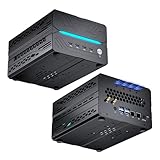
- [Powerful Processor] Mini Gaming PC equipped with Core i9-14900F, 24 Cores 32 Threads, 36M Cache, Max Turbo Frequency: 5.8GHz, Windows 11 pro (64 Bit).64G DDR5-5600 RAM| 4T M.2 NVME PCIE4.0 SSD| 4T SATA SSD. With GeForce RTX 50 Series GPUs. supporting ray tracing and AI cores. Delivering AI-acceleration in top creative apps. Whether you’re rendering complex 3D scenes, editing 4K video, or Gaming livestreaming with the best encoding and image quality.
- [Powerful Capacity & Storage Expansion] The mini desktop computer is equipped with Dual-DDR5 RAM (dual channel DDR5 high-speed memory, which can support up to 96G RAM), 1 x M.2 2280 PCIE4.0 high-speed SSD, and support add 1 x 2.5-inch SATA HDD/SSD is enough to accommodate system files and massive games, Excellent reading and writing speed greatly shortening your boot time.
- [8K@60Hz Four-Display] Mini PC equipped with GeForce RTX5060Ti 16GB GDDR7 discrete graphics card, supporting ray tracing and AI cores. easy connect 4 monitors, 1×HDMI 2.1b and 3×DisplayPort 2.1b(All Support 8K@60Hz display), It can provide you with a first-class TV experience and realistic picture quality, for your visual home entertainment, streaming video, web browsing, work design and 3D games create a very smooth experience.
- [Functional Interfaces] Mini computer is equipped with 4 x USB 3.2, 4 x USB2.0, 1 x HDMI2.1 port, 3 x DP2.1 ports, 2xRJ-45 Gigabit Network Ethernet, 1 x Fiber Optic PORT, 1 x Audio in/out. Built-in Bluetooth 5.4 and IEEE 802.11be wifi 7, Higher transfer rates and lower latency. Mini PC supports multiple device connection and can be used with servers, monitoring equipment, office equipment, projectors, televisions, etc, Mini desktop computer support automatic power on and Wake On Lan.
- [Warranty & heat dissipation] Warrant: 2 year/24 months. The compact computer size: 8.6*6.6*4.5in, 5.5lb, Inside the chassis are four all-copper turbo fans and eight vacuum heat pipes for powerful cooling performance. Make it can work smoothly and will not cause too much noise.
Useful operational signals include queue depth and age, deferred counts by destination, delivery outcomes, retry volume, storage headroom, and the number of messages awaiting operator action. Alert on conditions that require intervention, such as a growing oldest-message age or rapidly diminishing queue capacity, rather than treating every temporary deferral as an incident.
What is the difference between SMTP TLS and DKIM?
| Mechanism | What it does | What it does not establish |
|---|---|---|
| SMTP TLS | Protects a transport connection with encryption; the configured trust model determines whether the peer is authenticated. Postfix documents TLS-capable SMTP server and SMTP/LMTP client roles. | It does not create a DKIM signature or, by encryption alone, prove that a message’s authoring domain authorized its contents. |
| DKIM | Attaches a cryptographic signature associated with a signing domain. A verifier retrieves that domain’s public key and checks the signature. | It does not encrypt the message or protect the SMTP connection. |
Do not treat opportunistic TLS as proof of recipient identity. In particular, a self-signed certificate can provide encryption without authenticating a remote peer under the relevant trust configuration. DANE-based trust also depends on DNSSEC validation and TLSA records; it is not simply another name for opportunistic TLS.
Best Value

- 【Supports Linux and Win11】Micro PC win 11 equipped with Celeron J4105 (2GHz to 2.7GHz) processor, supports Win 11 Pro OS, supports Linux, Ubuntu as well. This portable and powerful fanless mini computer is a great helper for your business, office, entertainment, classroom, conference room, industrial IOT applications, home and more
- 【Low-noise fanless design and PC material】Mini PC fanless has a special cooling system and outer texture design (efficient heat dissipation) to simulate overheating, no fan no noise. Provides a quiet and stable computer environment when using, portable PC supports 7/24 hours operation
- 【USB-C and multiple interfaces】Desktop mini PC stick Win 11 Pro equipped with 1 x USB-C (wider compatibility), 2 x USB 3.0 ports, TF card reader, 1 x HDMI 2.0 ports, 1 x Gigabit LAN port, 1 x 3.5 mm audio jack, you can connect to multiple devices such as projector, NAS, monitor, keyboard mouse, etc., mini desktop supports USB PD 3.0 Charge 0 Charge 024 W)
- 【Dual band Wi-Fi & 4K @ 60Hz】Portable mini pc stick server built in 2.4/5GHz I/O ports, WiFi and Bluetooth 5.0, our fanless mini PC equipped with HDMI port together with the UHD 600 graphics, supports HDMI 4K UHD graphics output, which can improve your video images to be more vivid
- 【Storage and storage】Mini PC stick HDMI equipped with 8GB LPDDR4, 128GB eMMC, fully functional to perform Win11 and HD video, micro computer can be easily connected to other devices, so you can easily deal with multiple tasks and projects at the same time
How do you rotate DKIM keys without breaking verification?
DKIM uses a selector to identify the public key a verifier should retrieve for a signing domain. A staged selector change lets new mail use a replacement key while verifiers can still check mail signed before the cutover.
- Generate and protect the replacement private key. Keep signing-key access restricted and document which signing systems will use it.
- Publish the new public key under a new selector. Make the DNS record available before changing signers, and allow for DNS publication and caching behavior.
- Switch signers to the new selector. Verify that newly generated messages carry the expected selector and can be checked against the published public key.
- Retain the old selector during the overlap. Messages signed before cutover may still be awaiting delivery or verification, so removing the old public key immediately can prevent those signatures from being checked.
- Remove the old record only after the transition window. Choose that window using the relevant DNS TTLs, caching behavior, queued-message lifetime, and operational conditions. The reviewed standards material does not set one universally correct overlap duration.
RFC 6376, published in September 2011 and subsequently updated, defines the selector and public-key lookup model. Check current RFC status and applicable algorithm requirements when implementing a signer or verifier; the selector sequence above is not a substitute for those implementation requirements.
How is TLS certificate rollover different?
TLS rollover changes the certificate and private key used for transport security, not the DKIM selector used to verify message signatures. Plan it as a separate deployment with its own trust and rollback checks.
Quick wins for a faster PC:
Fix the driver behind crashes, sound loss and screen glitchesFind Drivers →Repair Windows errors before they cause bigger problemsFix Now →Scan for outdated or missing drivers - takes under a minuteDriver Scan →Postfix TLS guidance recommends, where supported, using a single chain file containing the private key and certificate chain. Updating separate key and certificate files independently can expose a race in which the service observes mismatched material during the change. Coordinate reload or restart behavior with the exact deployed Postfix version and configuration.
For a DANE deployment, coordinate DNS and server changes: publish the new TLSA digest before deploying the replacement key and certificate, allow cached old TLSA data to expire before switching, and remove the old digest once the replacement is in use and the transition is complete. Treat DNSSEC validation and the timing of cached records as part of the trust transition.
Quick Recap
What should you decide before operating the gateway?
- Acceptance contract: Define when the gateway acknowledges a message and how callers learn about later delivery outcomes.
- Durability and capacity: Set storage and recovery objectives, monitor headroom, and establish the backpressure behavior for a full or unavailable queue.
- Scheduling policy: Tune destination concurrency, retry behavior, backlog isolation, and message expiry to workload and recipient response patterns.
- Security ownership: Assign responsibility for SMTP TLS trust configuration, certificate renewal, DKIM signing-key custody, DNS publication, and rotation.
- Operational controls: Define who can inspect or replay messages, how permanent failures are handled, and what evidence is retained for troubleshooting.
- Version management: Confirm behavior and parameter defaults against the exact MTA release deployed; documentation may describe behavior without specifying the defaults for your release.
Product prices and availability are accurate as of the date/time indicated and are subject to change. Any price and availability information displayed on Amazon at the time of purchase will apply.

